
I. Execution Over Perfection
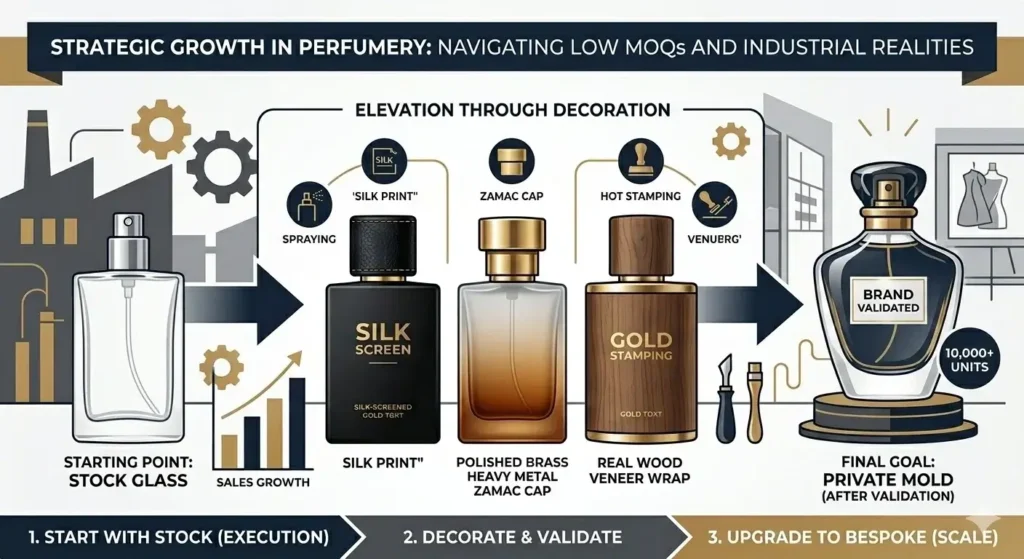
In the early stages of a brand, blindly pursuing a private mold (custom bottle shape) is often a primary trigger for financial collapse. The savvy approach is to utilize high-quality stock bottles and elevate them into “bespoke” products through secondary artisanal processing and unique secondary components.
1. Surface Decoration: Redefining Stock Glass Perfume Bottles
Even common stock bottles can be redefined with premium textures to create visual differentiation:
- Spraying: Achieve solid, translucent, gradient, or matte finishes. This is the fastest way to eliminate a “generic” look and establish a brand color palette.
- Electroplating: Gives glass a metallic texture (Gold, Silver, Rose Gold) or futuristic iridescent/mirror effects.
- Silk/Pad Printing: Ideal for logos and minimalist text, achieving high-definition visual clarity at a manageable cost.
- Hot Stamping: Adds thickness and reflective brilliance to metallic elements, significantly enhancing the brand’s luxury appeal.
- Laser Engraving: Etches 3D patterns into coatings or metal layers, adding a tactile dimension that feels expensive in the hand.
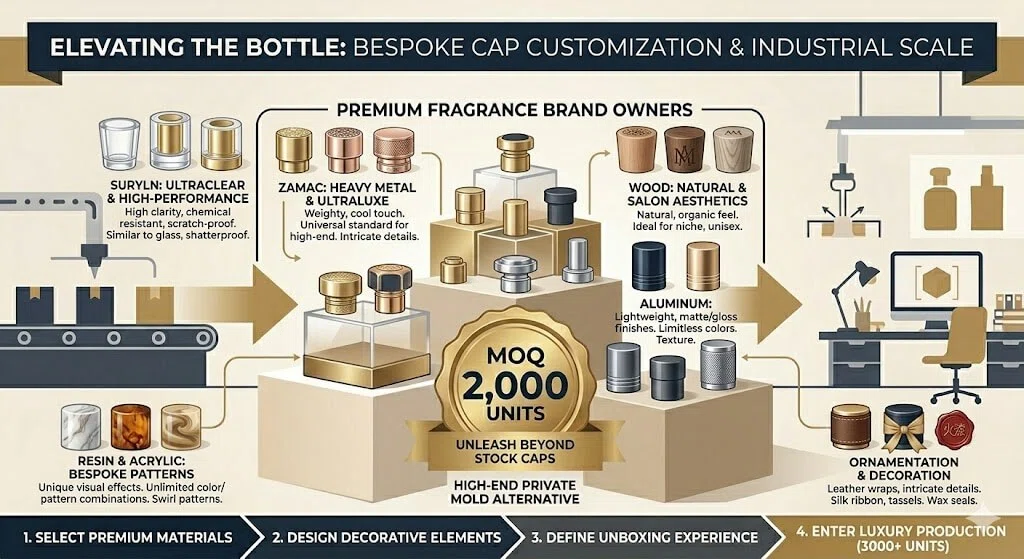
2. Perfume Cap & Ornamentation: The Soul of the Brand
The cap is the “crown” of the bottle and the component consumers interact with most frequently.
- Material Selection:
- Surlyn: High transparency and chemical resistance. Used by major luxury houses like Chanel; it offers a glass-like weight but is shatterproof.
- Wood: Beech, Ash, or Black Walnut. Creates a natural, “niche” aesthetic ideal for unisex, botanical, or woody scents.
- Resin: Can mimic marble, quicksand, or amber. Since patterns vary, every cap is unique, providing a bespoke feel.
- Zamac (Zinc Alloy): Hefty and cold to the touch. This weight is a universal indicator of high-end positioning.
- Aluminum: Lightweight and versatile; easily anodized into various colors and metallic finishes.
- Decorative Elements: Ribbons, leather wraps, tassels, or artisanal wax seals to enhance the brand’s storytelling.
3. Luxury Fragrance Packaging: The Unboxing Ritual
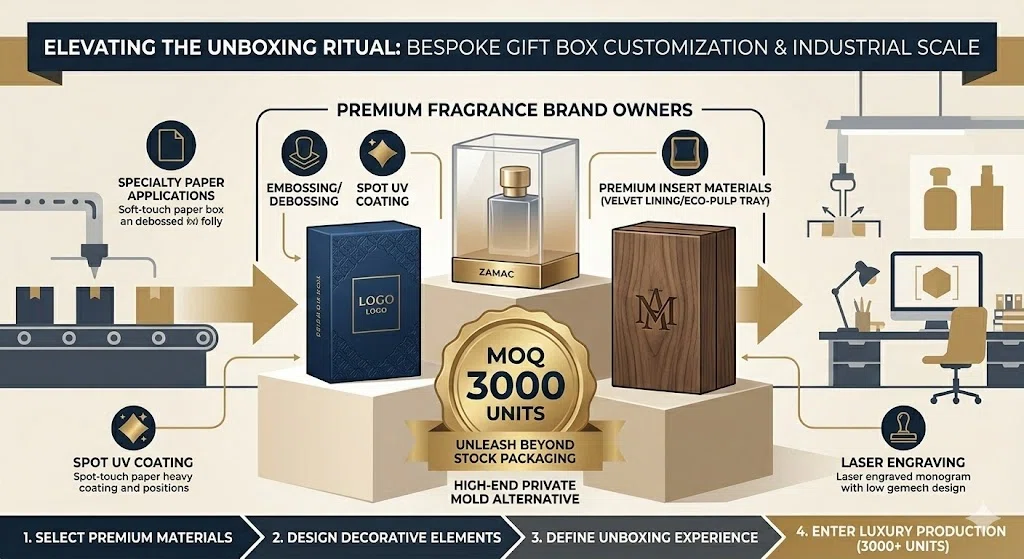
The gift box is critical for establishing the first impression and perceived value.
- Customization Techniques:
- Specialty Paper: Soft-touch paper, leather-textured paper, or pearlescent finishes to create immediate tactile differentiation.
- Embossing/Debossing: Creates physical depth and layers on the paper, making the logo “pop.”
- Spot UV: Adds a high-gloss contrast to specific areas (like the logo) against a matte background.
- Insert Materials: High-density foam with velvet lining, EVA, or eco-friendly biodegradable pulp trays to display the bottle professionally.
II. Why is Private Molding Impossible Below 10,000 Units or The Industrial Reality: Why 10,000 Units Won’t Get You a Custom Mold?
Many newcomers believe 10,000 units is a massive order, but in industrial glass manufacturing, this is considered a “micro-batch.”
| Stage | Challenges & Cost Factors |
| Molding | A full set of IS (Individual Section) machine molds costs thousands of dollars; amortizing this over only 10k units makes the unit price prohibitively high. |
| Setup | Glass furnaces run 24/7. Changing molds requires stopping production, cooling, installation, and reheating, costing hours or even a full day of lost utility. |
| Purging | Switching colors (e.g., from green to clear) requires a massive “flush” of molten glass to clear residues, leading to significant material waste. |
| Mixing | Furnaces operate by the ton. 10k units might use only a fraction of a batch, making precision raw material mixing extremely difficult for the factory. |
| Speed | Modern machines produce thousands of bottles per hour; a 10k order finishes in less than half a day, making it unprofitable compared to long-term runs. |
III. Brand Evolution: Pre-heating, Upgrading, and Professional Alignment and The “Finish First, Perfect Later” Strategy for Perfume Startups
1. Market Validation (Buying Time)
Pre-heat the market for 1-2 years using stock bottles while collecting real-world feedback. By the time you are ready to upgrade, you will clearly understand:
- Which capacity (30ml, 50ml, or 100ml) has the highest demand?
- Whether your brand’s visual language resonates with your target audience.
- Your actual budget burn rate and cash flow cycle.
2. Communication with Factory Engineers
Sales engineers at factories act as your “reality calibrators.”
- Professionalism vs. Dreams: Beginners talk about “disrupting the industry with unique shapes”; professional owners talk about “wall thickness uniformity,” “tolerance control,” and “per-unit cost efficiency.”
- Alignment: Once you have a proven sales record, factories view you as a viable long-term partner and become much more willing to allocate technical resources to help realize your custom designs.
The Bottom Line: To a professional factory team, an amateur’s “dream” is just a costly burden. Solid sales figures are the only lever that moves professional teams to cooperate with your vision.
FAQ – Frequently Asked Questions and Scaling Your Perfume Brand: Transitioning from Stock to Bespoke
- Q: Will using a stock perfume bottle make my brand look cheap?
- A: Not at all. Brands like Chanel and Jo Malone often use minimalist stock-style silhouettes. The “luxury” feel comes from the weight of the cap, the quality of the sprayer, and the label texture.
- Q: What is the typical MOQ for decorated stock or off-the-shelf bottles?
- A: While you can buy plain stock bottles in quantities of 500-1,000, secondary processes like spraying or silk-screening usually require 2,000-3,000 units to be cost-effective.
- Q: Which cap material is the most “high-end”?
- A: Zamac (Zinc Alloy). Its metallic weight and cold touch are the standard for luxury perfumery.
- Q: Why do some glass perfume bottles have tiny bubbles or seams?
- A: These are mold marks or process defects. Lower-tier factories have poor quality control; professional owners demand higher AQL (Acceptable Quality Level) standards.
- Q: What is the most cost-effective way to make perfume packaging look expensive?
- A: Use dark-colored specialty paper (like deep navy or forest green) with single-color hot stamping. It avoids the cost of full-color printing while looking more sophisticated.
- Q: Can I buy “stock caps” from the perfume packaging lid factory?
- A: Yes. These are “stock molds.” By electroplating them in custom colors or adding a leather wrap, you can make a stock cap look unique to your brand.
- Q: Are perfume glass bottle or lid mold fees refundable?
- A: Many factories offer a refund on the mold fee once your cumulative order volume reaches a certain milestone (e.g., 50,000 or 100,000 units).
- Q: What does “Neck Size” mean in perfume bottles?
- A: The most common size is FEA15. You must ensure the bottle neck, the pump/sprayer, and the cap all share the same FEA specifications to fit.
- Q: Can I add embossed patterns to a stock perfume bottle?
- A: You cannot change the physical glass shape of a stock bottle, but you can use “high-build” screen printing (3D ink) to create a tactile embossed effect on the surface.
- Q: Why are factories reluctant to work with startup perfume brands?
- A: Startups often have high demands but low volumes and lack technical knowledge, making the communication cost higher than the profit. Providing professional AI or CAD files significantly increases your credibility.
Would you like to get the stock bottle catalogue and discuss with factory sales engineers?
- WhatsApp: +86 18107699312
- Email: [email protected]
