
Perfume Bottle cap requirements vary significantly depending on market demands, and let us discuss the specific Perfume Bottle Closure Trends for each market individually.
European Market Trends: The Ultimate Fusion of Sustainability and Natural Aesthetics
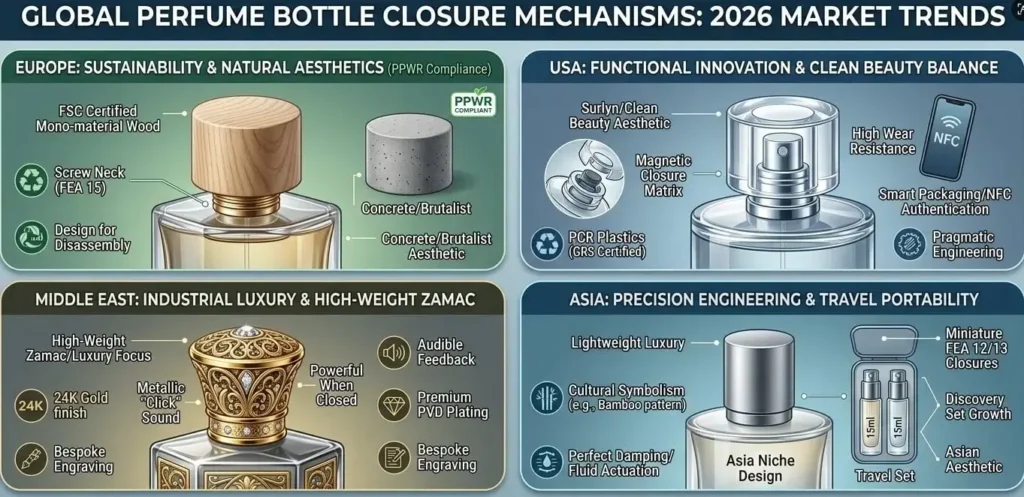
- Regulatory-Driven Material Reconstruction: Driven by the EU’s Packaging and Packaging Waste Regulation (PPWR), which comes into full force on August 12, 2026, European demand for eco-compliant closures has reached unprecedented levels. Traditional methods—combining plastic inserts with multi-layer electroplating—are being rapidly phased out by mainstream European brands.
- The Mono-Material Revolution in Wood Caps: European brands—particularly niche and luxury artisanal perfumers in France and Italy—are fully embracing plastic-free, mono-material wood caps. Through high-precision engineering or natural cork-friction fitting, these caps achieve a secure mechanical seal directly onto FEA 15 screw-neck bottles. Materials such as FSC-certified beech, ash, and maple are prioritized, emphasizing 100% biodegradability and carbon neutrality.
- Architectural Aesthetics: Concrete & Marble Caps: To convey “Brutalist aesthetics” and a sense of timeless nature, concrete caps are emerging as a major trend among modern independent European brands, offering a tactile, rugged appeal. Meanwhile, ultra-luxury brands are turning toward marble and other natural stones. While heavier, these caps are viewed as “collectible art,” aligning with the European preference for sustainable, high-value, long-lasting packaging.
US Market Trends: Balancing Functional Innovation with Accessible Luxury
- Clean Beauty Driving Transparency: The US market is deeply influenced by the “Clean Beauty” movement and DTC (Direct-to-Consumer) brands. While Post-Consumer Recycled (PCR) plastics (PCR-PP, PCR-PET) and high-purity Surlyn resins remain dominant in commercial and masstige fragrance segments, brands now demand rigorous, documented material traceability.
- Functional Closures for Refillable Systems: The US market is highly pragmatic. By 2026, over half of new product launches in major retailers (e.g., Sephora, Ulta) feature FEA 15 screw-neck pump systems. Closures must be engineered to withstand frequent “open-refill-lock” cycles, placing high technical requirements on wear resistance and leak prevention.
- Smart Digital Interaction: With the rise of North American “new retail” and niche digital marketing, there is a surge in demand for closures with integrated NFC chips or laser-etched anti-counterfeiting codes, positioning the bottle cap as the primary vehicle for brand storytelling and authentication.
Middle East Market Trends: Industrial Luxury & High-Weight Zamac
- Weight Equals Value: Unlike the lightweighting trends in Europe, the Middle East (led by the UAE, Saudi Arabia, and Oman) continues to prioritize “heft and ultimate luxury” in its traditional Oriental fragrance and bespoke markets.
- The Dominance of Zamac (Zinc Alloy) Caps: The core trend here involves large, heavy, and intricately designed Zamac caps. 2026 designs feature fine 3D embossed reliefs, traditional Arabic calligraphy, and complex geometric hollow-out structures.
- Premium Plating & Magnetic Weight: In surface finishing, Middle Eastern clients prefer thick 24K gold plating, rose gold, and vibrant PVD finishes, often accented with crystals, gemstones, or leather wraps. To support these heavy caps, internal mechanisms must feature high-performance magnetic matrix closures, where the deep, solid “metallic click” upon closing serves as a key indicator of quality for the consumer.
Asian Market Trends: Precision Engineering & Personalized New Retail
- Sensory Micro-Innovation: The Asian market (centered on China, Japan, and Korea) focuses on intricate technical details and refined aesthetics. 2026 trends emphasize “lightweight luxury”—caps that visually convey the premium textures of marble or metal but are engineered for significantly reduced weight. There is a strong demand for smooth, effortless damping and a crisp, pleasant “click” sound.
- Explosion of Travel Sizes & Small-Caliber Closures: Driven by social media trends and the “fragrance wardrobe” concept, demand for 10ml and 15ml travel sets is skyrocketing. Consequently, FEA 12 and FEA 13 closures and their associated miniature, lightweight caps are the fastest-growing segments in the 2026 Asian supply chain.
- “Guochao” & Emotional Symbolism: In China, cap design is a vital bridge for telling “Oriental stories.” Designs incorporating jade-like finishes, ceramic firing, glaze textures, or bamboo elements are highly sought after by emerging local brands, pushing manufacturers to master cross-material integration.
2026 Global Perfume Closure Market: Regional Requirement Comparison
| Market | Core Design Focus | Key Materials & Technology | Key Drivers |
| Europe | Eco-compliance, minimalism, natural aesthetics | FSC-certified wood, concrete, stone, FEA 15 screw necks | PPWR regulations, circular economy, plastic reduction |
| USA | Pragmatism, functional innovation, transparency | PCR plastics, Surlyn resin, NFC smart chips | Clean Beauty, DTC growth, anti-counterfeiting |
| Middle East | Extreme luxury, industrial style, status symbol | Zamac (zinc alloy), high-weight metals, magnetic matrices | Bespoke luxury, 24K gold plating, sensory experience |
| Asia | Precision engineering, portability, cultural symbols | Glass/ceramic-like finishes, travel sizes (FEA 12/13), lightweight structures | Social commerce, “fragrance wardrobe” concept, Guochao aesthetics |
For a deeper understanding of the technical specifications mentioned in this table (such as FEA standards and material grades), please refer to our Complete Guide to Perfume Packaging Terms and Glossary.
Frequently Asked Questions (FAQ) for Perfume Bottle Closure Mechanisms
This relies on high-precision mechanical design and the natural elasticity of wood. Two mainstream solutions exist: 1) Using 5-axis CNC machining to carve micro-level physical grooves inside the cap, utilizing the wood’s natural flexibility to snap onto the bottle neck; 2) Using natural cork or starch-based eco-materials as an internal fitment, ensuring the cap remains a mono-material product that is fully recyclable.
The main challenges are brittleness, excessive weight that can cause shipping damage, and porosity that can lead to fragrance absorption or evaporation.
Solutions: Inserting high-strength biodegradable resin liners to prevent glass-to-stone contact; applying food-grade nano-hydrophobic coatings to seal the surface; and using custom high-density EVA or molded pulp packaging to absorb shock during international transit.
In Middle Eastern culture, heavy weight is a direct proxy for value. Zamac excels in die-casting complex 3D details and hollow structures. 2026 trends focus on “magnetic matrix integration” to ensure heavy caps stay secured, and “nickel-free plating” to meet rigorous international skin-contact safety standards.
The key is perfect alignment and permanent, stable suction. Large-scale production requires automated polarity detection and assembly lines to ensure the N/S magnetic poles of the cap and bottle neck are perfectly aligned. High-grade Neodymium magnets are required, fixed with specialized epoxy to prevent solvent-induced demagnetization or detachment.
