

Below is a detailed analysis of common quality risks associated with Wooden Perfume Caps during manufacturing and actual usage, along with root causes, preventive solutions, a comparison table, and 10 FAQ items.
1. Root Cause Analysis & Prevention Strategies
1. Debonding & Liner Popping (Inner Liner Separation)
- Root Cause Analysis: Wood and plastic inner liners (PP, ABS, etc.) are heterogeneous materials. Wood absorbs and releases moisture, expanding and contracting subtly with temperature and humidity changes, whereas plastic exhibits a different coefficient of thermal expansion. Additionally, residual wood dust, oils, or smooth inner surfaces reduce adhesive bonding, causing conventional glues to fail over time.
- Prevention & Solutions:
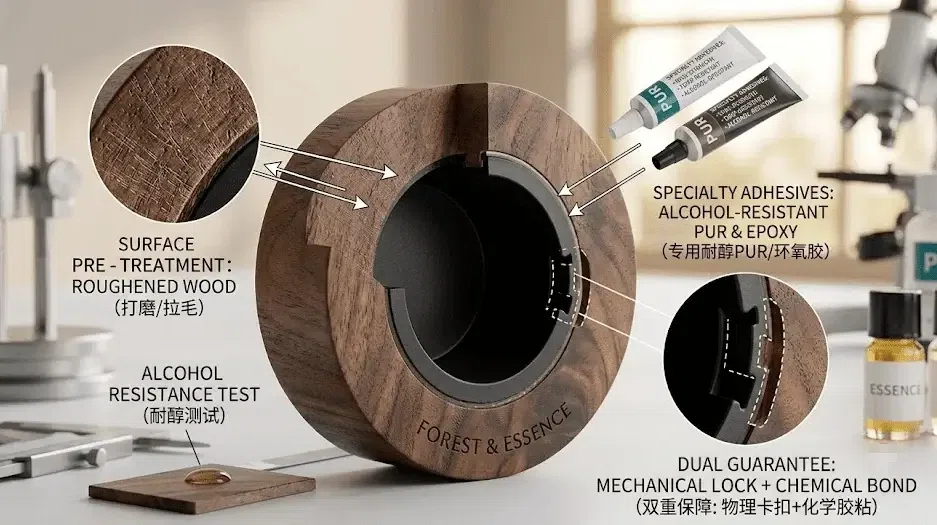
- Surface Pre-treatment: Remove dust and oil from the cap’s inner wall before assembly, applying a roughening process (sanding or grooving) to increase mechanical adhesion.
- Specialty Adhesives: Utilize high-strength, temperature-resistant, and alcohol-resistant two-component epoxy resins or modified PUR structural adhesives.
- Mechanical Interlocking: Design structural locking mechanisms (undercuts, locking grooves, or threads) to achieve a dual guarantee of “Mechanical Interlocking + Chemical Bonding,” completely eliminating liner debonding.
2. Cracking & Splitting During Use
- Root Cause Analysis: Improper control of Moisture Content (MC). If MC exceeds the ambient humidity of the destination market, the wooden cap loses moisture and shrinks, leading to stress cracks. Furthermore, excessive interference fit between the liner and the wood creates internal stress that splits the wood along the grain during environmental fluctuations.
- Prevention & Solutions:
- Strict Moisture Content Control: Raw materials undergo professional kiln-drying and secondary climate-conditioning equalization to lock MC precisely within the optimal 8%–12% range.
- Optimized Fit Tolerances: Precisely engineer tolerances between the inner liner and the wooden shell to eliminate excessive assembly stress.
- Protective Surface Coatings: Apply a complete seal coating using eco-friendly anti-cracking lacquers or micro-molecular varnishes to block external humidity intrusion and prevent internal moisture loss.
3. Fitment & Dimensional Instability
- Root Cause Analysis: Wood is a naturally anisotropic material prone to dimensional variation under changing environmental humidity. Without strict tolerance controls, caps may become too loose (lacking a premium feel), too tight (causing cap breakage), or result in inconsistent snap torque across production batches.
- Prevention & Solutions:
- High-Precision CNC Machining: Utilize high-precision CNC turning and carving to maintain mechanical machining tolerances within ±0.1 mm.
- Standardized Plastic Liners: Implement high-precision plastic inner liners as the standardized interface with bottle necks and pumps. The wood serves solely as an aesthetic outer shell, ensuring consistent snap feeling and pull-off force.
- 100% Inspection: Conduct 100% fitment and tactile force testing using standard bottle fixtures prior to dispatch.
4. Surface Defects (Pores, Pinholes & Burr)
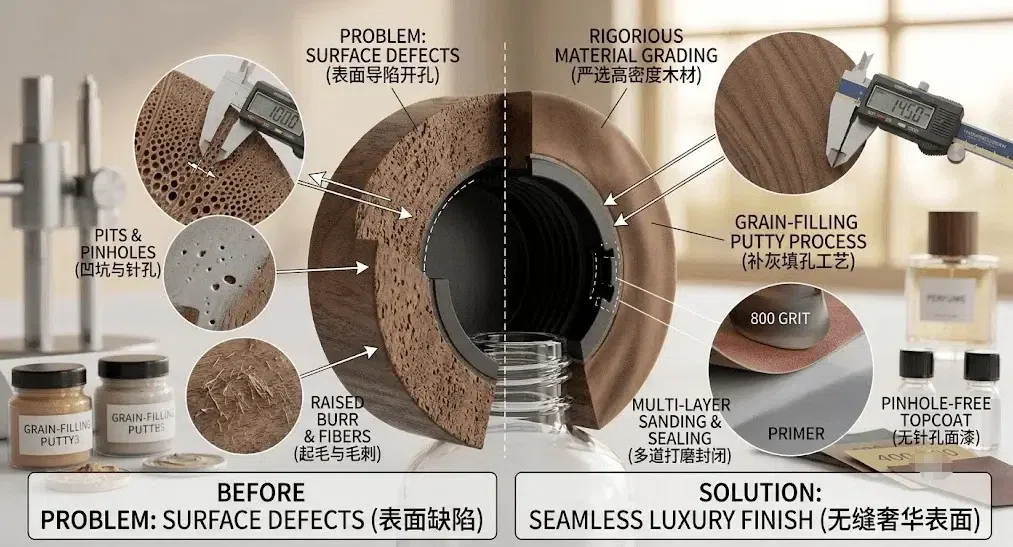
- Root Cause Analysis: Natural hardwoods feature inherent vascular pores and vessels (e.g., ring-porous woods like oak or ash). Insufficient sanding or inadequate primer sealing leaves pits, pinholes, or raised wood fibers after topcoat application, compromising luxury feel and visual quality.
- Prevention & Solutions:
- Rigorous Material Grading: Reject raw wood with knot holes, dead knots, scars, or severe color variations, selecting only high-density, uniform wood blocks.
- Multi-Layer Filling & Sanding Process: Implement a thorough grain-filling putty process, sealed primers, and multiple rounds of hand and machine fine-sanding (400–800 grit) before applying the topcoat to ensure a seamless, pinhole-free finish.
5. Odor Interference & Off-Odor
- Root Cause Analysis: Certain wood species naturally release strong resins. Alternatively, volatile organic compounds (VOCs) from low-quality paints, uncured adhesives, or chemical solvents can seep out and alter the fragrance’s delicate note balance, spoiling the user experience.
- Prevention & Solutions:
- Eco-Friendly Materials: Use low-VOC, non-toxic, odorless water-based paints or food-grade PU coatings alongside odorless structural adhesives.
- Curing & De-Gassing Stages: Pass assembled caps through forced-air curing chambers to ensure complete solvent evaporation and degassing before packaging.
- Olfactory Quality Control: Conduct sensory blind-sniff tests prior to shipment to ensure zero residual chemical or off-odors.
2. Key Quality Issues & Solutions Comparison Table
| Defect / Risk | Primary Root Causes | Prevention & Technical Solutions |
| 1. Inner Liner Debonding | Heterogeneous expansion; inner wood dust/oil residue; alcohol-intolerant glue; reliance on glue alone without mechanical lock. | Add mechanical locking grooves/threads; apply modified PUR or epoxy structural adhesive; perform surface cleaning & roughening prior to assembly. |
| 2. Cracking During Use | Moisture content out of spec; excessive assembly interference fit; sudden climatic changes causing shrinkage. | Kiln-dry and condition wood to a strict 8%–12% MC; optimize tolerance fits; apply full-coverage anti-cracking protective sealers. |
| 3. Fitment Instability | Natural wood deformation; broad machining tolerances; lack of standardized inner liners. | CNC precision machining (±0.1 mm); use standardized plastic inner liners for consistent snap force; 100% fixture test before dispatch. |
| 4. Pores, Pinholes & Burrs | Natural wood vessels; inadequate sanding; insufficient grain filler and primer coat. | Strict wood grading; multi-stage grain filling, fine sanding (400–800 grit), and sealed primer application; 100% surface smoothness inspection. |
| 5. Odor Interference | Off-gassing from low-grade paints/glues; strong natural wood resins; incomplete coating curing. | Low-VOC food-grade water-based/PU coatings; forced oven-curing & degassing; factory olfactory blind-sniff testing. |
3. Frequently Asked Questions (FAQ) from Custom Design Wooden Perfume Caps Manufacturing Factory
A: Debonding occurs due to differing thermal expansion rates between wood and plastic, alongside alcohol-induced glue degradation. We solve this by integrating mechanical locking grooves/threads inside the wood cap combined with modified PUR structural adhesives and surface roughening. This dual “mechanical + chemical” locking mechanism prevents separation over long-term use.
A: Uncontrolled moisture content leads to cracking. We eliminate this risk by kiln-drying and climate-conditioning our wood to a precise 8%–12% Moisture Content (MC)—the golden industry standard. We then seal the caps completely with waterproof, anti-cracking lacquers to withstand global environmental shifts.
A: We use high-precision CNC machining to maintain outer wood tolerances within ±0.1 mm, paired with standardized, precision-molded plastic inner liners. The bottle neck fitment and snap force are dictated by the liner, ensuring uniform tactile feel across every single cap.
A: No. We enforce strict timber selection (rejecting knots and flaws) and execute a multi-layer process involving grain filling, sealed primers, and multi-stage fine sanding (400–800 grit). This completely fills natural wood pores, delivering a smooth, velvety finish free of pinholes or burrs.
A: Not at all. We strictly utilize low-VOC, non-toxic, odorless water-based or PU coatings alongside odorless structural adhesives. Finished caps pass through elevated-temperature curing and degassing chambers followed by sensory blind-sniff tests to guarantee zero chemical odor residue.
A: Our raw timber moisture content is strictly controlled within 8%–12%. This range is universally recognized in the luxury packaging industry as the optimal stability window to prevent warping, shrinkage, and cracking.
A: No. Our surface coatings undergo rigorous alcohol-resistance testing (including solvent wipes and immersion tests) to ensure the finish remains intact without peeling, fading, or swelling upon contact with alcohol.
A: Our R&D team recommends a “Lined Stepped Locking Groove + Glue Distribution Cavity” design. This ensures uniform adhesive distribution for maximum liner retention while leaving micro-expansion relief zones for the natural movement of the wood.
A: We conduct five core QC checks: 1. Raw material Moisture Content (MC) testing; 2. CNC dimensional tolerance checks; 3. 100% fixture snap & pull-force testing; 4. Cross-hatch adhesion and alcohol-resistance coating tests; and 5. Thermal shock and olfactory blind-sniff testing.
A: Yes. We customize our manufacturing parameters based on the destination market’s climate. This includes fine-tuning the target equilibrium moisture content, applying enhanced sealing coats, or adjusting plastic liner wall thicknesses to ensure flawless performance anywhere in the world.
