
As a European and American Famous Perfume Packaging Supplier, we are qualified to discuss their requirements and our partnership insights.
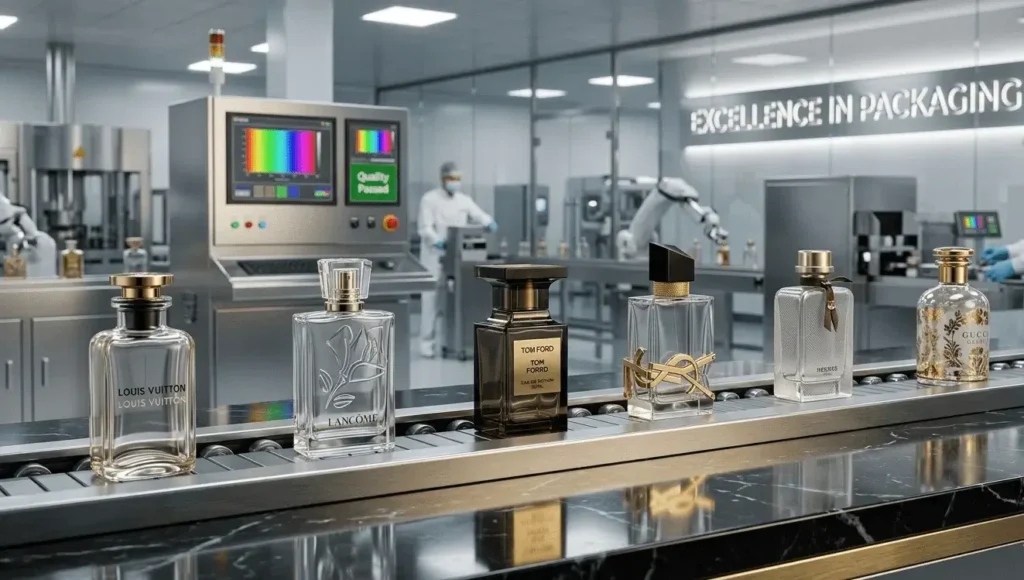
In the luxury industry, perfume is not merely an art of scent, but also the pinnacle of visual and tactile expression. Whether it is the craftsmanship of Louis Vuitton, the French elegance of Lancôme, the avant-garde minimalism of Tom Ford, the rebellious luxury of YSL, the understated texture of Hermès, or the intricate aesthetics of Gucci, the suppliers behind these major brands are the “elite” of global manufacturing.
To become a partner to these giants, a factory is not simply providing contract manufacturing; it is an extension of the brand’s value.
I. The “Top-Tier Entry Ticket”: Hard Requirements from Major Brands
To enter the supplier pool of global beauty conglomerates such as Estée Lauder and Sephora, an enterprise must demonstrate capabilities that extend far beyond production.
1. Factory Certifications and Qualifications (The Basic Threshold)
- ISO Series Certifications: ISO 9001 (Quality Management), ISO 14001 (Environmental Management), and ISO 45001 (Occupational Health and Safety) are the absolute foundations.
- Industry Access Standards: ISO 22716 (Good Manufacturing Practices for Cosmetics) is indispensable, ensuring packaging safety and hygiene when in contact with perfume products.
- Social Responsibility and Sustainability (CSR): This is currently a top priority for first-tier major brands. EcoVadis ratings, SEDEX (Social Responsibility Audits), and FSC (Forest Stewardship Council certification for paper boxes) are key factors in determining whether a partnership is possible.
2. Core Soft and Hard Power
- Hardware Strength: Automated high-precision mold processing, cleanroom production facilities, fully automatic color-calibrated printing systems, and precision leak detectors (perfume packaging strictly forbids leakage).
- Software Strength: A strong process R&D team, global supply chain integration capabilities, strict quality traceability systems (ERP/MES), and forward-looking material innovation.
II. Maintaining Partnership: “Long-termism”
In the realm of luxury packaging, there is no “buying and selling” relationship—only “strategic symbiosis.”
- Transparent Communication: Proactively share raw material market fluctuations and logistics warnings, and establish joint forecasting mechanisms.
- Joint Development: Get involved at the conceptual stage, utilizing the supplier’s process expertise to optimize the designer’s plan, achieving a balance between “design effect” and “industrial manufacturing.”
- Response Speed: The luxury industry iterates rapidly. The ability to complete the journey from sampling to mass production under the pressure of new product launches is the core determinant of loyalty.
III. The “Stop-Loss Line”: Under What Circumstances Is Cooperation Terminated?
Even for major brands, if a bottom line is touched, they will decisively “sever ties”:
- Collapse of Quality Stability: Occurrence of severe batch-specific color differences, uneven glass distribution (leading to failed filling pressure tests), or peeling of printing processes.
- Compliance Failure: Factory shutdowns due to environmental violations or labor issues, affecting the brand’s global launch schedule.
- Trade Secret Leakage: Packaging designs leaked or counterfeited before a new product launch.
- Supply Chain Rigidity: Inability to cooperate with the sustainable development goals proposed by the brand (such as plastic reduction or alternative recyclable materials).
IV. Industry Summary and Comparison
| Dimension | Ordinary Supplier | Luxury-Grade Supplier |
| Core Focus | Price and Capacity | Brand Aesthetics and Process Execution |
| Equipment Level | Standard Machinery | High-Precision Automation / Custom Processes |
| Quality Standard | Spot Checking | 100% Inspection / Digital Traceability |
| R&D Depth | Drawing Conversion | Design Consultation and Technical Optimization |
| Cooperation Mindset | Order Execution | Long-term Strategic Partnership |
V. FAQ: Core Industry Questions for Top Perfume Packaging Supplier
A: The core of LV’s packaging lies in “eternal heritage.” Its suppliers must not only handle high-end paper but also possess the technology for special coatings, magnetic closures, and precision embossing. The focus is on the material’s weight (GSM) and the consistency of the brand’s signature colors, requiring suppliers to have extreme precision processing capabilities.
A: As a high-end brand under the L’Oréal Group, Lancôme currently places extreme importance on LCA (Life Cycle Assessment). Suppliers need to provide recyclable glass bottle designs and FSC-certified, eco-friendly paperboard, while also aligning with the group’s “plastic reduction” goals to reduce volatile organic compounds (VOCs) in packaging coatings.
A: Tom Ford’s packaging style usually carries a strong sense of geometry and metallic texture. The core of the supplier’s soft power lies in the mastery of metal plating and lacquer spraying processes, which must ensure that there are no fingerprint marks or edge defects on the minimalist exterior, placing extreme demands on the factory’s cleanroom and automated surface treatment capabilities.
A: YSL packaging often combines complex metal logo inlays with unique leather textures. Suppliers must excel in cross-material composite processes (perfectly combining metal, plastic, and fabric) and ensure high yields during the assembly of complex components, while maintaining physical durability (drop and abrasion resistance).
A: Hermès represents the upper limit of packaging craftsmanship. Its suppliers are required to have extremely high manual value-add (or highly realistic automated processes), especially regarding the grasp of paper box seams, ribbon accessories, and embossing details, which must match the exquisite aesthetics of its saddlery origins, with almost zero “margin for error” in every detail.
A: Gucci’s designs often include a large amount of floral patterns and retro color palettes. Suppliers need top-tier multi-color lithography and hot-foil stamping overprinting technology to ensure colors remain vibrant and accurate despite complex patterns, while requiring precise control over the ink absorption of specialty papers.
A: As a global giant, Estée Lauder’s suppliers must possess a powerful Global Quality Management System (QMS). Whether the factory is located anywhere, the packaging produced must perfectly match the automated operation of different filling lines worldwide, placing high requirements on mold consistency and digital quality traceability.
A: As a retail channel, Sephora focuses on “shelf appeal.” Its packaging must not only protect the perfume but also possess light-resistance (to prevent fragrance degradation) and shock-resistance (to adapt to frequent handling). In addition, Sephora has clear technical interface requirements for anti-theft designs (such as barcode placement and RFID tag integration).
A: Burberry Goddess features a refined, square-shaped bottle that reflects the brand’s heritage. The packaging is designed with sustainability in mind, offering a refillable format that balances modern convenience with a timeless, architectural aesthetic.
A: The Eilish by Billie Eilish bottle is uniquely shaped like a bust, celebrating the human form. It is notable for its eco-friendly manufacturing, using recyclable materials and wind energy, proving that high-fashion aesthetics can align with environmental responsibility.
A: Armani packaging is known for “essential elegance.” The design often utilizes organic shapes and curved lines that reflect nature, while the brand increasingly focuses on sustainability through refillable options and the elimination of single-use plastics.
A: Byredo is the benchmark for minimalist, modern luxury. Their packaging philosophy centers on a clean, monochromatic aesthetic that allows the fragrance itself to take center stage, emphasizing understated refinement over ornate decoration.
A: “Aesthetic” packaging typically relies on deliberate minimalism, high-quality materials like heavy glass or specialty paper, and subtle details like debossing or spot UV finishes. It focuses on visual balance and “less is more” to create a modern, curated feel.
A: Luxury packaging often features rigid, hand-assembled boxes with textured specialty paper, magnetic closures, and precision-engineered inserts that hold the bottle securely. The tactile “hand feel” is crucial, often combining matte finishes with metallic accents to convey prestige.
A: Lattafa is known for its opulent, Middle Eastern-inspired design. Their packaging often features extravagant, intricate details, rich gold or metallic accents, and substantial, ornate bottle designs that reflect the boldness of the oriental fragrances inside.
A: Loewe emphasizes a “craft” approach, often using natural materials like ash wood and organic cork. Their packaging is designed to be highly functional and collectible, sometimes including limited-edition posters or artisan-inspired cases.
