

1. Why Perfume Juice Packaging is Your Silent Brand Ambassador
In the fragrance world, the juice is the soul, but the packaging is the body.
- The First Impression Hook: Before a consumer smells a single note, they “smell with their eyes.” High-end packaging serves as a physical manifestation of the olfactory pyramid. If your scent is “Oud & Velvet,” but your bottle feels like lightweight plastic, the brain experiences cognitive dissonance.
- Expansion Catalyst: Scaling requires moving from “handmade/niche” to “industrial luxury.” An upgrade signals to international distributors and high-end retailers (like Sephora or Harrods) that your brand is ready for the premium shelf.
- The 2026 Factor: We are entering an era of tactile luxury. Consumers in 2026 value the “weight” of the experience and the ethics of the supply chain (refillable ecosystems).
2. Strategic Foundation: Aligning with Market Expansion Goals
A “one-size-fits-all” bottle rarely works across diverse geographies.
- Western Markets (US/EU): A shift toward “Quiet Luxury.” Think clean lines, PCR (Post-Consumer Recycled) glass, and minimalist typography.
- Middle Eastern Markets: Opulence is king. High-density Zamac caps, heavy-bottomed glass (Extra Flint), and intricate gold foiling (hot stamping) are non-negotiable for the “prestige” segment.
- Asian Markets: Focus on “The Ritual.” Intricate unboxing, smaller 30ml “handbag” sizes, and hyper-detailed storytelling through inserts.
3. The Anatomy of an Upgrade Fragrance Packaging: Component-Level Innovation
True luxury is found in the details of the assembly.
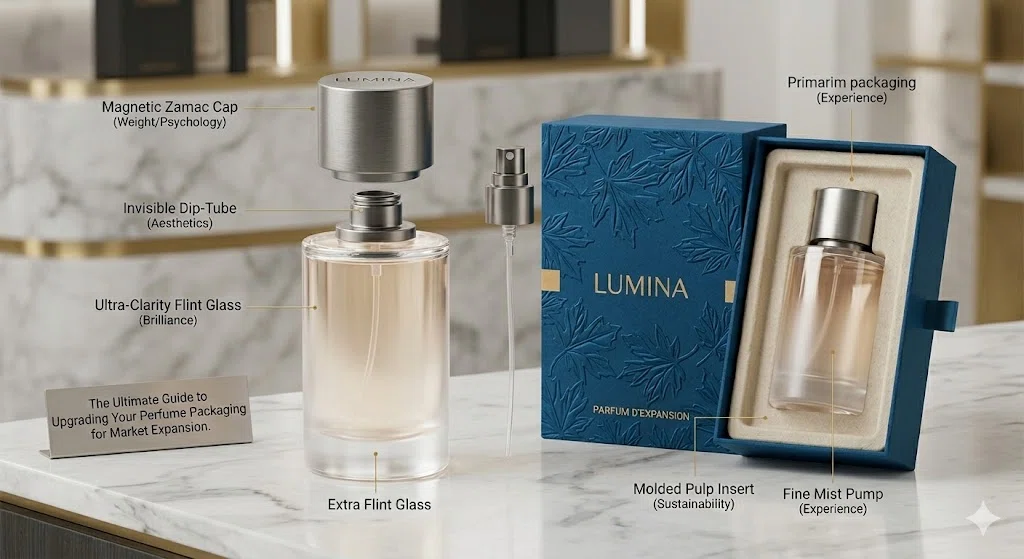
- The Perfume Bottle (The Soul): Upgrade from “Soda-lime” glass to Super Flint Glass. This provides maximum transparency and brilliance. Consider internal lacquering or “gradient frosting” to add depth.
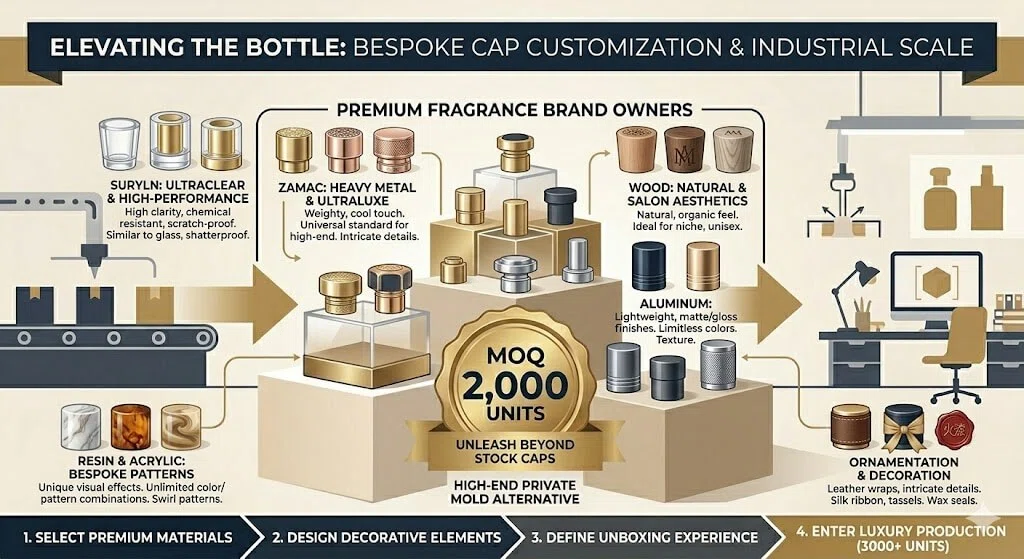
- The Perfume Cap (The Crowning Jewel): The “Click” matters. Upgrading to a magnetic closure creates a psychological “prestige trigger.” Moving from plastic to Zamac (Zinc alloy) adds the cold-to-the-touch feel associated with $200+ fragrances.
- The Perfume Pump (The Experience): The spray should be a “fine mist,” not a “squirt.” Invisible dip tubes (which disappear when submerged in liquid) are currently the gold standard for high-end aesthetics.
4. Secondary Packaging: The Gift Box Experience
The outer box must protect, but it must also perform.
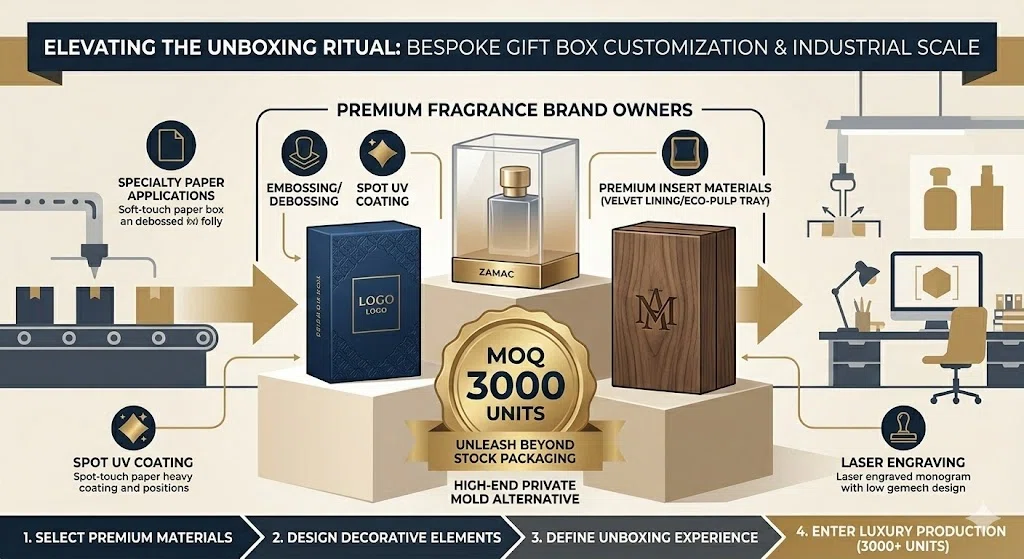
- Structural Integrity: Move away from flimsy 300gsm folding cartons. Upgrade to Rigid Boxes (Greyboard wrapped in specialty paper).
- Insert Innovation: Replace chemical-smelling EVA foam with Molded Pulp or FSC-certified paper structures. This improves both the “unboxing scent” and your sustainability profile.
5. Technical Considerations for Global Compliance
Expansion is impossible without legal adherence.
- Regulatory Labeling: Ensure your ingredient list (INCI) meets both EU (high scrutiny) and US (MoCRA) standards.
- Logistics Testing: Perform ISTA Drop Tests. A beautiful bottle is a liability if the neck snaps during air freight to a distributor in Dubai.
- Anti-Counterfeit: For luxury brands, “Grey Market” protection is vital. Integrate NFC tags in the cap or hidden QR codes in the box lining to track batch authenticity.
6. Sustainability: The New Gold Standard
Sustainability is no longer a “pro” feature; it’s a prerequisite for EU market entry.
- The Refillable Revolution: Transition from “Crimp-neck” (non-removable) to Screw-neck (SNI 15/18) pumps. This allows consumers to buy refill pouches, increasing CLV (Customer Lifetime Value).
- Weight vs. Carbon: While heavy glass feels luxurious, “Light-weighting” glass technology is trending to reduce shipping emissions without sacrificing the premium look.
7. Financial & Logistics Management
- ROI of the Upgrade: Spending an extra $1.50 on a Zamac cap and a better pump often allows a brand to jump from a $60 MSRP to a $120 MSRP.
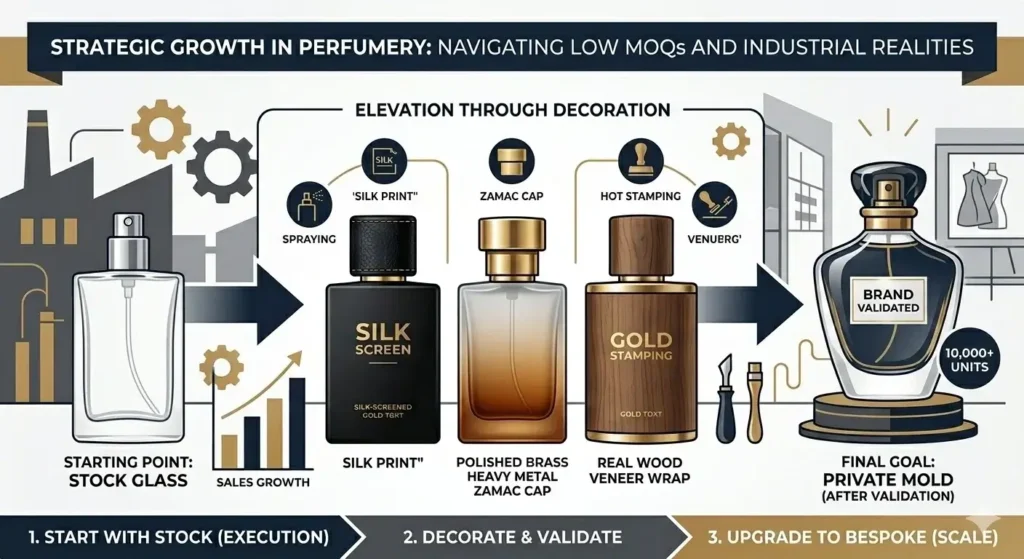
- MOQ Strategy: Global expansion usually requires an MOQ of 10,000 units for custom molds. If you aren’t there yet, use “Stock Bottles” with custom “Surface Decoration.”
Professional FAQ: Perfume Packaging & Market Expansion
- What is “Extra Flint Glass,” and why does it matter? It is the highest-grade glass, with maximum clarity and no green/blue tint, essential for showing off the fragrance’s true color.
- Why use Zamac for perfume caps? Zamac is a zinc alloy that provides a heavy, cool-to-the-touch feel, which consumers subconsciously associate with high value.
- What is the difference between a Crimp pump and a Screw pump? Crimp pumps are permanent; Screw pumps (SNI) allow the bottle to be opened, refilled, and recycled more easily.
- How does “Invisible Dip Tube” technology work? The tube is made of a polymer with a refractive index nearly identical to the perfume oil, making it virtually vanish.
- What is the most eco-friendly secondary packaging? FSC-certified uncoated paper with soy-based inks and molded sugarcane pulp inserts.
- Does heavy packaging always mean luxury? In traditional luxury, yes (weight = value). However, in “Modern Luxury,” sustainability and smart design are starting to outweigh raw mass.
- What is an ISTA-6 test? It is a rigorous shipping simulation test required by retailers like Amazon to ensure packaging survives the e-commerce supply chain.
- How can I prevent my perfume from leaking during air transit? Ensure your pump has a high-quality gasket (usually PE or Surlyn) and that the torque on screw caps is professionally calibrated.
- What is “Hot Stamping” vs. “Silk Screening”? Hot stamping uses heat to transfer foil (metallic), while silk screening applies ink directly to the glass (tactile texture).
- What is Surlyn?A high-grade resin used for transparent caps that doesn’t crack when in contact with perfume oils (unlike standard acrylic).
- How do I choose the right “Dosage” for my sprayer? Standard luxury sprayers are usually 0.10ml to 0.12ml per pump. Anything more feels wasteful; anything less feels “cheap.”
- What are the labeling requirements for the EU market? You must list the 26 potential allergens (like Citral or Linalool) if they exceed a certain threshold.
- Why are magnetic caps becoming standard? They provide a consistent “sensory feedback” (the click) and ensure the logo on the cap always aligns perfectly with the bottle front.
- How long does it take to develop a custom glass mold? Typically, 3–5 months from 3D design to mass production.
- What is PCR glass? Post-Consumer Recycled glass. Using 20–40% PCR is the current “sweet spot” for eco-luxury.
- How can I protect my brand from the “Grey Market”? Unique serial numbers or hidden UV-ink codes on the bottom of the box.
- What is a “Book-style” rigid box? A luxury box that opens with a magnetic flap on the side, like a hardcover book, providing a premium unboxing experience.
- Can I use wood for perfume caps? Yes, but it must have a plastic inner liner (usually PP) to prevent the wood from absorbing the alcohol and cracking.
- What is “Internal Lacquering”? A process where the inside of the glass is colored, creating a strong, jewel-like effect while keeping the outside smooth.
- What is the ROI of upgrading packaging? Typically, for every $1 invested in packaging quality, brands can see a $5–$10 increase in perceived retail value.
