

Summary: Choosing the right perfume bottle shapes and understanding the intricate parts of a perfume bottle is essential for any fragrance brand’s success. From selecting a diamond shaped perfume bottle to mastering 1.7 oz perfume in ml conversions for international shipping, this guide provides a deep dive into the perfume glass industry. Whether you are looking for glass perfume bottles wholesale or need to know how to open a perfume bottle for refilling, we cover every technical and commercial aspect to help you navigate the global supply chain.
In the fragrance industry, packaging costs often account for 40% to 60% of the total product cost. As a Marketing Specialist at FragrancePackage.com, I don’t just sell bottles; I help brands build a visual moat. Before diving in, we highly recommend reviewing our cornerstone article: The Complete Guide to Perfume Packaging Terms to build a professional foundation for discussing perfume bottle components.
I. Visual Productivity: Diverse Perfume Bottle Shapes and Brand Narrative (Perfume Bottle Shapes)
The visual language of a perfume bottle is a consumer’s first sensory interaction with a scent. According to data from the Global Cosmetic Industry, over 70% of consumers make a purchase impulse based on bottle design before ever smelling the fragrance.
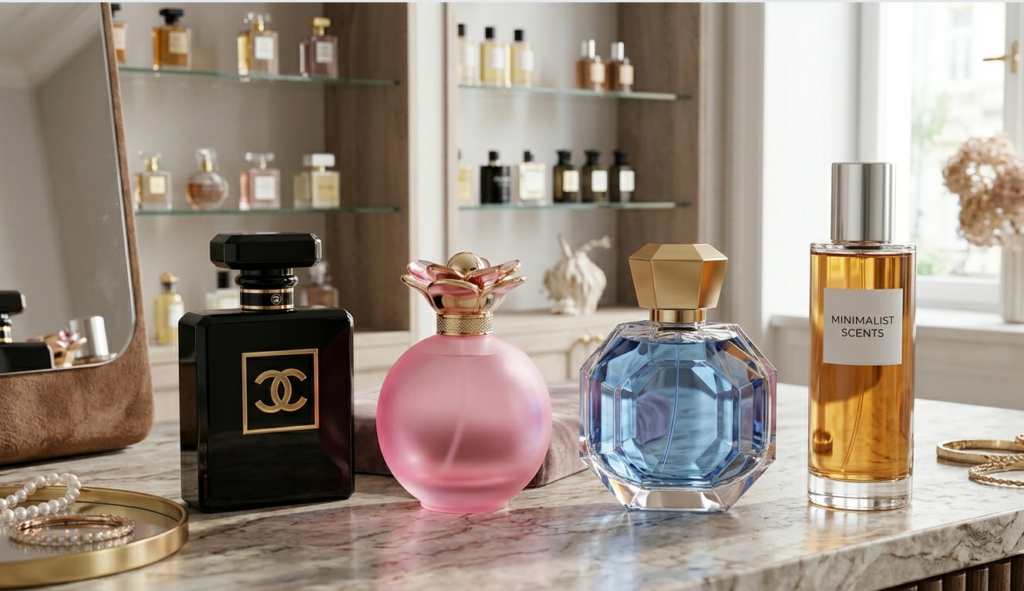
1.1 Classical Geometric Aesthetics
- Square and Rectangle (Square Perfume Bottle / Rectangle Perfume Bottle): These symbolize power, stability, and order. The black square perfume bottle by Chanel remains the pinnacle of this style.
- Round and Spherical (Round Perfume Bottle): Representing inclusivity and softness, the pink round perfume bottle is a staple for youthful, feminine fragrance lines.
- Hexagonal and Cylindrical (Hexagonal Perfume Bottle / Cylinder Perfume Bottle): A hexagonal perfume bottle creates mesmerizing light refraction, while cylindrical shapes are often favored by minimalist niche perfume houses.
1.2 Biomimetic and Unique Designs (Unique Perfume Bottles)
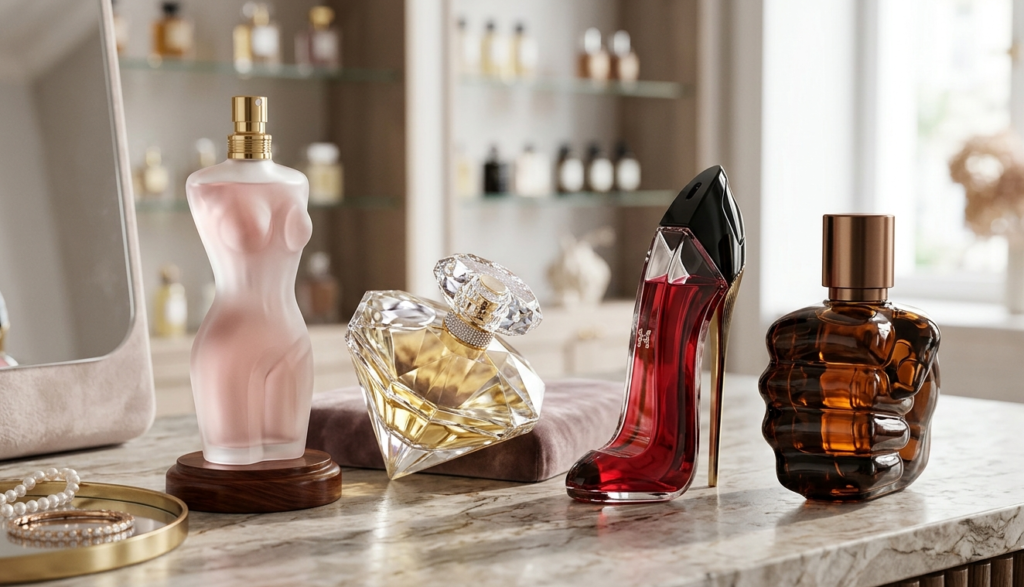
Modern brands increasingly utilize a shaped perfume bottle to cement their brand identity:
- Anatomical Curves (Perfume Bottle Shaped Like a Woman): This design pays homage to sensory aesthetics, often categorized as a woman-shaped perfume bottle.
- Diamonds and Gemstones (Diamond Shaped Perfume Bottle / Diamond Shape Perfume): The sharp facets of a perfume in a diamond-shaped bottle create a sense of luxury through light reflection, common in high-end bespoke collections.
- Fashion Accessories: Notable examples include the perfume shaped like high heel shoes or the perfume handbag bottle.
- Special Symbolism: The fist perfume bottle represents strength, while the dragon perfume bottle is frequently seen in limited editions with Eastern cultural themes.
1.3 Materials and Texture (Perfume Glass)
The quality of the perfume glass determines the fragrance’s perceived grade. The industry primarily utilizes high-flint glass.
- Frosting and Color: Matte black glass perfume bottles offer an air of mystery, while a red round perfume bottle or purple glass perfume bottle is used to convey passion or enigma.
- Craftsmanship: Hand-blown glass perfume bottles and a cut glass perfume bottle with a stopper are considered collector-grade art pieces.
II. Mechanical Engineering: Precision Anatomy and Function (Parts of a Perfume Bottle)
What appears to be a simple bottle is actually a system of precision-engineered components.
2.1 Deep Dive into Core Components (Perfume Bottle Parts)
According to the FragrancePackage.com Glossary, a standard bottle assembly includes:
- Bottle Body (Container Glass): The main reservoir for the liquid.
- Pump (Perfume Pump / Sprayer Perfume): The core power system that dictates the fine mist of the perfume bottle spraying.
- Nozzle (Perfume Nozzle / Spray Nozzle): The exit point and the part with the highest failure rate (perfume nozzle replacement is a common maintenance need).
- Dip Tube (Dipstick): Crucial for ensuring every last drop of liquid is extracted.
- Cap (Perfume Cap / Lids): Provides both decorative flair and a tight seal. Common types include the wood cap, crown cap, or magnetic closures.
- Collar: Sits between the bottle neck and the pump to enhance aesthetic continuity.
2.2 Common Issues and Maintenance (Perfume Bottle Repair)
End users frequently search for how to fix a perfume sprayer or how to fix a broken perfume nozzle.
- Clogging: A perfume spray not working is usually caused by fragrance oil crystallization.
- Opening Techniques: Knowing how to open a perfume bottle or how to unscrew a perfume bottle is essential for decanting. For specific brands, searches like how to open Jean Paul Gaultier perfume or how to open Victoria’s Secret perfume bottle often require specialized removal tools to avoid breakage.
III. Volume Conversion: Ounces to Milliliters Industry Standards (1.7 oz Perfume in ml)
In international trade, confusion over volume conversions often leads to logistics and compliance errors.
3.1 Core Capacity Conversion Chart (Perfume Sizes Chart)
| Size (Ounces) | Size (Milliliters) | Common Use | Remarks |
| 0.17 oz | 5 ml | Perfume sample bottle | Gift with purchase / Tester |
| 0.33 oz | 10 ml | Travel size perfume | Commuting / Travel size |
| 1.0 oz | 30 ml | 30ml perfume size | Small retail size |
| 1.7 oz | 50 ml | 1.7 oz perfume bottle | Core high-volume seller |
| 3.4 oz | 100 ml | 3.4 oz perfume size | Maximum airline carry-on limit |
| 6.7 oz | 200 ml | 6.7 oz perfume | Jumbo / Value size |
3.2 Analysis: 1.7 oz vs. 3.4 oz?
Is 1.7 oz perfume small? For most users, 1.7 oz (50ml) is the ideal size—it prevents excessive oxidation of the fragrance and fits perfectly in the hand (1.7 oz perfume size in hand). Conversely, how big is 3.4 oz of perfume? It is the standard 100ml and is typically the flagship size for most major brands.
IV. Aviation Restrictions and Consumer Guide (Perfume on Plane)
Can you bring perfume on a plane? This remains a primary pain point for consumers.
4.1 TSA Regulations (TSA Approved Perfume Size)
According to the TSA (Transportation Security Administration) 3-1-1 liquids rule:
- Carry-on Luggage: Individual containers must not exceed 3.4 oz (100ml).
- Checked Baggage: Perfume in checked baggage does not have the strict 100ml limit, though flammability (high alcohol content) should be considered.
- International Travel: When searching “Se puede llevar perfume en el avión internacional,” rules are generally consistent globally, though total aggregate volume is often capped at 2 liters.
4.2 Travel Solutions
Many travelers opt for a refillable perfume travel bottle or a travel perfume atomiser. Knowing how to fill a travel perfume bottle is a technical skill usually performed in two ways:
- Bottom-Fill (Fill perfume bottle): Directly docking the travel bottle valve onto the original pump stem.
- Decanting (How to transfer perfume to a travel bottle): Using a micro-funnel or syringe.
V. Supply Chain and Wholesale: A B2B Perspective (Perfume Bottle Wholesale)
For brand owners, finding reliable perfume bottle suppliers is the cornerstone of success.
5.1 Global Supply Landscape
- China Perfume Bottle: Manufacturers in China, such as those in the Al Wara Perfumes Industry hubs, offer exceptional cost-to-performance ratios.
- Luxury Perfume Bottles Manufacturers: Italian and French manufacturers excel in high-precision luxury glasses bottle room perfumes.
- Customization: A custom perfume bottle manufacturer can provide end-to-end solutions from design to assembly based on your perfume business plan.
5.2 Procurement Advice
- MOQ (Minimum Order Quantity): Wholesale empty perfume bottles usually require an order of 5,000 to 10,000 units. For startups, searching for small glass perfume bottles wholesale or empty perfume bottles on eBay is a viable way to find smaller quantities for sampling.
- Regulatory Compliance: Ensure your perfume bottle contents are clearly labeled, as this is a legal requirement in the EU and US markets.
VI. Sustainability and Environmental Impact (Recycling Perfume Bottles)
As sustainable packaging becomes the industry trend, the question “Are perfume bottles recyclable?” is one every brand must answer.
- Recycling Challenges: Perfume bottles are multi-material (glass, metal pumps, plastic tubes), making them difficult to recycle directly.
- Solutions: Promote the refillable perfume bottle. By understanding how to open a perfume bottle to refill, consumers reduce the demand for new empty glass perfume bottles.
- Upcycling: What to do with old perfume bottles? They are frequently repurposed as bud vases or reed diffusers.
VII. Professional FAQ (Expert Insights)
How do I transfer perfume into a travel bottle? (How to put perfume into a travel bottle?)
How many sprays are in a 100ml bottle? (How long does 100ml perfume last?)
How do I get perfume out of a bottle with a broken sprayer? (How to get perfume out of a bottle with a broken sprayer?)
How do I open uniquely designed bottles like Jean Paul Gaultier? (How to open Jean Paul Gaultier perfume bottle?)
How big is a 1.7 oz (or 3.4 oz, 4.2 oz, etc.) bottle in milliliters, and how can I visualize its physical size?
3.4 oz (100 ml): This is the flagship large size and the maximum limit for airline carry-ons. It is roughly the size of a soft drink can but usually slimmer.
4.2 oz (125 ml): A common size for masculine colognes; it feels substantial and heavy in the hand.
Small sizes: 1.0 oz (30 ml) is a small retail bottle, while 0.33 oz (10 ml) is the standard travel or “rollerball” size.
How many sprays are in a standard bottle, and how long will a 50 ml or 100 ml bottle last with daily use?
100 ml (3.4 oz): Contains ~1,000 to 1,200 sprays. If you use 3 sprays a day, it will last approximately one year.
50 ml (1.7 oz): Contains ~500 to 600 sprays. With 3 sprays a day, it lasts roughly 6 months.
Shelf Life: Unopened perfume can last 5 to 10 years if kept in a cool, dark place. Once opened, it typically stays fresh for 2 to 3 years before the notes begin to oxidize.
How do I open a perfume/cologne bottle, and how can I fix a sprayer or pump that is broken or stuck?
Fixing a Sprayer: If it won’t spray, the nozzle is likely clogged with dried perfume oils. Remove the plastic nozzle and soak it in warm water or rubbing alcohol for 10 minutes. If the internal pump mechanism is snapped, you must transfer the liquid to a new atomizer.
How do I transfer perfume/cologne into a travel atomizer or another bottle?
Alternative: Use a tiny plastic funnel or a syringe (decanting kit) to draw liquid out and move it into a glass travel vial.
How much perfume/cologne can I bring on a plane, and how should I pack it?
Checked Bag: You can pack larger bottles in checked luggage, but it is recommended to wrap them in bubble wrap or place them inside a sealed plastic bag to prevent leakage due to pressure changes.
How do I properly dispose of old perfume, and how do I clean out glass jars or essential oil bottles?
Cleaning Glass: To remove wax or oil, use boiling water to melt residue or rubbing alcohol to dissolve stubborn oils.
How many ounces do standard mason jars hold, and how are glass bottles manufactured?
Manufacturing: Commercial glass is made by melting silica sand, soda ash, and limestone at extremely high temperatures ($1500^\circ\text{C}$), then blowing or pressing the molten “gob” into a mold.
Conclusion
A perfume bottle is more than a container; it is a vital part of a brand’s equity. From selecting the opulence of a diamond-shaped perfume to the utility of how to refill a perfume bottle, every decision impacts the user experience.
Whether you are looking for glass perfume bottles wholesale or looking to design your own perfume bottle, FragrancePackage.com is your most reliable strategic partner. We offer custom glass perfume bottles and comprehensive global supply chain support.
Contact our packaging experts today for your bespoke solution!
References and Data Sources:
- International Journal of Cosmetic Science – Impact of Packaging Transparency on Purchase Intent.
- TSA Official Website – Liquids Rule [tsa.gov].
- Grand View Research – Global Glass Perfume Bottle Market Forecast 2023-2030.
- FragrancePackage Glossary– Industry Standardized Vocabulary.
