

In the pantheon of fragrance packaging, the Perfume Bulb Atomizer is revered as the “Crown Jewel.” It serves not only as a visual emblem of vintage aesthetics but also as a masterpiece of modern precision engineering. From the timeless collections of Guerlain to the limited editions of Dior, this design has consistently defined the “sensorial ritual” of perfumery.
However, beneath this elegance lies an incredibly rigorous manufacturing standard. To fully resolve the industry’s pervasive issues of evaporation and leakage, a high-quality bulb atomizer must undergo over 40 meticulous stages of production. From an industrial-grade tolerance control of ±.02mm to the artisanal mastery of hand-woven fabric sleeves, every detail dictates the luxury heritage of a brand.
[!NOTE] Before diving into these complex manufacturing processes, we invite you to explore our Complete Guide to Fragrance Packaging Industry Terms. Mastering these core concepts will provide a solid foundation for understanding the high-end production logic discussed below.
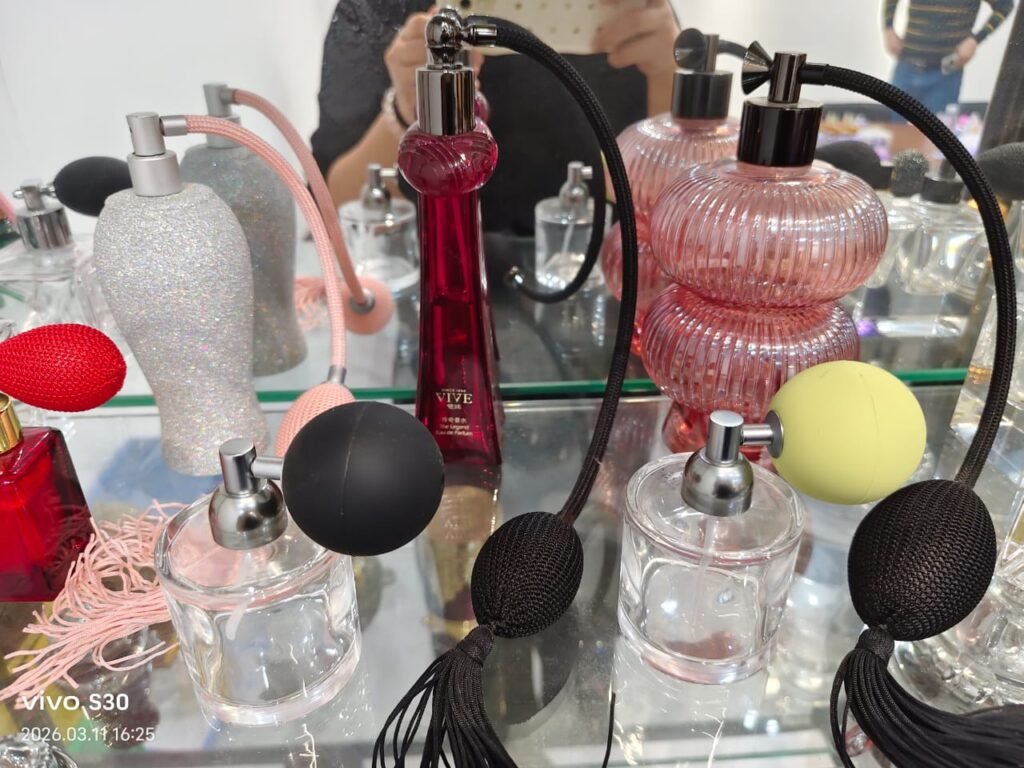
Market Analysis: Why Do Luxury Brands Remain Loyal to Vintage Perfume Atomizers?
From Guerlain’s boutique collections to Dior’s vintage limited editions, the Perfume Atomiser Bulb has always been synonymous with top-tier luxury. Despite the efficiency and lower cost of modern Pump Spray Perfumes, the high-end market has never abandoned the bulb atomizer.
- Audience Insight: The target demographic consists of high-end consumers seeking “ritual.” Pressing the bulb not just a sensory delight, but a symbol of status. This “slow fragrance” experience perfectly aligns with the definition of Niche Luxury.
- Business Logic: Integrating Vintage Perfume Atomisers significantly enhances a product’s premium pricing power. However, evaporation and leakage often exist. Traditional Squeeze Bulb Perfumes are notoriously prone to these issues, which not only result in inventory loss but also erode brand equity. Therefore, partnering with a supplier capable of industrial-grade precision is mission-critical.
The Art of “Slow” Manufacturing: Why Cannot Fast-Track High-Quality Fragrance Atomizers
I often encounter clients in the early stages of collaboration who request a one-third reduction in lead time, assuming this is merely a “rubber ball attached to a tube.” It is only when they step into our production facility and witness the 40+ precision steps involved that they become our most patient partners. After observing the microscopic inspection of every single component, they realize: Precision is something that cannot be rushed; quality requires the sediment of time.
Deconstructing the Core Technology: The Rigorous Logic Behind 40+ Steps
Manufacturing Replacement Atomizer Bulbs that meet industrial standards (±.02mm tolerance control) involves five core technological modules. A minor error in any single step can cause an entire bottle of expensive fragrance to fail.
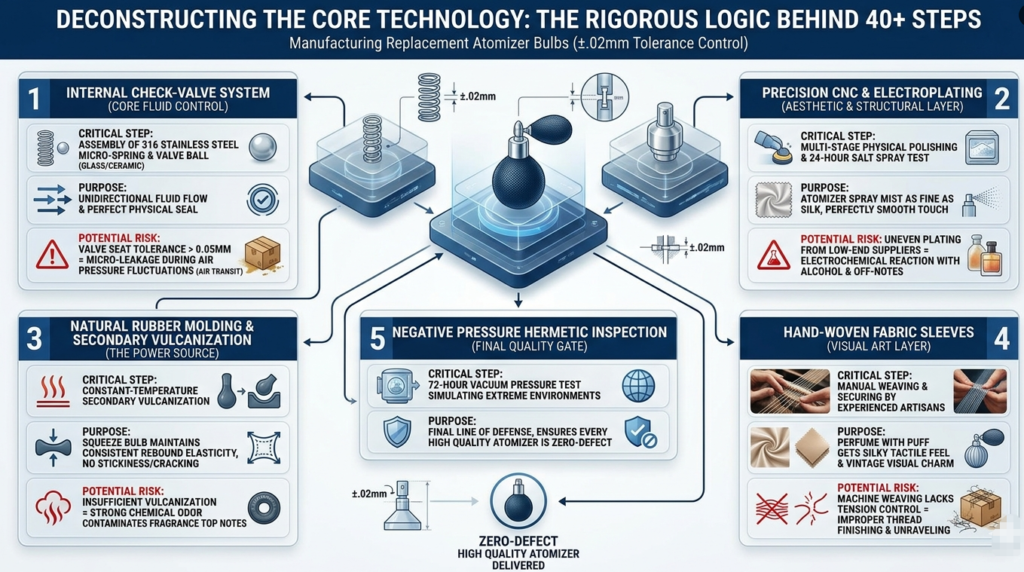
1. The Internal Check-Valve System (Core Fluid Control)
This is the most vital component, determining whether the perfume will evaporate or leak.
- Critical Step: Assembly of the 316 stainless steel micro-spring and the implantation of the Valve Ball (glass or ceramic).
- Purpose: To ensure unidirectional fluid flow and achieve a perfect physical seal when not in use.
- Potential Risk: If the valve seat tolerance exceeds $0.05\text{mm}$, perfume will micro-leak during air pressure fluctuations (such as during air transit), leading to oil stains on the packaging box.
2. Precision CNC & Electroplating (Aesthetic & Structural Layer)
- Critical Step: Multi-stage physical polishing followed by a 24-hour salt spray test.
- Purpose: To ensure the Atomizer Spray produces a mist as fine as silk and feels perfectly smooth to the touch.
- Potential Risk: Many low-end Wholesale suppliers have uneven plating, which causes high-alcohol perfumes to react electrochemically with the metal, resulting in discoloration or off-notes.
3. Natural Rubber Molding & Secondary Vulcanization (The Power Source)
- Critical Step: Constant-temperature Secondary Vulcanization.
- Purpose: To ensure the Squeeze Bulb Perfume maintains consistent rebound elasticity over thousands of uses without becoming sticky or cracking.
- Potential Risk: Insufficient vulcanization leaves rubber molecules unstable, releasing a strong chemical odor that directly contaminates the fragrance’s top notes.
4. Hand-Woven Fabric Sleeves (Visual Art Layer)
- Critical Step: Manual weaving and securing by experienced artisans.
- Purpose: To give the Perfume with Puff its silky tactile feel and vintage visual charm.
- Potential Risk: Machine weaving often lacks tension control; improper thread finishing can lead to unraveling, which severely undermines the perception of luxury on the retail shelf.
5. Negative Pressure Hermetic Inspection (Final Quality Gate)
- Critical Step: A 72-hour vacuum pressure test simulating extreme environments.
- Purpose: This is the final line of defense before delivery, ensuring every high-quality perfume bottle bulb atomizer is zero-defect.
Data Comparison: Technical Differences Between High-End vs. Standard Perfume Atomizer Vintage Bulb Pumps
To help procurement managers make data-driven decisions, we have quantified the differences between industrial-grade standards and common market standards:
| Technical Indicator | Standard Grade (Low-tier) | Our Industrial Standard (High-end) | Impact on Brand |
| Machining Tolerance | $\pm0.1\text{mm}$ | ± 0.02 mm | Critical for sealing and leakage prevention |
| Sealing Material | Standard Silicone | Fluororubber / High-Density PE | Alcohol resistance and shelf life |
| Rebound Lifespan | < 3,000 presses | > 10,000 presses | Long-term user experience and brand trust |
| Manual Labor Ratio | Approx. 10% | Approx. 35% (Exquisite hand-weaving) | Visual detail and luxury perception |
| Testing Cycle | 12-hour spot check | 72-hour full aging test | Long-term evaporation risk management |
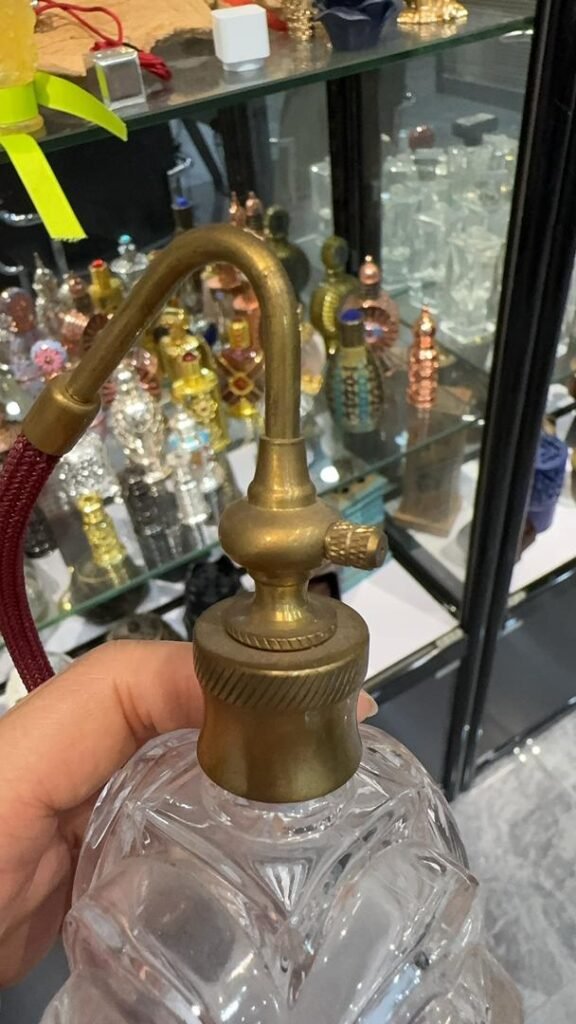
Rubber Hand-Bulb Pump Atomizers Case Study: From “Rushing Orders” to “Building Trust”
Most brands were eager to source Perfume Glass Bottles with Bulb Atomizers for their new collection, and after booking, often push the production status almost daily.
After visiting our factory, we will check the bulb atomizer production lines. When he saw how we inspect every single valve seal under a microscope, and how our artisans weave the outer layer of the bulb stitch by stitch, he fell silent for a long time. He remarked, “I used to think this was just a rubber ball and a sprayer; I didn’t realize you were manufacturing this to the standards of a precision instrument.”
In the fragrance packaging industry, there are no shortcuts to producing a high-quality antique-style perfume sprayer Atomizer. As we stated above, every component represents a technical barrier to overcome.
Learn how the perfume bulb atomizer works https://fragrancepackage.com/perfume-atomizer-bulb-how-to-work/

FAQ about Perfume Atomizer Bulb
To assist you in making professional sourcing decisions, we have summarized the 10 most common questions from our global clients:
A: Primarily improper seal in the internal check valve. If the factory uses ±0.02mm mold control to ensure a completely airtight environment in a static state.
A: No. if use high-grade natural rubber subjected to secondary vulcanization and deep deodorization to ensure it is 100% odorless.
A: We use a double-reinforced manual tying technique that remains structurally sound and retains its shape even under high-frequency use.
A: We understand the challenges of emerging brands and offer flexible MOQ support for specific custom projects. Please contact our sales managers for details.
A: The 40+ steps include mandatory material aging periods and intensive hand-weaving time; this is the scientifically required cycle to ensure a zero-return rate.
A: Yes. We provide end-to-end solutions from vintage Glass Crystal Perfume Bottles to the atomizer assembly.
A: We provide standardized Replacement Atomizer Bulbs, making it easy for brands to provide after-sales maintenance to their end consumers.
Are you looking for a Vintage Perfume Atomizer Bulb Wholesale? Please feel free to contact us.
To learn more about the technical foundations of the industry, please visit: Fragrance Packaging Industry Terms & Glossary
