

Marble Perfume Caps, as a natural stone, are favored by niche artisan fragrances and high-end brands for their unique texture and luxurious feel. However, due to its physical properties, there are many “traps” in design, production, and after-sales service.
The following is a summary of precautions and common customer complaints regarding marble perfume caps:
Part I: Natural Marble Stone Perfume Caps
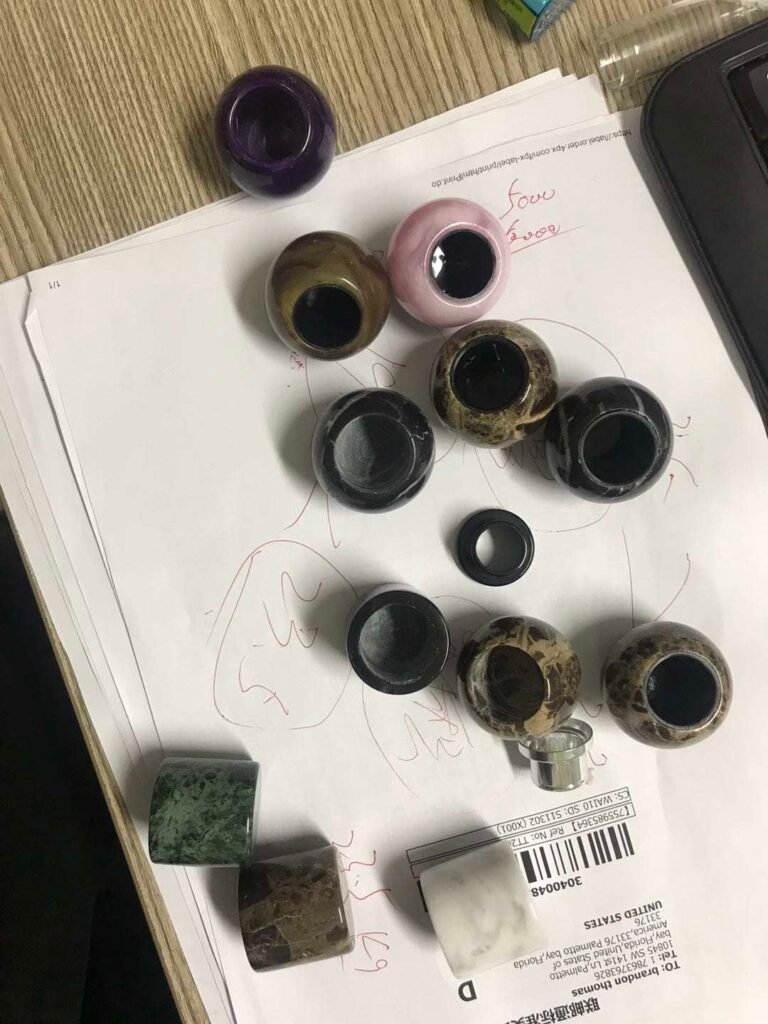
Natural marble is considered the “standard configuration” for high-end perfumes due to its one-of-a-kind veining.
Production and Design: 5 Critical Aspects
1. Production Precautions and Solutions
- High Brittleness: Marble is as brittle as a cracker.
- Solution: The wall thickness must be maintained at 3mm or more, and precise CNC machines should be used for light cutting. If the wall is designed too thin, it will break very easily during cutting or transportation.
- 2. Excessive Weight: Can lead to a top-heavy bottle. Marble caps are very heavy (typically 40g-80g). If the bottle body is too light or the center of gravity is unstable, the perfume bottle will tip over easily when capped.
- Solution: Increase the glass thickness at the bottom of the perfume bottle to lower the center of gravity. Evaluate the overall packaging balance to ensure the base is substantial enough.
3. Integration of the Inner Plastic Liner
- Point of Caution: Stone cannot come into direct contact with the glass bottle neck or sprayer because stone is hard and rough; it will scratch the bottle or lead to a poor seal.
- Recommendation: A PP or Surlyn plastic liner must be used. The liner and stone must be bonded with glue. The glue must be tested to ensure it doesn’t de-bond due to perfume evaporation (alcohol).
4. Natural Color and Texture Variation
- Point of Caution: Every piece of stone has differences in texture, depth, and base color.
- Recommendation: The contract must clearly state “Texture Randomness.” If a customer requires a highly uniform color (e.g., pure white), the yield rate will be extremely low, and the cost will double.
5. Surface Coating Treatment (Sealing/Coating)
- Point of Caution: Marble has microscopic pores that easily absorb liquids (such as perfume, dyes, or oils from hands).
- Recommendation: The surface must undergo oil-proof and anti-fouling wax sealing or light polish coating treatment.
Part II: Dyed Marble Perfume Caps
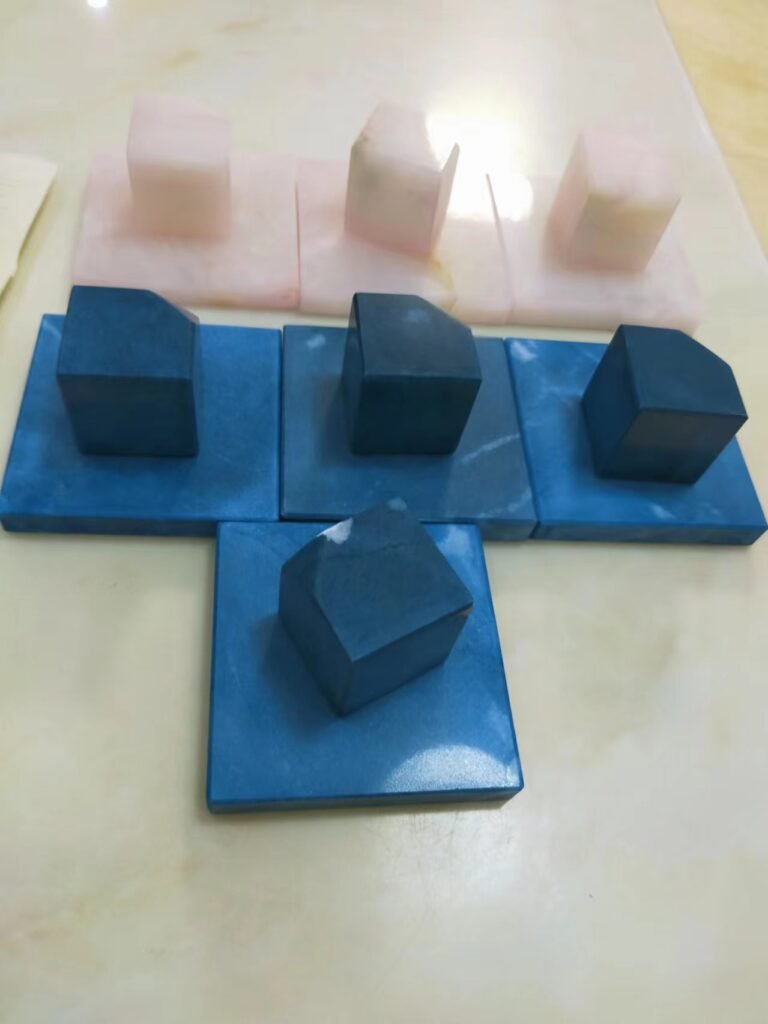
Through artificial penetration technology, stone can achieve vibrant colors rarely found in nature.
1. Precautions and Solutions
- Alcohol Fading: The alcohol in perfume can dissolve pigments, causing the cap to “lose color.”
- Solution: Vacuum dyeing must be performed, followed by a spray-on alcohol-resistant UV clear coat.
- Surface Bleeding: Pigments may stain the packaging box or clothing.
- Solution: Perform high-temperature color fixing after dyeing and conduct a 96-hour alcohol immersion test.
- Natural Hidden Fractures: Heating during the dyeing process may cause the stone to crack.
- Solution: Screen the raw stones before processing and eliminate those with existing cracks.
2. Common Customer Complaints
- Fading Issues: Customers report that the cap color fades over time.
- Significant Color Variance: Different batches of caps have inconsistent color depth.
- Odors: Improper handling of dyes may leave residual chemical smells.
3. Material and Color Recommendations
- Suitable Material: It is recommended to choose marble with a lighter base color and more pores (such as white marble) so that the color absorption is more uniform.
- Popular Colors: Emerald green, navy blue, and pastel purple. These colors make the product stand out prominently on the counter.
Part III: Natural vs. Dyed Marble Comparison Table
| Item | Natural Marble | Dyed Marble |
| Core Advantage | Purely natural, ultra-luxury, never fades | Vibrant colors, strong customization |
| Core Disadvantage | Limited colors, uncontrollable variance | Sensitive to alcohol, complex process |
| Price | High (depends on stone rarity) | Very High (Stone cost + dyeing labor) |
| MOQ | 500 – 1,000 pcs | 1,000 pcs minimum |
| Tech Requirement | CNC cutting, polishing precision | Vacuum absorption, UV sealing |
| Alcohol Resistance | Excellent (Stone is unaffected) | Dependent on protective coating |
Part IV: Natural Marble Stone Caps Color Classifications
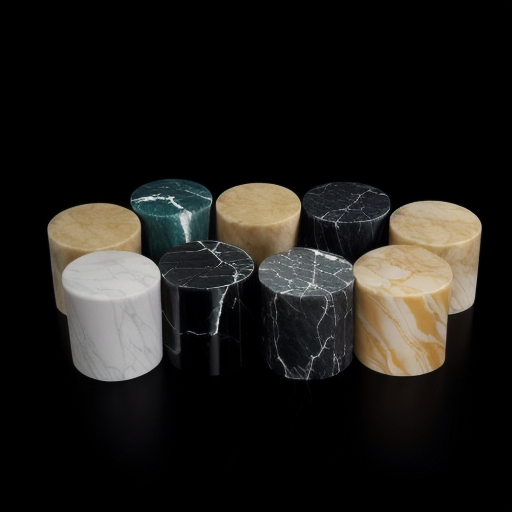
1. White Series — Most popular with major brands
White marble is clean and elegant, best reflecting the purity of niche perfumes.
- Carrara White: From Italy. White base with light grey silk-like veins. It is the most classic and widely used color.
- Volakas White: Whiter base with textures that spread like an ink painting, creating a poetic feel.
- Ariston White: Extremely high purity with very little patterning; the price is very high.
2. Black Series — High-end and Mysterious
Black marble usually brings a sense of stability, suitable for men’s fragrances or “night” series.
- Nero Marquina: Deep black base with striking white lightning-like veins. Strong contrast and high visual impact.
- Laurent Black Gold: Black base with gold or brown linear veins, looking very luxurious (pairs well with gold sprayers).
3. Grey Series — Industrial and Minimalist
Grey has been a trendy color recently, perfect for minimalist or unisex brands.
- Tundra Grey: Light grey base with some irregular dark dots or linear textures, providing a high-end feel.
- Castle Grey: Darker color and hard texture, looking like the stone of an ancient castle.
4. Green Series — Retro and Natural
Green stone is common in retro styles and fragrances themed around forest scents.
- Verde Alpi: Deep green base filled with large white patterns. Very rich colors and artistic.
- Rainforest Green: Unique textures that look like tree roots.
5. Beige/Cream Series — Warm and Soft
- Sahama Beige: Warm jade-like luster with fine texture, suitable for elegant, soft fragrances.
Part V: Quick Tips for Color Selection
| Color | Natural Texture Control | Cost Grade |
| White | Prone to yellowing; requires picking | Medium to High |
| Black | Easily shows scratches; needs good polish | Medium |
| Green | Huge texture span; hard to find matches | High |
| Grey | Most stable color; relatively small variance | Moderate |
Part VI: The 4 Most Common Customer Complaints
1. “Product Does Not Match Sample” (Color/Pattern Inconsistency)
- Complaint: “Why is the cap I received so much darker than the sample?” or “Why is there a black line (actually a natural vein) on this cap?”
- Solution: Send “Golden Samples” in advance and inform customers of the natural stone variation range; provide a “Color Range Reference.”
2. Detachment Issues (Liner Detachment)
- Complaint: “When I pull off the cap, the marble shell comes off, but the plastic liner stays on the bottle.”
- Solution: Usually caused by alcohol dissolving the glue. Use industrial-grade alcohol-resistant glue and perform a “drawing” (texturing) process on the marble’s inner wall to increase friction.
3. Cracks and Breakage
- Complaint: “Fine cracks found on the top of the cap upon arrival,” or “Broken immediately after dropping on the floor.”
- Solution: Ensure it’s not too thin during processing. Strengthen packaging protection (use independent EPE foam slots) and eliminate pieces with “hidden cracks” during QC.
4. Fitting Issues (Too Tight or Too Loose)
- Complaint: “The cap is too hard to pull off,” or “It wobbles after being capped.”
- Solution: Marble is machined while plastic liners are injection-molded; controlling the tolerance between the two is difficult. Strictly test the tension of the liner’s clips.
Part VII: Tips to Avoid Pitfalls
- QC Standard: When inspecting marble caps, don’t just look at the appearance. Tap it gently with your hand; a crisp sound usually means no internal cracks, while a dull sound may indicate hidden fractures.
- Terminology: Understanding professional stone processing terms is vital. You can refer to the pillar page Complete Guide to Perfume Packaging Terms Glossary to ensure accurate communication with suppliers.
Part VIII: Custom Marble Perfume Cap Technical FAQ
A: Because marble is too hard and uneven. Capping it directly on a glass bottle would cause leaks. The plastic liner provides sealing and cushioning.
A: No. Every piece of natural marble is unique, which is its selling point. For dyed marble, colors are closer, but patterns remain different. If you want total uniformity, consider artificial stone or marble-imitation resin.
A: Yes. It is a fragile item and should be handled as carefully as a glass cup.
A: Because dyeing adds several processes—vacuum absorption, drying, and protective spray coating—on top of the natural stone cost.
A: Natural stone won’t be ruined. However, if the protective coat on a dyed cap is poorly made, alcohol will “wash away” the color.
A: Tap it with your finger. A crisp sound indicates it’s intact; a dull thud suggests internal cracks.
A: The stone itself won’t, but if the glue fails and moisture enters, the glue area might develop odors or mold spots.
A: Black has high reflectivity; any tiny abrasion is more obvious than on white stone.
A: Professional factories use fixing and coating treatments. As long as the pigment does not come into direct contact with the skin, it is very safe.
A: Very difficult. Stone is dense. The only way to reduce weight is to make the walls extremely thin, but this makes them very fragile.
A: Typically via Laser Engraving or Oil Filling. A groove is carved into the stone and then filled with gold or silver paint.
A: Generally, Black and Green marbles are slightly more brittle and prone to micro-cracks when machined into thin caps. Wall thickness needs special attention here.
A: Natural stone colors absolutely never fade. As long as the surface has an alcohol-resistant seal, its beauty will last for decades.
For more advice on packaging details and material matching, welcome to check the Complete Guide to Perfume Packaging Terms Glossary again.
