
Last Updated: January 27, 2026 Authored by: Inga Elegant Packaging Technical Team Reviewed by: Senior Glass Process Engineer, Mr. Chen (20+ Years Experience) Reading Time: 8 Minutes
For luxury fragrance brands, the bottle is not merely a container; it is the physical embodiment of the scent and a critical brand asset. However, selecting the right manufacturing process is a delicate balance of aesthetics, physics, and economics.
At Inga Elegant Perfume Packaging Company, we move beyond surface-level descriptions. This guide provides the quantifiable data, tolerance standards, and technical specifications you need to vet suppliers and minimize risk in your supply chain.
1. Manufacturing Processes: The Data-Driven Comparison
While there are various ways to form glass, two methods dominate the perfume industry. According to Grand View Research, automated glass manufacturing accounts for over 85% of the global container glass market share, while semi-automatic processes occupy the luxury niche.
A. IS Machine (Individual Section) – The Industry Standard
- Process: Molten glass is cut into “gobs” and formed using compressed air in high-speed molds.
- Best For: High-volume orders (>20,000 units) requiring strict dimensional consistency.
- Market Reality: Used by 90% of commercial brands (Source: Glass Packaging Institute Reports).
B. Semi-Automatic / Hand-Blown – The Luxury Choice
- Process: Artisans manually gather glass; machine assistance is used only for shaping.
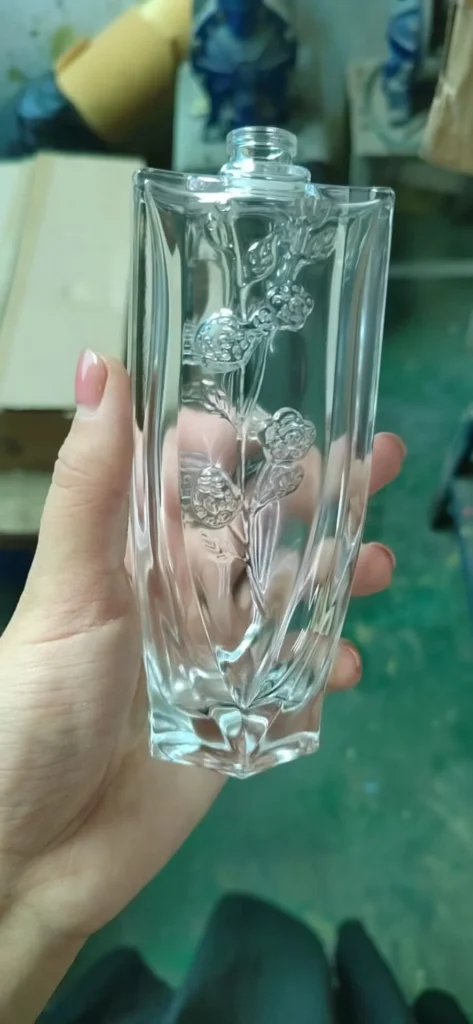
- Best For: Heavy-bottom designs (Glass distribution >15mm at base) and complex, non-symmetrical shapes.
- Trade-off: Higher cost and lower daily output, but unmatched clarity.
📊 Technical Comparison: Machine vs. Semi-Auto
| Feature | IS Machine (Automated) | Semi-Automatic (Hand-Crafted) |
| Daily Output | 50,000 – 100,000+ units | 2,000 – 5,000 units |
| Mold Cost | High ($3,000 – $5,000+) | Medium ($1,000 – $2,000) |
| Glass Distribution | Very Uniform (Wall variance <1mm) | Variable (Creates “Artisanal” refraction) |
| Defect Rate (Avg) | < 3% (Before sorting) | 10% – 15% (Requires heavy manual sorting) |
Tech Note: For ultra-premium clarity, we recommend “Super Flint” glass (Fe2O3 content < 0.02%), which increases light transmission by approximately 15% compared to standard flint glass.
2. Critical Quality Standards & Tolerances (The “Spec Sheet”)
A “good quality” bottle isn’t subjective; it’s mathematical. We adhere to CETIE (International Technical Centre for Bottling and Packaging) standards and GPI (Glass Packaging Institute) guidelines.
A. Dimensional Tolerances (CETIE DT 2 Standards)
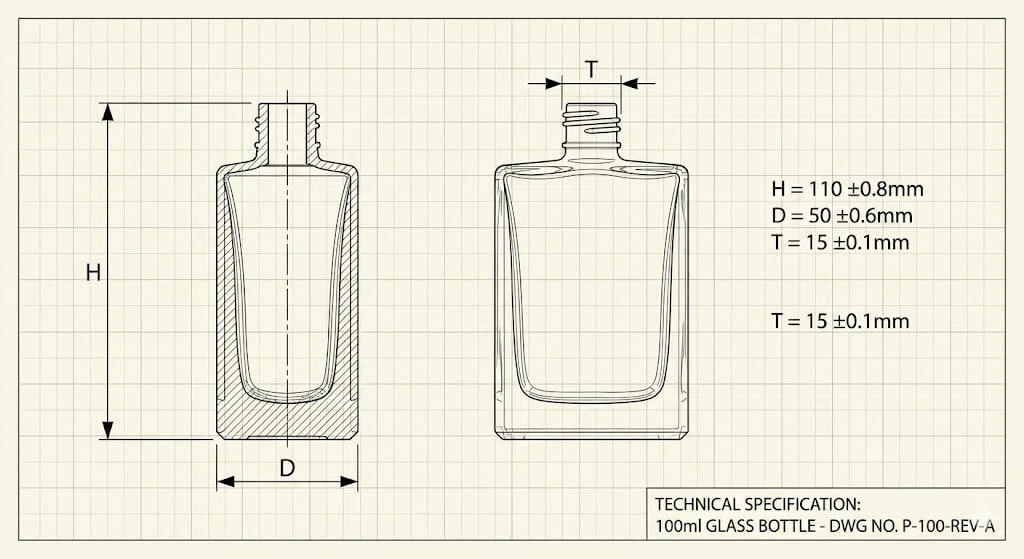
Ignoring tolerances is the primary cause of leaking pumps and loose caps. We guarantee:
- Height (H): ±0.8 mm (for bottles < 100mm height)
- Body Diameter (D): ±0.6 mm
- Verticality: Max deviation 1.2 mm (Prevents the “leaning tower” effect on shelves)
- Brimful Capacity: ±2% of total volume (Crucial for automated filling lines)
B. Neck Finish & Leakage Prevention
The interface between the bottle neck and the pump is the critical failure point.
- Standard: FEA 15 / FEA 20 (Crimp) or GPI 400/415 (Screw).
- Control Metric: We use “Go/No-Go” gauges to measure the “T” (Thread/Crimp diameter) and “I” (Inner diameter) to 0.1mm accuracy.
3. Surface Treatment: Durability Metrics
A beautiful finish is useless if it peels. We validate our surface treatments using ISO Standard Test Methods.
- Frosted (Acid Etching vs. Sandblasting):
- Acid Etching: Chemical immersion. Creates a 0.02mm depth micro-structure for a silky, fingerprint-free finish.
- Sandblasting: High-pressure impact. Creates a rougher surface, ideal for rustic textures.
- Coating & Metallization Testing:
- Adhesion Test (ISO 2409): Cross-Cut Tape Test. Standard: Class 0 or 1 (0-5% peeling).
- Chemical Resistance: 24-hour immersion in Bulk Fragrance (alcohol + essential oils). Standard: No discoloration or softening.
4. Sustainability: The PCR Ratio Truth
“Eco-friendly” requires transparency. According to FEVE (The European Container Glass Federation), the trade-off between clarity and PCR (Post-Consumer Recycled) content is physical:
- Standard Flint (Clear): Max 15-20% PCR.
- Why? Higher percentages introduce a grey/green tint due to mixed cullet impurities.
- Amber / Green / Dark Glass: Up to 60-90% PCR.
- Why? Dark colors mask impurities effectively.
- Inga Elegant Solution: For clients demanding 100% clarity and sustainability, we use PIR (Post-Industrial Recycled) cullet from our own production line, ensuring zero contamination.
5. Your Questions Answered: Expert FAQs
Q1: What is the breakage rate on filling lines?
Answer: Industry standard allowance is 2%. However, our bottles undergo Annealing at 560°C to relieve stress. Clients typically report breakage rates below 0.5% on high-speed lines.
Q2: Can you match a specific Pantone color exactly?
Answer: Yes. We use spectrophotometers to ensure the color difference (Delta E) is < 2.0, making the variance invisible to the human eye.
Q3: Is internal spraying really scratch-proof?
Answer: Yes. Since the coating is inside the glass, it is physically impossible to scratch during transport or retail handling. It creates a depth perception that external spraying cannot mimic.
Q4: How do you define a “Critical Defect”?
Answer: We follow ISO 2859-1 (AQL Standards):
- Critical (AQL 0.65): Safety issues (Sharp edges, cracks).
- Major (AQL 1.0): Functional issues (Leaking, blocked neck).
- Minor (AQL 2.5): Visual specs (Tiny bubbles <1mm).
6. Your Questions Answered: Top 10 Public FAQs for Perfume Bottle Customization
Here are the most common questions brand decision-makers ask us, along with our expert answers:
- What is your typical MOQ for custom perfume bottles?
- Our standard MOQ for custom molds is typically 10,000-30,000 units, varying based on bottle complexity and decoration. For existing molds with custom decoration, MOQs can be lower.
- How long does it take to develop a new custom bottle mold?
- Mold development usually takes 6-8 weeks from confirmed design to first sample production.
- Can you help with bottle design if we only have an idea?
- Absolutely! Our in-house design team can work with you from concept to 3D rendering and technical drawings, ensuring your vision comes to life.
- What’s the difference in cost between acid etching and sandblasting?
- Acid etching is generally more expensive due to the chemical process and the need for specialized equipment and waste treatment. Sandblasting offers a more budget-friendly matte option.
- Is internal spraying really scratch-proof?
- While highly durable, no surface is entirely scratch-proof. However, internal spraying offers significantly superior scratch resistance compared to external spraying as the color is protected by the outer glass layer.
- How do you ensure color consistency across large production runs?
- We use spectrophotometers for precise color matching, maintain strict batch control for paints, and conduct regular in-line inspections to ensure color consistency within a specified Delta E tolerance (typically < 2.0).
- Can we get samples before committing to a full order?
- Yes, we provide pre-production samples (PPS) for your approval after mold development and decoration trials. This ensures you are fully satisfied before mass production begins.
- What are the most popular decoration methods for luxury brands?
- For luxury, fire polishing combined with hot stamping, internal spraying, and intricate silk screen printing are highly sought after for their refined finish and premium feel.
- Do you offer sustainable packaging options?
- Yes, we are committed to sustainability. We offer bottles made with high PCR (Post-Consumer Recycled) glass content, lightweighting options, and can recommend eco-friendlier decoration alternatives.
- What are the payment terms and shipping options?
- Standard payment terms are typically 30-50% upfront, with the balance due upon shipment. We offer various shipping options (FOB, CIF, DDP) and can arrange logistics to your preferred destination.
Elevate Your Brand with Inga Elegant Perfume Packaging
Don’t leave your brand’s legacy to chance. Partner with a manufacturer that speaks the language of precision, science, and art.
Ready to transform your fragrance vision into a tangible masterpiece?
Contact us today for a consultation:
- WhatsApp: +86 18107699312
- Email: [email protected]
