
The “Invisible Guardian” on Perfume Packaging
In the world of high-end perfumery, packaging is more than just a decorative shell; it is a critical vessel for safety and communication. Most consumers view perfume as a luxury cosmetic, but from a logistics and safety standpoint, perfume is classified as Class 3 Dangerous Goods. This is due to its high alcohol content—typically ranging from 70% to 90%—making it highly volatile and combustible.
The Flammable Symbol did not appear overnight. It is the result of decades of evolving safety standards, shifting from a voluntary practice to a mandatory global requirement under the GHS (Globally Harmonized System of Classification and Labelling of Chemicals) and regional regulations like the EU’s CLP. For brand owners and sourcing managers, understanding this timeline is essential for ensuring Regulatory Compliance in international trade and avoiding costly market recalls.
1. Traceability: The Evolution of Flammable Symbols
The history of safety labeling on fragrance bottles is a journey from aesthetic purity to rigorous transparency.
- Pre-1960s: The Era of Aesthetics. Before the 1960s, there were no universal mandates for safety icons. Perfume houses prioritized brand identity, and safety information was almost non-existent on the primary Glass Bottle.
- 1967 (Directive 67/548/EEC): The European Foundation. The European Economic Community introduced this directive to classify dangerous substances. It gave birth to the first recognizable hazard symbols—black icons on orange square backgrounds.
- 2003: The Birth of GHS. The United Nations officially released the GHS framework to harmonize chemical safety worldwide. This set the stage for a global standard that would replace fragmented regional systems.
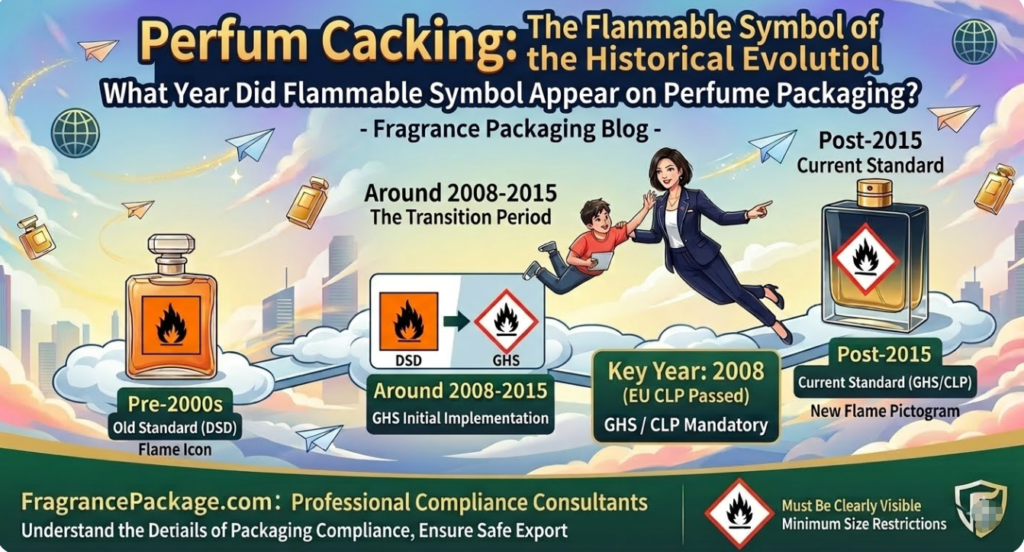
- 2009–2015: The Great Transition. This was the most critical period for the fragrance industry. The EU adopted CLP Regulation (EC) No 1272/2008, which officially mandated the transition from the old orange squares to the modern GHS02 Flame Pictogram (a red diamond border with a black flame on a white background). By June 1, 2015, these labels became mandatory for all chemical mixtures, including perfumes.
2. In-depth Comparison: Labeling Standards Evolution
Understanding the nuances between old and new standards is vital for Quality Assurance and historical authentication of vintage stocks.
Comparison of Flammable Labeling Standards
| Feature | Old Standard (DSD/DPD) | Current Standard (GHS/CLP) |
| Visual Appearance | Orange square, black flame symbol | Red diamond frame, white background, black flame |
| Mandatory Date | Late 1960s – approx. 2010 | Fully mandatory since June 2015 |
| Legal Basis | Directive 1999/45/EC | Regulation (EC) No 1272/2008 |
| Market Reach | Primarily European Union | Global Standard (UN GHS Framework) |
| Placement | Often hidden on the bottom or back | Must be clearly visible with minimum size requirements |
3. Compliance in Perfume Packaging Design
As a professional manufacturer at FragrancePackage.com, we help brands navigate the technicalities of applying these symbols without compromising the “shelf appeal.”
- Material Compatibility: Printing a Pictogram on glass requires specialized Anti-alcohol Inks. Standard inks may dissolve if the perfume leaks, violating safety codes that require labels to remain legible throughout the product’s lifecycle.
- Legal Risk Mitigation: Failure to include a compliant flammable symbol can lead to Customs Seizure, heavy fines, or even the destruction of the shipment. This is especially true when exporting to the EU or North America.
- Balancing Aesthetics and Compliance: To maintain a luxury feel, many brands use Screen Printing (silk-screen) or Hot Stamping in metallic foils. While the GHS suggests specific colors, we provide solutions that integrate the Signal Word and Hazard Statements into the layout using transparent labels or discrete placement on the Secondary Packaging (outer box).
4. Conclusion
The flammable symbol is far more than a legal hurdle; it is a brand’s commitment to consumer safety and professional integrity. In an era of strict Regulatory Compliance, knowing the “when” and “how” of safety labeling is non-negotiable for success in the global market.
At FragrancePackage.com, we offer One-stop Sourcing & Design services. We don’t just provide bottles; we provide peace of mind by ensuring every element of your packaging—from the Cap to the Outer Box—is compliant with international safety standards.
