

The “Red Alert” of Fragrance Logistics
In the global fragrance trade, perfume is much more than a luxury accessory; it is scientifically classified as Class 3 Dangerous Goods (DG). This classification stems from its high ethanol concentration—typically between 70% and 90%—which makes it highly flammable and volatile.
Whether you are utilizing Air Freight for rapid market entry or Ocean Freight for bulk distribution, the regulatory scrutiny is immense. This article analyzes the legal, financial, and reputational risks a brand faces when Customs or a Carrier discovers undeclared perfume, ensuring your business maintains Regulatory Compliance.
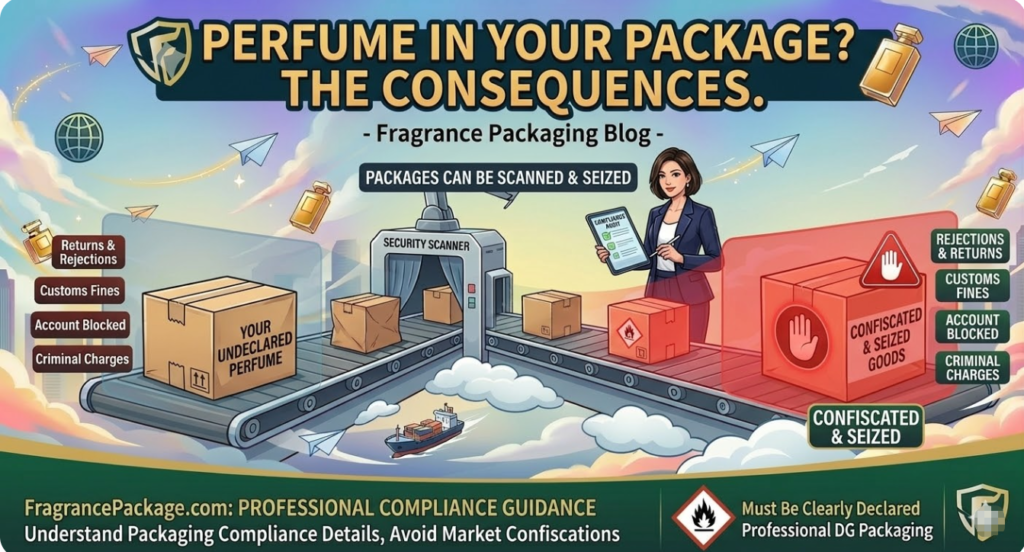
1. Core Risk Analysis: What Actually Happens?
- Direct Consequence 1: Rejection & Return. Modern logistics hubs use sophisticated AI-driven X-ray scanners. If a carrier like DHL or FedEx detects unannounced flammable liquids, the shipment is immediately rejected. The sender is often forced to pay for the return leg, and the original shipping fee is non-refundable.
- Direct Consequence 2: Customs Seizure & Fines. When a shipment hits international borders, a Misdeclaration (declaring perfume as “gifts” or “glass bottles”) is seen as a serious offense. Customs authorities may seize the entire lot, and administrative fines can range from a few hundred to tens of thousands of dollars, depending on the severity and intent.
- Direct Consequence 3: Account Blacklisting. Logistics companies maintain “Shipper Profiles.” Repeated violations will lead to Account Blacklisting, making it impossible for your company to export goods through major global carriers.
- Safety Hazards: The Real Danger. Beyond legalities, there is a physical risk. In an unpressurized cargo hold, poor Seal Integrity can lead to Leakage. If alcohol vapors meet an electrical spark, the result can be a catastrophic fire or explosion mid-flight.
2. Deep Analysis: Declared vs. Hidden Shipping
For sourcing managers, the choice between compliance and “gray channels” is the difference between a sustainable brand and a legal disaster.
| Feature | Hidden/Undeclared Shipping | Declared DG Cargo (Compliance) |
| Success Rate | Extremely Low (High detection via AI) | High (Standardized Procedure) |
| Logistics Channel | Illegal “Gray” channels or small parcels | Specialized DG Aircraft/Vessels |
| Clearing Speed | Unpredictable (High risk of seizure) | Stable and predictable lead times |
| Legal Risk | Fraud charges and heavy penalties | Full legal protection under trade law |
| Overall Cost | Low upfront, potentially ruinous later | Higher upfront for proper documentation |
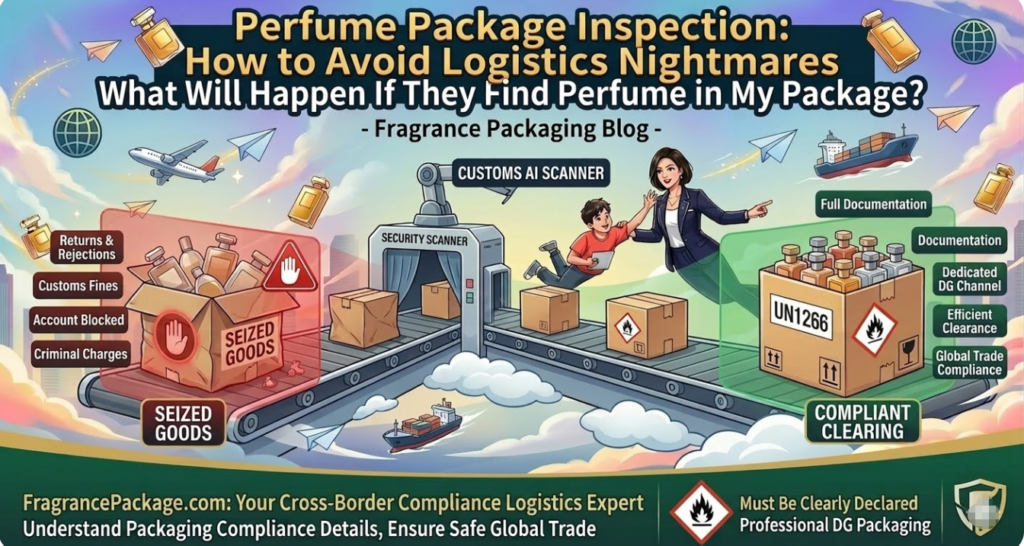
3. Expert Insight: Securing Your Fragrance Exports
As specialists at FragrancePackage.com, we advise our clients on the technical requirements for safe passage:
- Technical Documentation: You must provide a current MSDS (Material Safety Data Sheet) and a Transport Safety Appraisal Report (e.g., UN38.3 equivalent for liquids).
- Engineering Requirements:
- Primary Packaging: The Glass Bottle must undergo pressure testing to ensure it won’t crack under atmospheric changes.
- Secondary Packaging: Use double-walled corrugated boxes with internal dividers to prevent friction between bottles.
- Labeling: Every carton must bear the GHS02 Flame Pictogram and Orientation Arrows.
- The FragrancePackage Role: We focus on Seal Integrity during the R&D phase. Our Pump and Actuator systems are vacuum-tested to ensures zero leakage even during extreme pressure fluctuations.
4. Conclusion
Compliance is the only foundation for a long-term, successful fragrance brand. Attempting to bypass safety protocols puts your inventory and your company’s future at risk. Partnering with an expert manufacturer like FragrancePackage.com ensures that your One-stop Sourcing includes not just beautiful design, but global logistical peace of mind.
