
On the journey to pursuing ultimate luxury and uniqueness, Natural marble and crystal caps are powerful tools to captivate consumers. However, the high raw material costs of natural stone have driven some budget-conscious brands, or those looking to cut costs, to take a deadly shortcut—choosing low-priced, dyed Marble Stone Perfume Caps.
If you are currently considering this option, stop immediately, because this choice is highly likely to plunge your brand into an irreversible disaster.
The Industry Inside Track: How Are Dyed Marble Stone Caps Actually Made?
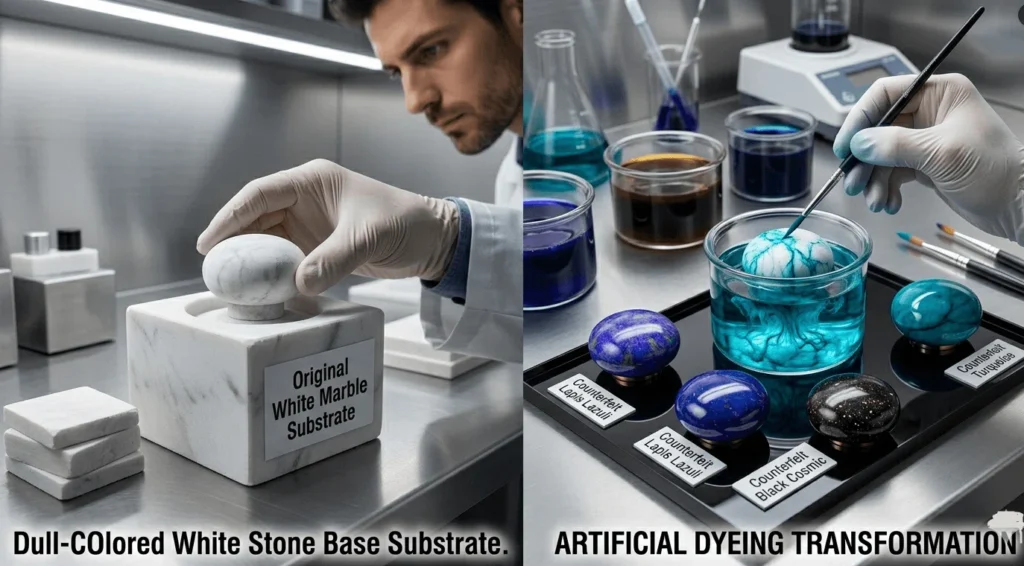
To slash costs, some unreliable suppliers use extremely cheap, dull-colored white stone (white marble) as the base substrate.
Because white stone acts like a blank sheet of paper, it easily absorbs chemical dyes.
Through artificial dyeing, they can transform cheap white stone
to counterfeit expensive Turquoise, Lapis Lazuli, Black Cosmic, or even various rare colored crystals.
When freshly out of the factory, or when inspected merely through photos,
these caps look vibrantly colorful—sometimes even more “perfect” than genuine natural stone.
A Predictable Brand Disaster: The Truth 6 Months Later
Perfume is not a fast-moving consumer good; it needs to sit on retail shelves or a consumer’s vanity for one year, two years, or even longer.
A dyed stone cap, however, is a ticking time bomb waiting to explode.
As the cap remains exposed to the air over time,
it inevitably suffers from the long-term impacts of ambient humidity, light exposure, temperature fluctuations, and perfume alcohol evaporation.
If the supplier lacks experience and the color-fixing process is inadequate (most low-end factories merely apply a simple dye layer and surface polish),
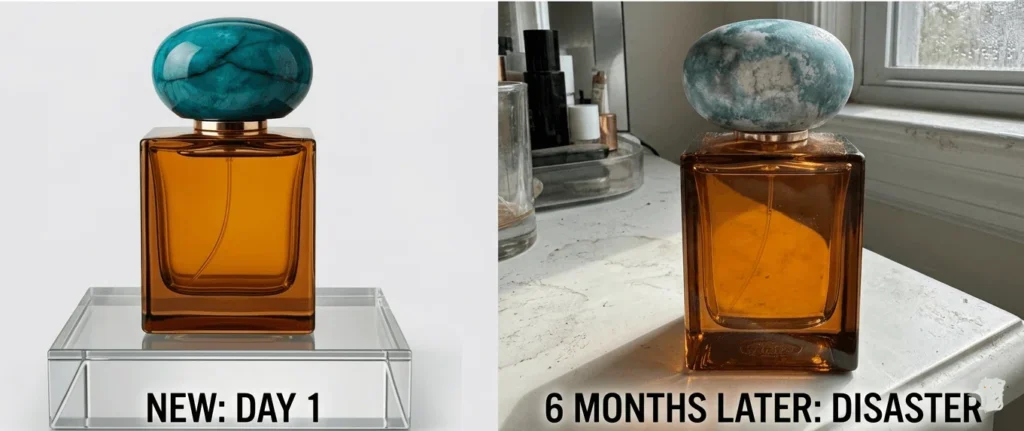
The cap will absolutely start to discolor and fade within 6 to 12 months!
- The once-rich colors will gradually fade away.
- The white base underneath will irreversibly bleed through.
- The surface will become mottled and uneven, looking like a cheap plastic toy.
When these products flow into the market and reach consumers, what they see is a faded, patchy cap.
The luxury image of your brand collapses in an instant, and the hundreds of thousands or millions you invested in marketing will go straight down the drain.
The Smart Decision Maker’s Choice: No Shortcuts to Quality
To save a tiny margin on material costs,
Gambling on a risk that guarantees fading and ruins your reputation is the most unprofitable deal you can make.
Our Commitment:
We strictly adhere to 100% pure, natural quarry mining. We never convince clients to choose dyed stone just to cater to low-price markets.
We would rather explain our price for a while than apologize for our quality for a lifetime.
FAQs on Dyed Marble Stone Cap Quality Control
A: There are two main reasons. First is cost: standard white marble or low-grade white stone is highly abundant, making the raw material cost exceptionally low. Second is the physical trait: the internal pore structure of white stone is relatively uniform, allowing chemical dyes to penetrate and color easily. However, this color achieved by chemical absorption is highly unstable in complex atmospheric environments.
A: Absolutely not. The fading of dyed caps is a chronic physical and chemical degradation process. When freshly processed at the factory, the surface looks flawless due to the temporary protection of polishing wax or topcoats. The fatal defect of an inadequate color-fixing process typically triggers only after the goods land overseas, endure humid sea freight, or face 6 to 12 months of exposure to air and UV rays at retail terminals.
A: The high-concentration, high-purity ethanol (alcohol) and various natural essential oils in perfume act as aggressive organic solvents. When consumers spray perfume, trace amounts from their fingers easily transfer to the cap. If the cap is artificially dyed, the alcohol rapidly dissolves the protective surface sealer, reacting directly with the internal dyes to cause rapid, localized whitening and blotchiness.
A: True luxury brands source raw stone blocks that possess natural coloration. Examples include genuine Red Jasper, Lapis Lazuli, Green Jade, or Malachite. While mining and processing these naturally colored minerals incur higher costs and present natural color variations, their colors were formed by internal metallic elements over millions of years. They never fade, which is the true source of your brand’s premium value.
A: An experienced procurement manager can perform a quick initial assessment using these three steps:
Check Vein & Color Distribution: In natural stone, the color transitions organically alongside the veins. In dyed stone, color heavily accumulates in cracks and recesses where the liquid dye naturally pools.
Alcohol Wipe Test: Firmly rub the inner hole or a hidden area with a high-concentration alcohol cotton ball. Substandard dyed caps will leave obvious color stains on the cotton.
Destructive Cross-Section Inspection: Cut a sample open. Natural stone displays identical color from the outer surface to the core. A dyed stone’s coloration is only a thin layer on the surface, while the center remains stark white.
