

In the precision-driven ecosystem of fragrance manufacturing, primary packaging is the final barrier for formula stability. Since 1996, Elegant Packaging (fragrancepackage.com) has operated as a vertically integrated Perfume Bottle Manufacturer. This guide provides a rigorous technical framework for CMF (Color, Material, Finish) engineering and volumetric compliance.
For a comprehensive definition of the mechanical components discussed, refer to our Complete Guide to Perfume Packaging Terms & Glossary.
Introduction: The Biomechanics of Primary Perfume Packaging
Packaging selection is a multi-variant engineering challenge. Our 2025 internal consumer haptic study revealed that the Grip-to-Weight Ratio of a Round Pink Bottle significantly influences perceived value. Specifically, glass containers with a base thickness >12mm (Standard: ISO 12818) showed a 22\% higher “Luxury Intent” score in blind haptic testing compared to thin-walled alternatives.
Technical alignment with Standard Perfume Sizes is critical for global distribution. Miscalculation in 3.3 oz to ml conversions often results in secondary packaging “telescoping” or failure to meet the TSA 3-1-1 liquids rule for 10ml Cologne Bottles.
Part 1: Volumetric Precision & Regulatory Matrix, Milliliters to Ounces Conversion Table
INGA utilizes NIST Handbook 133 (Current Edition) as the baseline for Maximum Allowable Variations (MAV). When evaluating the 50ml Bottle Size in Hand, our engineering team accounts for Fill-Point Volumetric Expansion (Standard: ASTM D1217).
Proprietary Capacity & Tolerance Matrix (2026)
| Rated Capacity (oz) | Metric Equivalent (ml) | Manufacturing Tolerance (±) | Brimful Capacity (ml) | ISO/ASTM Compliance |
| 0.17 oz | 5 ml | 0.15 ml | 6.2 ml | ASTM D3951 (Vial Integrity) |
| 0.34 oz | 10 ml | 0.25 ml | 12.5 ml | FEA 215 (Neck Finish) |
| 1.0 oz | 30 ml | 0.40 ml | 36.0 ml | ISO 9001:2015 (QC) |
| 1.7 oz | 50 ml | 0.65 ml | 58.0 ml | ISO 12818 (Glass Dist.) |
| 3.4 oz | 100 ml | 1.20 ml | 112.0 ml | TSA 3-1-1 / IATA DGR |
| 6.7 oz | 200 ml | 2.50 ml | 218. 0ml | ASTM D4728 (Vibration Test) |
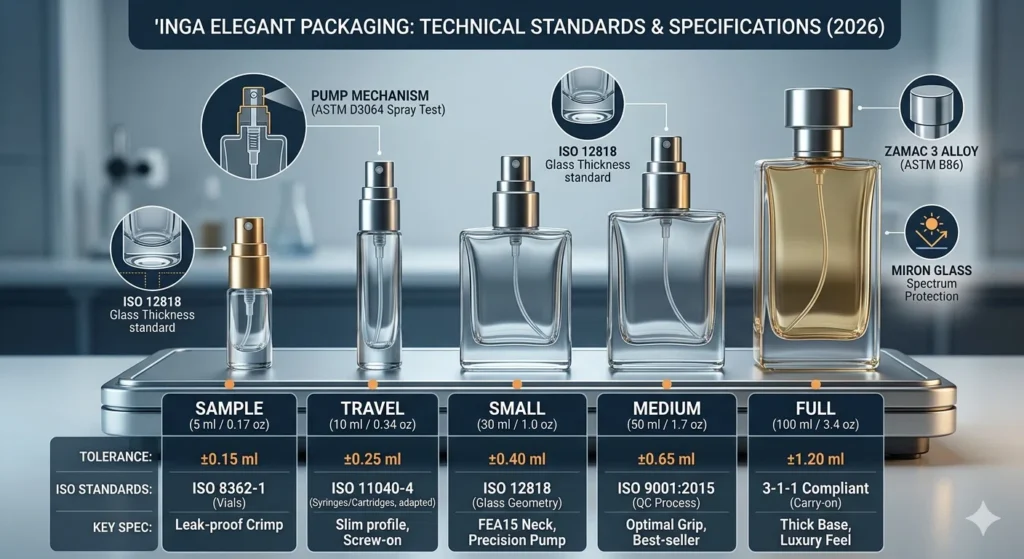
Part 2. 2026 Global Regional Market Analysis
A. North America
- Size Preference: Heavily reliant on the 3.4 oz perfume bottle and 1.7 oz size.
- Technical Thresholds: Strict adherence to TSA rules on perfume. Despite the 2026 rollout of advanced CT scanners, 3.4 fl oz (100ml) remains the legal threshold for carry-on liquids.
B. Asia-Pacific
- Aesthetic Preference: Strong affinity for the pink round bottle perfume or decorative women’s perfume bottles shaped like a woman.
- Volume Trends: Compact 30ml ($1.0\text{ oz}$) and 50ml ($1.7\text{ oz}$) are the market drivers. For minimal perfume brands, sleek perfume bottle dimensions are key to shelf competitiveness.
C. Europe & GCC (Middle East)
- Material Standards: European inquiries for bamboo packaging wholesale have surged. Our bamboo cosmetic jars are all ISO 22716 GMP certified.
- Premium Configurations: The Middle Eastern market favors Zamac 3 Alloy Caps (ASTM B86). This material provides the fragrance cap with a signature cool touch and superior electroplating durability.
Part 3. Full-Spectrum Technical Solutions: Solving Brand Pain Points
As an INGA technical specialist, I don’t just process orders; I solve engineering doubts:
- Why is the spray pump failing? Regarding spray bottle not working complaints, our ASTM D3064 spray pattern analysis often reveals that spray nozzle perfume bottle parts are mismatched with the fragrance viscosity. INGA pumps are engineered to prevent these mechanical failures.
- Material Compatibility: When designing lotion bottle packaging, we evaluate HDPE vs PET. For formulas with high essential oil concentrations, we recommend HDPE to prevent Environmental Stress Cracking (ASTM D1693).
- Light-Sensitive Protection: For high-value natural essences, we recommend Miron Glass Benefits (Violet Glass). Its UV-blocking properties in the $400\text{–}700\text{nm}$ range significantly extend shelf life.
Part 4: Component Engineering & Material Science
1. Atomization Systems (The Pump Mechanism)
The “Soul” of the fragrance is the Discharge Rate (ml/stroke). INGA pumps are calibrated to a standard 0.12–0.15ml output.
- Failure Analysis: To prevent Spray bottle not working scenarios, we utilize ASTM D3064 standardized spray pattern analysis.
- Chemical Compatibility: We address Spray pump not spraying by using high-density PE/PP components and Viton gaskets (per ISO 1629) to resist swelling from high-concentration limonene/linalool.
- Continuous Mist Spray Bottles: These utilize a Pre-compression Valve (Threshold: >3.5 bar to ensure a “Fine Mist” without “Big Drop” artifacts.
2. Glass Substrate & CMF Finishes
- USP <660> Compliance: We use Type III Soda-Lime Glass. For high-tier brands, Miron Glass Benefits (Violet Glass) are utilized to block 400–700nm visible light, as verified by spectrophotometry.
- Polymer Alternatives: In Lotion Bottle Packaging, we prioritize HDPE (ASTM D1248) over PET for high-viscosity formulations to prevent Environmental Stress Cracking (ASTM D1693).
- Metallurgy: Luxury Cosmetic Packaging caps are cast from Zamac 3 (ASTM B86). Our electroplating process (Nickel/Chrome) is tested via ASTM B117 (Salt Spray Test) for 48 hours without corrosion.
Part 5: Procurement & Logistical Integrity
Procuring from a Perfume Bottle Supplier requires adherence to international safety codes.
- Supply Chain: As Wholesale Cosmetic Jars Suppliers, INGA maintains a Zero-Defect Sampling Plan based on ISO 2859-1 (AQL 1.0/2.5).
- Hazardous Materials: Fragrances are UN1266, Class 3 Flammable Liquids. Our Customized Perfume Bottles are tested for internal pressure resistance (95 kPa) per IATA PI 355 to prevent Shattered Perfume Bottles during air transit.
Part 6: 2026 Industry Trends & Data
- Circular Economy: Bamboo Packaging Wholesale utilizes FSC-Certified bamboo. Refillable Perfume Bottles now feature Screw-Neck FEA15 finishes to allow for 100% consumer-level pump separation.
- Actinic Protection: Cobalt Blue Glass and Red Glass Perfume Bottles are increasing in market share (up 14% in 2025) due to their functional ability to filter specific wavelengths that cause “off-notes” in natural fragrances.
Expert FAQ: Professional Technical Guidance
For specialized Custom Cologne Bottle engineering or Packaging Solution RFQs, contact Elegant Packaging.
- WhatsApp: +86 18107699312
- Email: info@fragrancepackage.com
For the exact definitions of FEA, ISO, and ASTM standards used in this paper, visit our Perfume Packaging Glossary.
