

How to Tell if a Perfume Box is Real: 7 Red Flags to Watch For
I. Introduction
The allure of a new fragrance is undeniable, but in today’s vast online marketplace, the excitement can quickly turn to anxiety. With the rise of third-party sellers and tempting discount sites, purchasing perfume carries an inherent risk of encountering counterfeits. Before you even get to the bottle, the packaging (the box itself) serves as your primary line of defense against fake fragrances. This article aims to equip you with a detailed checklist, guiding you through the critical details of outer packaging, printing, and subtle nuances that differentiate an authentic perfume from a cleverly disguised imitation.
II. 5 Key Characteristics of a Legit Perfume Box
Genuine perfume packaging is a testament to a brand’s commitment to quality and detail. Counterfeiters often cut corners here, revealing their fraud.
1. Cellophane Wrapping (The Outer Skin)
The cellophane is the first physical barrier you interact with.
- Authentic: Expect a tight, flat, and impeccably sealed cellophane wrap. The seams, particularly where the cellophane overlaps, should be perfectly aligned and often feature a sophisticated, glue-free heat-sealed finish. There should be no loose areas or excess material.
- Fake: Counterfeit cellophane often appears loose, baggy, or crinkled. You might notice trapped air bubbles, visible glue residue, or uneven, clumsy folds and seams.

2. Cardboard Quality & Structure (The Foundation)
The box’s material and internal design are crucial indicators.
- Authentic: Genuine boxes are made from high-quality, dense cardboard that feels substantial and sturdy in your hand. The interior often features a precisely designed cardboard insert or tray to securely hold and protect the perfume bottle from movement and damage during transit. The inner lining should also be clean, often white or a specific brand color, not grey or raw cardboard.
- Fake: Counterfeit boxes often use flimsy, thin, and cheap-feeling cardboard. They might lack a proper protective insert, or the insert might be poorly constructed, allowing the bottle to rattle inside. The inner cardboard color might be a generic grey or inconsistent.
3. Printing Precision (The Visual Story)
High-end brands invest heavily in their visual identity.
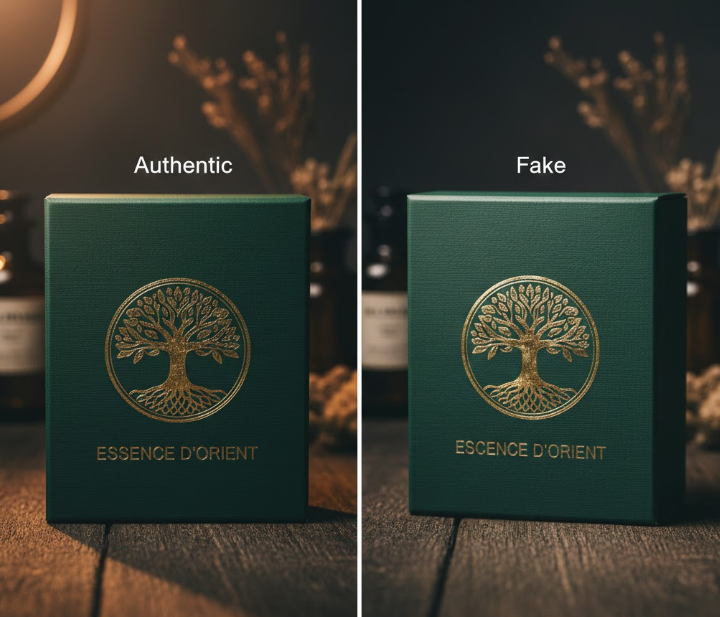
- Authentic: Inspect the logo, brand name, and all text for impeccable clarity and consistency. There should be no blurred edges, smudges, or pixelation. Luxury brands frequently employ sophisticated printing techniques like embossing (raised text/logo) or debossing (indented text/logo), which should be sharp and tactile.
- Fake: Counterfeit printing often shows blurry text, inconsistent font sizes, incorrect spacing, or misspelled words. Any embossed or debossed elements, if present, might be shallow, uneven, or poorly defined. The colors might also appear off-shade compared to official product images.

4. Batch Code (The Product’s DNA)
This is a non-negotiable authenticity marker.
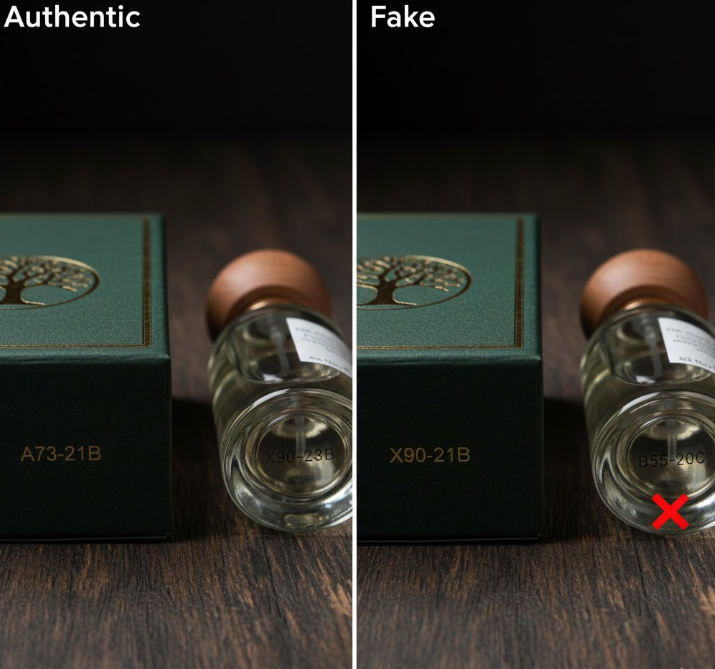
- Crucial Point: Every legitimate perfume box has a batch code (or production code) printed or debossed on its bottom. This code is a unique identifier for the production batch. The EXACT SAME BATCH CODE MUST BE PRESENT ON THE PERFUME BOTTLE ITSELF, usually on the bottom. It should be consistent in font, size, and placement on both the box and the bottle.
- Fake: Counterfeits might have no batch code at all, an easily rub-off code, or, most commonly, a batch code on the box that does not match the one on the bottle. This is a definitive sign of a fake.
5. Barcodes & Regulatory Symbols (The Legal Fingerprint)
These small details signify adherence to international standards.
- Authentic: Genuine perfume boxes will feature a clearly printed barcode (typically EAN-13), usually on the bottom or side. Alongside this, you’ll find various regulatory symbols such as the recycling logo (e.g., Mobius loop), the flame symbol (flammable product), the open jar symbol (PAO – Period After Opening), and the “e” symbol (estimated quantity). These should be crisp, correctly positioned, and proportional.
- Fake: Counterfeits might have blurry or skewed barcodes, missing essential regulatory symbols, or symbols that are incorrectly drawn, disproportionate, or in the wrong location.
III. Red Flags to Watch For: Common Counterfeit Flaws
Beyond the core characteristics, be vigilant for these common slip-ups by counterfeiters.
1. Missing Legal Information
Authentic perfume boxes are legally required to display comprehensive information, including:
- An ingredient list (INCI list).
- The country of origin (Made in France/USA, etc.).
- The manufacturer’s name and address.
- Often, a warning about allergens or flammable content. Fake boxes frequently omit some or all of this crucial regulatory text, or the information provided might be sparse, incorrect, or poorly translated.
2. Color Discrepancies
Authentic packaging adheres strictly to brand guidelines, resulting in consistent, high-quality colors. Fake packaging often shows significant color deviations—the box might be too dark, too light, or have a noticeably different shade compared to official product images on the brand’s website. These inconsistencies are often due to using cheaper inks and printing processes.
3. Chemical Odor
Authentic perfume boxes should have no discernible strong odor, or perhaps a faint, clean scent of paper and ink. Fake boxes can sometimes emit a strong, unpleasant chemical smell, often indicative of cheap glues, low-quality cardboard, or inferior inks used in their production. This odor is distinct from the fragrance itself and is a clear warning sign.
IV. Digital Verification Tools: Leveraging Technology
In the age of information, technology can be your ally in verifying authenticity.
1. Batch Code Lookup Websites
These online tools provide a quick cross-reference:
- CheckFresh.com or CheckCosmetic.net are popular platforms where you can input the batch code from your perfume box and bottle. These sites can often tell you the approximate manufacturing date of the product. While not foolproof (as codes can be replicated), it’s a good first step to ensure the code is at least recognized. If the code yields no results or indicates a vastly different product, be suspicious.
2. QR Code Scanning
- While QR codes can be easily faked to redirect to a legitimate-looking but fraudulent website, scanning them with the brand’s official app (if available) can offer a layer of verification. Always use the brand’s direct app for this, not a generic scanner. If the QR code leads to a suspicious website or doesn’t work, it’s a red flag.
V. Where You Buy Matters: Trust Levels of Purchase Channels
Your choice of retailer significantly impacts your risk of receiving a counterfeit.
1. Tier 1 Trust (Lowest Risk)
- Brand’s Official Website: Always the safest bet. You are buying directly from the source.
- Authorized Department Stores & Boutiques: Retailers like Sephora, Macy’s, Nordstrom, Harrods, or the brand’s own physical boutiques are highly reliable. They source directly from the brand.
2. Tier 2 Trust (Moderate Risk, but Reputable)
- Well-Known Discount Fragrance Websites: Sites like FragranceNet.com, FragranceX.com, or Notino are generally considered legitimate and sell authentic products. They acquire stock through various channels, allowing them to offer discounts. While highly reputable, always check their return policies and customer reviews.
3. Tier 3 Risk (Highest Risk)
- eBay, Amazon Third-Party Sellers, Facebook Marketplace, etc.: These platforms are notorious for counterfeit products. While some legitimate sellers exist, the risk of receiving a fake is significantly higher. Exercise extreme caution and scrutinize seller reviews and return policies.
- Social Media “Private Decants” or “Personal Sellers”: Unverified individuals selling decants (small portions) or full bottles, often claiming “personal collections,” carry substantial risk. Their sourcing is opaque, and authenticity is difficult to prove.
VI. Expert FAQ: Addressing Common Concerns
Q1: Does a perfume without cellophane wrapping always mean it’s fake?
A: Not necessarily. While most perfumes come cellophane-wrapped, certain niche or artisan brands, or specific luxury collections (e.g., some Creed or Tom Ford Private Blend series), may intentionally forgo cellophane as part of their packaging aesthetic or for sustainability reasons. Always research the specific brand and product line to confirm their standard packaging practices.
Q2: My perfume box looks different from the old one; is it fake or just a redesign?
A: Brands periodically update their packaging as part of a redesign or refresh cycle. This is known as a “Packaging Update.” If you notice differences, first check the brand’s official website or social media channels for announcements regarding recent packaging changes. A legitimate redesign will be uniform across new stock, while a fake will likely have inconsistent flaws.
Q3: Why does the packaging look authentic, but the scent seems wrong?
A: This is a concerning scenario that points to a more sophisticated type of fraud: the “re-bottling” or “refilling” scam. Counterfeiters might acquire empty genuine bottles and boxes (sometimes from discarded luxury items) and fill them with fake or diluted perfume. In this case, the box (and even the bottle) might appear legitimate, but the liquid inside is not. This highlights why a comprehensive check, extending beyond the packaging to the scent itself, is crucial.
VII. Conclusion
The journey to authentic fragrance begins with a critical eye on the packaging. While the box is your primary screening tool, it’s essential to integrate this knowledge with a holistic assessment of the bottle, sprayer, and, ultimately, the fragrance itself. Always prioritize purchasing from authorized retailers and official brand channels to minimize your risk. Don’t let the allure of a deep discount lead you to a counterfeit disappointment. Your senses—and your wallet—deserve genuine luxury.
