
Title: From Shortcuts to Dead Ends: A Supply Chain Retrospective for Startup Perfume Brands
Category: Supply Chain Management / Perfume Packaging Insights
Reading Time: 12 Minutes
I. Introduction: The Mirage vs. The Reality
There is an old saying in the perfume packaging manufacturing world: “Amateurs talk about price. Professionals talk about quality. Masters talk about stability.”
For every startup fragrance founder, the initial phase is a battle against the “Impossible Triangle”: Low Price, High Quality, and Low MOQ (Minimum Order Quantity). You want niche-market luxury with mass-market economics.
Many founders, driven by passion but limited by budget, try to “hack” this triangle. They search for the supplier who says “Yes” to everything—the one who promises 500 custom bottles at rock-bottom prices. They believe they have found a shortcut.
This article is a warning. Based on the collective experiences of brands we have rescued, we will dissect the hidden costs of taking the “easy path” and why, in the world of complex chemical packaging, pragmatism is the only true shortcut.
II. The Story: Sarah’s “Perfect” Deal
Let’s introduce Sarah, the founder of a fictional rising brand, “Lumina Scent.” Sarah had an exquisite nose for fragrance but a limited budget.
The Setup:
Sarah approached top-tier manufacturers but was turned away. “MOQ is 20,000 pieces,” they said. “We need technical drawings,” they insisted.
Frustrated, she found “Global Fast Pack” online. They were a trading company with no factory, but their sales rep was charming.
- The Promise: “500 pieces MOQ? No problem. Custom color? Sure. We can consolidate bottles, caps, and pumps in one shipment. Cheapest price on the market.”
Sarah signed the contract, believing she had outsmarted the industry. Three months later, the dream began to crumble.
III. The 5 Stages of Perfume Packaging Supply Chain Failure
The collapse of a perfume brand due to packaging rarely happens all at once. It happens in five agonizing stages.
Stage A: The Production Crisis — Trust Evaporates
The Event: Lumina Scent planned a Christmas launch. October came, and there was no shipping notification.
The Reality Check:
- The Consolidation Trap: “Global Fast Pack” didn’t own a single machine. They were waiting for other small orders to pile up so they could beg a factory to run a “consolidation batch.”
- No QC/QA Process: There was no Pre-production Sample (PPS) confirmation. The trader simply forwarded a generic photo.
- Ghosting: When Sarah asked for updates, the rep stopped replying. Excuses shifted from “Customs inspection” to “Raw material shortage.”
- The Mold Trap: Sarah paid $2,000 for a “custom mold,” but she had no idea where it was located. When she tried to switch suppliers, she realized she didn’t own the mold—the trader did.
Stage B: Quality & Safety — The Core Destruction
The Event: The goods finally arrived in January (missing the Christmas launch). Sarah opened the first box, and the smell of leaked alcohol hit her.
Technical Analysis of Failure:
| Defect Type | The “Shortcut” Result | Professional Standard |
| Chemical Compatibility | Dissolved Glue: The alcohol and Essential Oils attacked the glue in the pump tube, turning the perfume cloudy. Stress Cracking: The ABS plastic inner cap cracked after contact with perfume vapor. | Material Selection: Use PP (Polypropylene) or Surlyn for inner parts. Testing: Mandatory 24-hour immersion & oven tests. |
| Functional Defects | High Priming Count: Customers had to press 10+ times to get the first spray. Jetting: The spray came out as a water column, not a mist. | Pump Specs: Controlled output (e.g., 0.12ml/t). Consistent Spray Angle (45°-60°). |
| Seal Integrity | Leakage: 30% of bottles leaked during transit due to poor Torque Control between the pump and bottle neck. | Vacuum Leak Test: Withstanding -0.06MPa pressure for 5 minutes without leakage. |
| Safety & Compliance | Coating Failure: The gold spray paint peeled off when wiped with alcohol (failed Cross-cut Test). Heavy Metals: Cheap electroplating contained lead, failing REACH/FDA standards. | Certified Safety: ISO-certified plating processes ensuring regulatory compliance. |
Stage C: The High Cost of Low Price
Sarah thought she saved $0.50 per unit. Here is the actual math of her loss:
- Full Inspection Cost: With a 40% defect rate, she had to hire a third-party team to open every single box and check every bottle.
- Sunk Costs: 1,000 customized caps were useless because they didn’t fit the bottles (tolerance mismatch).
- Logistics Nightmare: Returning the defective goods to the trader costs 3x the product value in shipping and duties.
Reference: According to the Harvard Business Review, the “Cost of Poor Quality” (COPQ) in manufacturing can range from 15% to 40% of sales revenue [2].
Stage D: Brand Reputation — The Long-Term Damage
The few bottles that were shipped out triggered a disaster.
- Influencer Backlash: A TikTok influencer posted a video of the Lumina Scent cap falling off and the bottle leaking in her purse.
- Negative Reviews: “Smells like glue,” “Cheap plastic,” “Do not buy.”
- Result: Brand positioning collapsed. A luxury price point cannot survive “dollar store” quality.
Stage E: Operational & Legal Risks
When Sarah tried to sue, she found “Global Fast Pack” was registered in an offshore jurisdiction with no assets.
- IP Theft: Two months later, Sarah saw her “exclusive” bottle design being sold on Alibaba to another brand.
- Compliance Fine: Authorities flagged the packaging for lacking MSDS (Material Safety Data Sheet) documentation for the coating materials.
IV. The Pragmatic Path: How to Avoid the Trap
Pragmatism means accepting that quality has a baseline cost and process.
1. Why “High Barrier” Suppliers Are Better
If a supplier asks you for technical drawings, insists on a reasonable MOQ, and demands a signed approval process, keep them. They are not trying to be difficult; they are trying to protect you from the risks mentioned above.
2. The Startup Due Diligence Checklist
Before you wire the deposit, run this audit:
- Certifications: Do they hold ISO 9001 (Quality Management) or ISO 22716 (Cosmetic GMP)?
- Transparency: Can they provide a sample IQC (Incoming Quality Control) and OQC (Outgoing Quality Control) report from a previous shipment?
- Testing Capabilities:
- [ ] Vacuum Leak Test: Do they test negative pressure?
- [ ] Pull Force Test: Is the pump and cap assembly secure?
- [ ] Compatibility Test: Do they have an oven lab to simulate aging?
- Site Visit: Even via video call, ask to see their QC Room and Mold Storage Area. A tidy 5S environment indicates a disciplined factory.
V. Top 10 FAQs for New Perfume Brands
Q1: Why do professional factories insist on an MOQ of 20,000 pieces?
A: It’s about Machine Setup Costs. Calibrating a glass furnace or an injection mold takes hours and wastes material. Small runs result in huge waste percentages that factories cannot absorb without charging exorbitant prices.
Q2: I have a limited budget. How can I work with a top-tier factory?
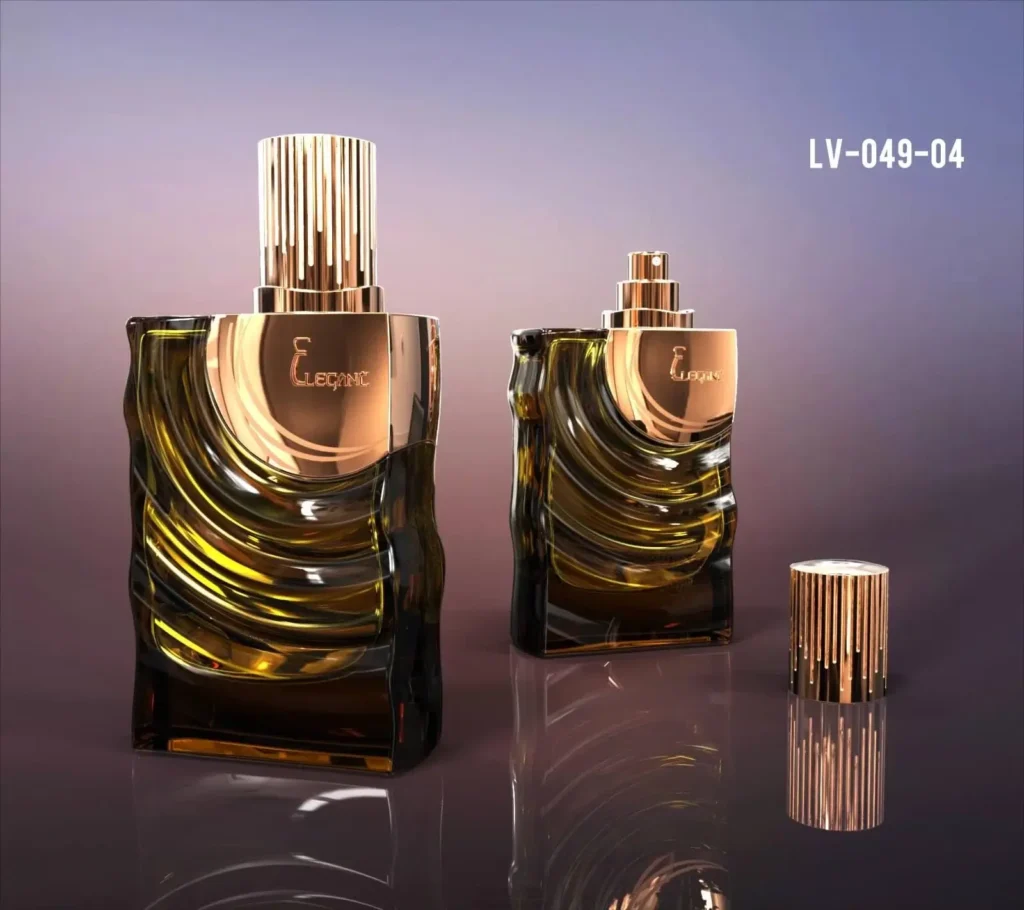
A: Don’t open a new mold. Choose a “Public Mold” (Stock Item) from their catalog. Focus your budget on high-end surface finishing (polishing, spraying) and a heavy Zamac cap or resin & wood perfume lid with low MOQ to elevate the look.
Q3: What is a “Golden Sample” and why do I need it?
A: A Golden Sample is the signed, sealed standard for mass production. It is the legal benchmark. If the final product doesn’t match the Golden Sample, you have grounds for a refund. Never start production without one.
Q4: Can I skip the Compatibility Test to save time?
A: Absolutely not. Stress Cracking is latent—it might happen 15 days after filling. Only a lab test (oven aging) can predict this. Skipping this is gambling with your brand.
Q5: Are all trading companies bad?
A: No. But you must choose a “Service-Oriented” Trader with technical engineers and fixed factory partners, not a “middleman” who just forwards emails. Ask to see their office and lab.
Q6: How do I determine the Pump Dip Tube length?
A: It depends on the bottle’s “dead corner.” We recommend a V-cut or Arc-cut tube that touches the bottom corner to ensure the “Usage Rate” (evacuation rate) is above 98%.
Q7: Who pays for breakage during transport?
A: This depends on your Incoterms. If you buy EXW (Ex-Works), you are responsible once it leaves the factory. We recommend FOB or DDP, and insist on Egg Crate or Palletized packaging to minimize breakage.
Q8: How do I handle quality disputes?
A: Your contract must specify an AQL (Acceptable Quality Limit) standard (usually ISO 2859-1) [1]. If defects exceed the agreed AQL (e.g., Major 1.0, Minor 2.5), the supplier must rework or replace the goods.
Q9: How do I prevent my design from being copied?
A: Sign an NNN Agreement (Non-Disclosure, Non-Use, Non-Circumvention) before sharing files. Ensure the contract states that you own the molds once paid for.
Q10: What are the hidden traps in a quotation?
A: Watch out for quotes that exclude Packaging Fees (cartons/pallets), Taxes, or use inferior materials (e.g., Recycled glass instead of High White glass) to artificially lower the price.
VI. Conclusion: Build for the Future to Create Your Own Perfume Brands
Sarah’s story is a tragedy, but it doesn’t have to be yours.
At Inga Elegant Packaging Company, we have seen too many dreams shattered by “shortcuts”,then seeked or been recommended to our team to upgrade their perfume packaging, and the brand owners who finally set off again and achieved success. We believe that steady, reliable, and compliant supply chains are the only foundation upon which a luxury brand can stand.
We might ask you for detailed drawings, insist on rigorous testing, and not be the cheapest on the market. But when your perfume lands in your customer’s hands, it will be perfect.
Ready to build a brand that lasts? Contact our engineering team today for a consultation. My factory also has 10 kinds of stocks classic bottle shapes for your option, supporting you to launch your own perfume brands.
References
- [1] ISO 2859-1:1999 – Sampling procedures for inspection by attributes (AQL Standards).
- [2] “The High Cost of Poor Quality (COPQ) in Manufacturing,” Harvard Business Review.
- [3] Regulation (EC) No 1223/2009 of the European Parliament on cosmetic products (Safety & Compliance).
