

In the fragrance world, the bottle is the “silent salesman.” While the juice captures the nose, the vessel captures the soul. For high-end brands, the transition from raw glass to a masterpiece involves sophisticated Post-Processing and a rigorous Quality Management System (QMS).
I. Advanced Post-Processing Techniques: From Raw to Radiant
Post-processing is where engineering meets art. It defines the tactile and visual identity of a brand.
1. Surface Coating & Texture
| Technique | Description | Industry Application |
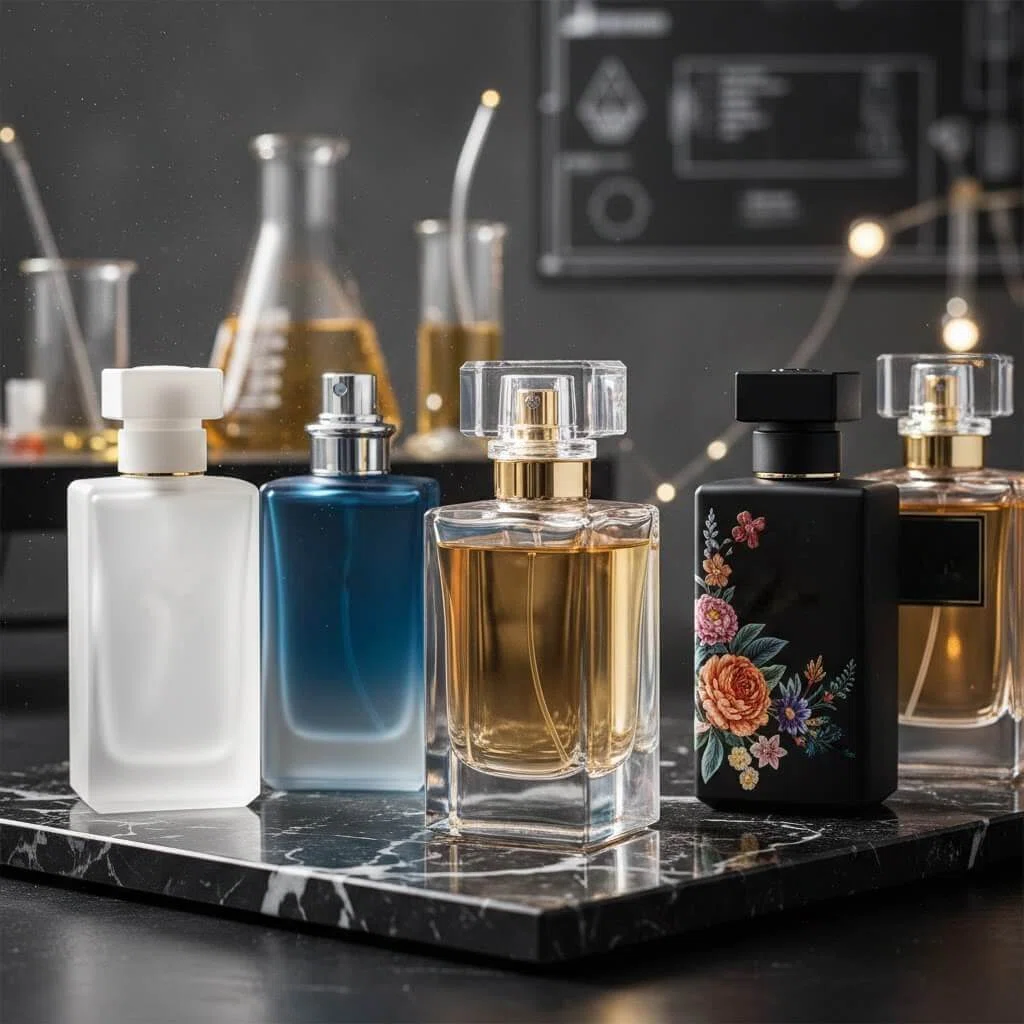
| Spraying (Automated) | Application of water-based or organic paints. Can be opaque, translucent, or gradient. | Used for “Thematic” collections (e.g., Dior Sauvage). |
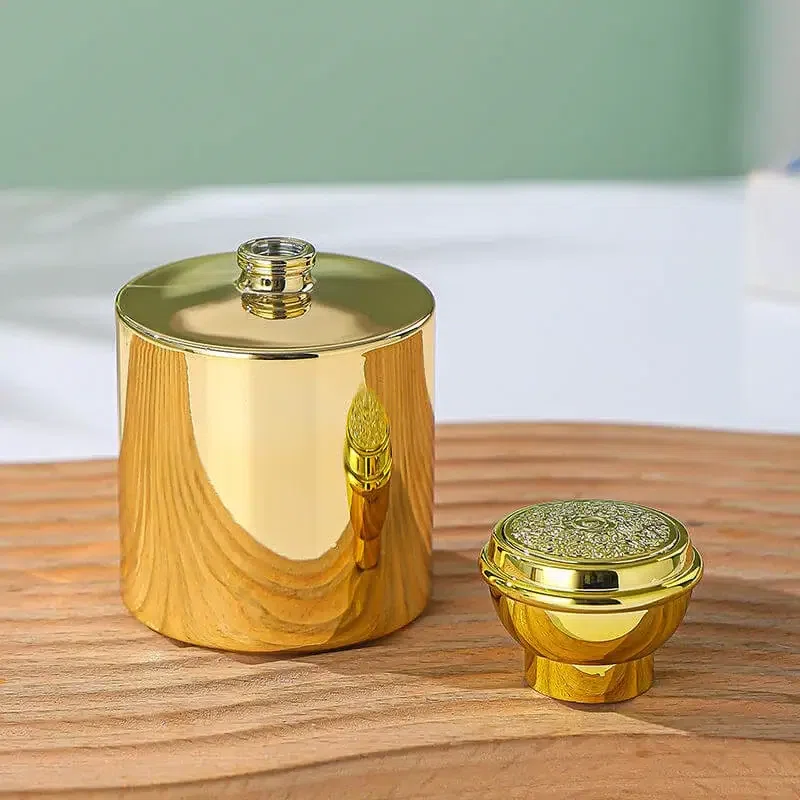
| PVD / Electroplating | Physical Vapor Deposition (PVD) creates a thin metallic film (Gold, Silver, Chrome). | High-end luxury “Gold” editions. |
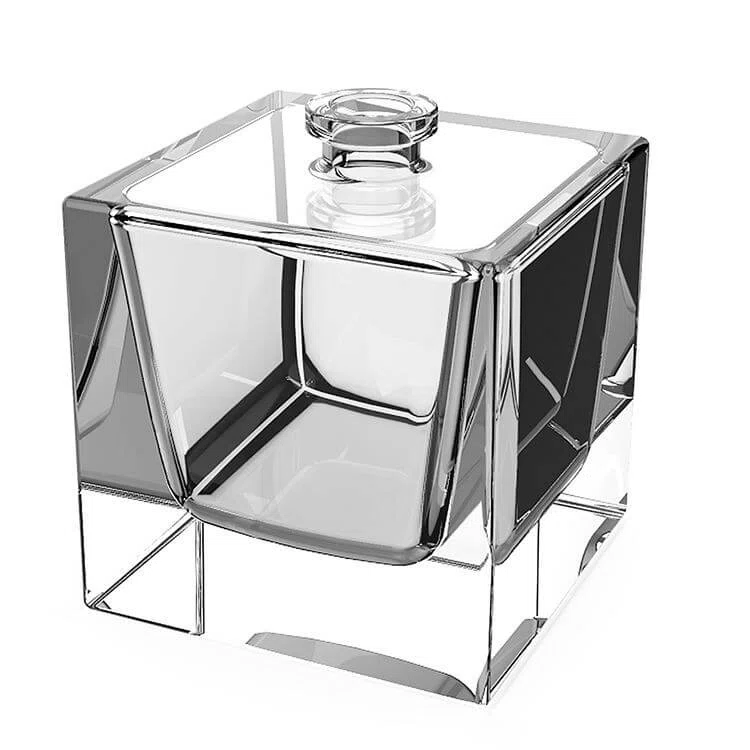
| Internal Lacquering | Coating the inside of the bottle, keeping the outside glass smooth. | Provides a unique “depth” and liquid-like glow. |
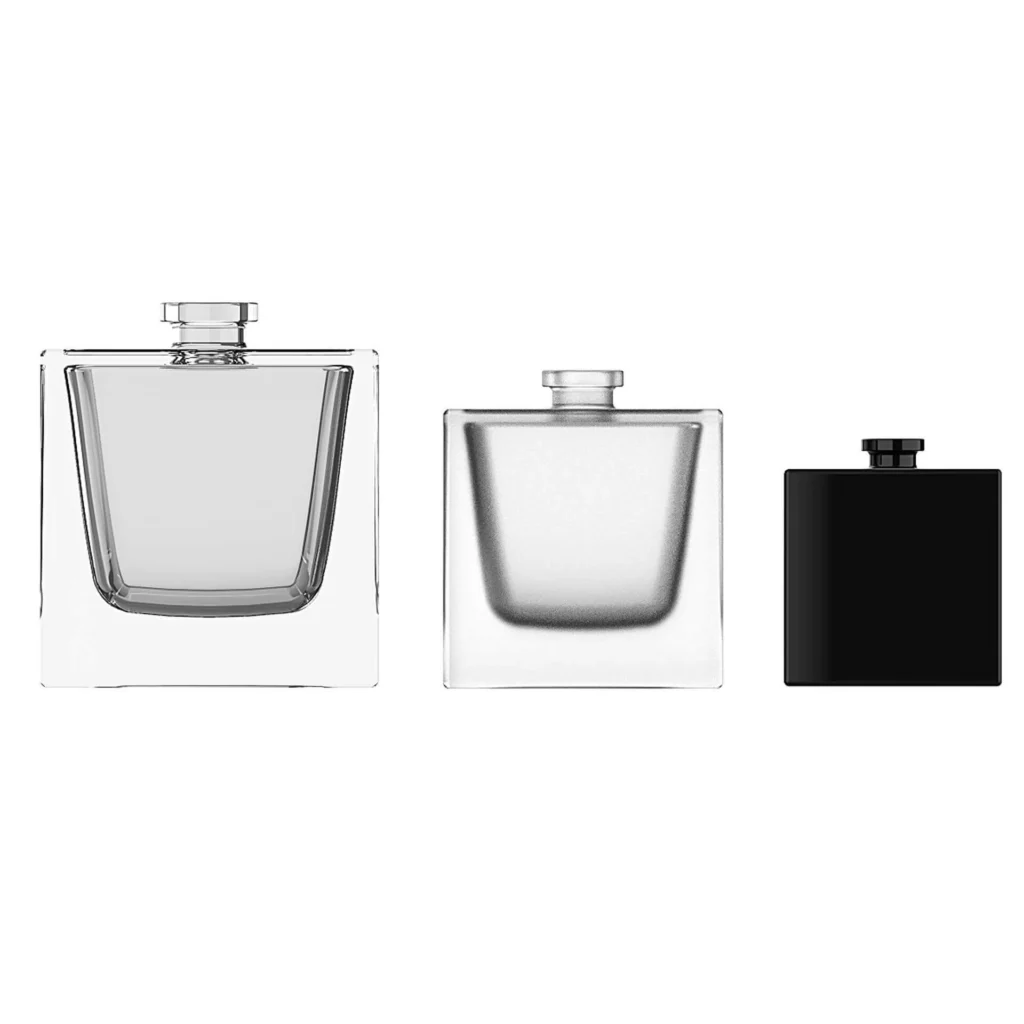
| Fire Polishing | Passing the bottle through a flame to melt surface micro-imperfections. | Standard for “Extra Flint” (Ultra-clear) glass. |
2. Decorative Branding
- Silk Screen Printing: Utilizes high-temperature inks ($500^{\circ}C-600^{\circ}C$) that fuse with the glass. It is virtually unscratchable.
- Hot Stamping: A dry printing method where a metallic foil is transferred via heat and pressure. It offers a level of “shine” that ink cannot match.
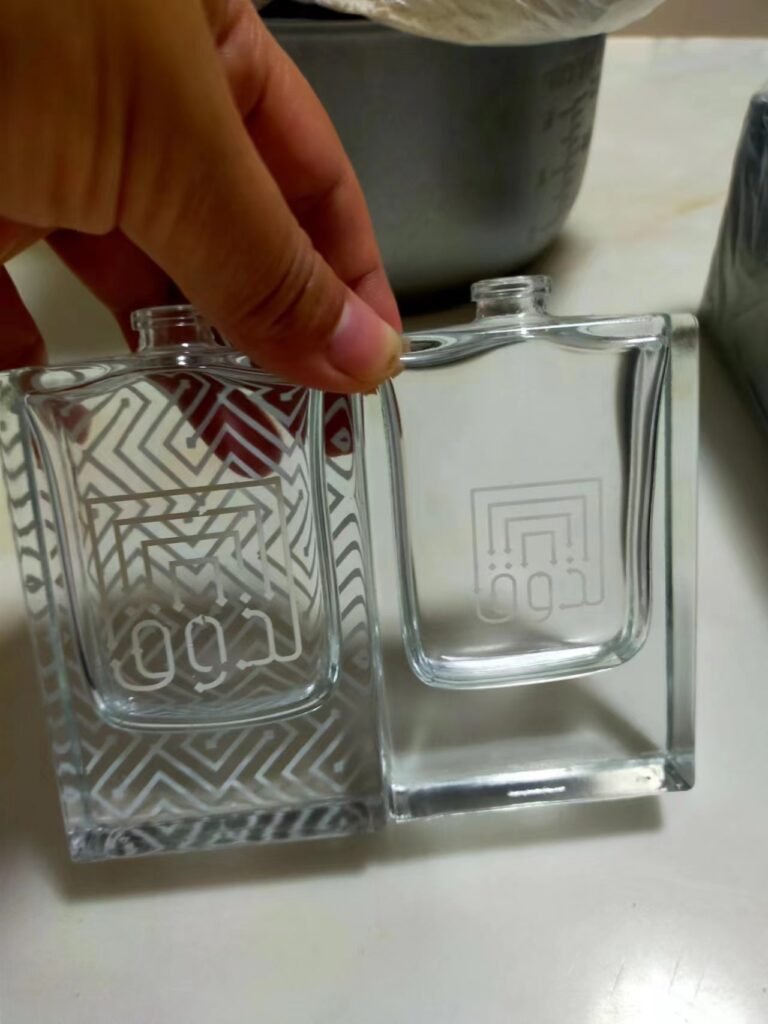
- Acid Etching: A chemical process that creates a permanent “frosted” look, much smoother to the touch than frosted spraying.
II. Quality Inspection Standards: The Science of Perfection
Luxury brands typically follow ISO 2859-1 for sampling, but the defect definitions are customized to the “Fragrance Grade.”
1. Visual Defect Classification (Table of Severity)
| Defect Category | Description | Tolerance (Luxury) |
| Critical | Sharp glass edges, cracks, or leakage risks. | 0% (Zero Tolerance) |
| Major (Functional) | Blocked neck, loose pump fit, significant color deviation ($\Delta E > 2.0$). | < 0.65 AQL |
| Minor (Cosmetic) | Tiny seeds/bubbles (<0.2mm), slight scuffs, internal dust. | < 1.5 AQL |
2. Dimensional & Physical Metrics
- Verticality (Tilt): Most high-speed filling lines require a verticality deviation of less than 0.5mm to 1.0mm.
- Annealing Stress: Measured via a Polarizer. Glass must be free of internal stress to prevent “spontaneous breakage” during the 24-hour fragrance maceration or shipping.
- Weight-to-Volume Ratio: A “Heavy Bottom” design is a hallmark of luxury, often requiring a glass-to-fragrance weight ratio of 2:1.
3. Reliability & Compatibility (The “Stress Tests”)
- Adhesion (ASTM D3359): The “Cross-hatch” test. A grid is cut into the coating; 3M tape is applied and ripped off. A score of 4B or 5B is required.
- The Fragrance Immersion Test: The bottle is submerged in its own fragrance oil for 24–48 hours at $45^{\circ}C$. The coating must not peel, swell, or discolor.
III. Industry FAQ: Glass Fragrance Bottle Manufacturing & Quality
Category I: Perfume Glass Bottle Manufacturing & Decoration Techniques
Q1: Why is “Fire Polishing” mandatory for high-end perfume bottles?
A: Fire polishing effectively melts and smooths the parting lines left by the mold, ensuring the bottle surface is seamless, ultra-clear, and possesses a high-gloss finish characteristic of luxury products.
Q2: What is the biggest challenge in “Gradient Spraying” glass fragrance bottles?
A: The most difficult aspect is controlling the overspray transition zone—ensuring the color fade is natural and maintaining strict consistency across mass-production batches.
Q3: What exactly is “Eco-friendly Water-based” coating?
A: Unlike traditional solvent-based paints, water-based coatings have significantly lower VOC (Volatile Organic Compound) emissions. This aligns with global ESG (Environmental, Social, and Governance) standards and market entry requirements in the EU and North America.
Q4: Why do electroplated or PVD glass bottles layers sometimes peel off?
A: This is typically due to poor adhesion of the primer or insufficient cleaning of the glass surface (leaving oil or dust residues) before the vacuum deposition process.
Q5: How do I choose between High-Temperature and Low-Temperature Silk Screen Printing perfume glass bottle ?
A: High-temperature inks are fired at $500^{\circ}C+$, fusing with the glass for extreme scratch resistance. Low-temperature inks offer a wider, more vibrant color gamut, making them ideal for complex brand palettes.
Q6: What is the “Internal Lacquering” process?
A: It involves coating the interior walls of the bottle. This preserves the cold, smooth touch of raw glass on the outside while creating a unique visual depth and a “liquid-gem” aesthetic.
Category II: Perfume Glass Bottle Quality Control & Testing Standards
Q7: What is the industry standard for “bubbles” in glass?
A: In the luxury segment, bubbles $>0.5\text{mm}$ are usually zero-tolerance. “Seeds” (tiny bubbles between $0.1-0.3\text{mm}$) are strictly limited to a maximum of 2 units in non-critical viewing zones.
Q8: Why is the “Fragrance Immersion Test” critical?
A: Fragrances contain varying ratios of essential oils and alcohol. Certain chemical compounds can act as solvents that may dissolve or blister specific surface coatings if they aren’t chemically compatible.
Q9: How does “Neck Flash” (burrs) affect the final product?
A: Flash or uneven glass at the neck prevents the pump gasket from seating correctly. This leads to leakage, evaporation of the scent, and oxidation of the fragrance.
Q10: What grade is considered a “Pass” in the Cross-hatch (Adhesion) test?
A: According to international standards (like ASTM D3359), a grade of 4B or 5B (Grade 0-1) is required, meaning the edges of the cuts are completely smooth or show only minimal flaking at intersections.
Q11: How do you detect “Annealing Stress” in glass?
A: By using a Polarizer (Stress Viewer). Excessive internal stress (poor annealing) is a major defect that can cause the bottle to spontaneously shatter during filling, transit, or shelf life.
Q12: What is the difference between “Nominal Capacity” and “Brimful Capacity”?
A: Nominal Capacity is the labeled volume (e.g., 50ml). Brimful Capacity is the total volume to the top of the neck; enough “headspace” must be left to account for the pump displacement and liquid expansion/contraction.
Q13: Why do dark-coated bottles have higher reject rates?
A: Dark, opaque finishes (especially high-gloss black) act like a mirror, magnifying even the smallest dust spots or micro-scratches. This typically results in a $20\%-30\%$ higher scrap rate compared to clear glass.
Category III: Perfume Glass Bottles Industry Pain Points & Trends
Q14: Why does some glass look blue or green?
A: This is caused by iron oxide impurities in the silica sand. High-end bottles use decolorizing agents (such as Selenium or Cobalt) or high-purity quartz sand to achieve “Extra Flint” or “Crystal” clarity.
Q15: Are decorated glass bottles 100% recyclable?
A: While glass is infinitely recyclable, heavy metallic electroplating or thick organic coatings complicate the sorting and melting process. Moving toward water-soluble inks and PCR glass is the current industry trend.
Q16: What is PCR Glass?
A: Post-Consumer Recycled glass. Utilizing PCR reduces energy consumption and carbon footprints, though a higher PCR percentage can slightly darken the glass or introduce minor inclusions.
Q17: Why are “Heavy Bottom” (thick base) perfume bottles popular?
A: A thick base provides a sense of “heft” and luxury. Achieving this requires specialized Press-and-Blow or semi-automatic molding processes to ensure the glass distribution is aesthetically centered.
Q18: How do you prevent metal pump components from oxidizing?
A: This is achieved through high-quality Anodic Oxidation with proper sealing of the pores. Additionally, the fragrance formulation must maintain a stable pH to avoid reacting with the metal.
Q19: What are “Hot-End” and “Cold-End” coatings perfume bottles ?
A: These are chemical vapors (like Tin or Polyethylene) applied during production to increase surface lubricity and hardness, preventing bottles from scratching each other on high-speed conveyor lines.
Q20: Why are luxury perfume brands moving toward “Lightweighting”?
A: It is driven by Sustainability. Reducing glass weight lowers the carbon footprint during manufacturing and global shipping, satisfying modern consumer demand for eco-conscious luxury.
References & Standards
- ISO 12818: Glass packaging — Standard tolerances for flacons.
- ASTM D3359: Standard Test Methods for Rating Adhesion by Tape Test.
- FEVE (European Glass Container Federation): Guidelines for Flaconnage.
Start a Strategic Conversation to Upgrade or Launch Your New Perfume Cosmetics Brand?
- WhatsApp: +86 18107699312
- Email: info@fragrancepackage.com
