

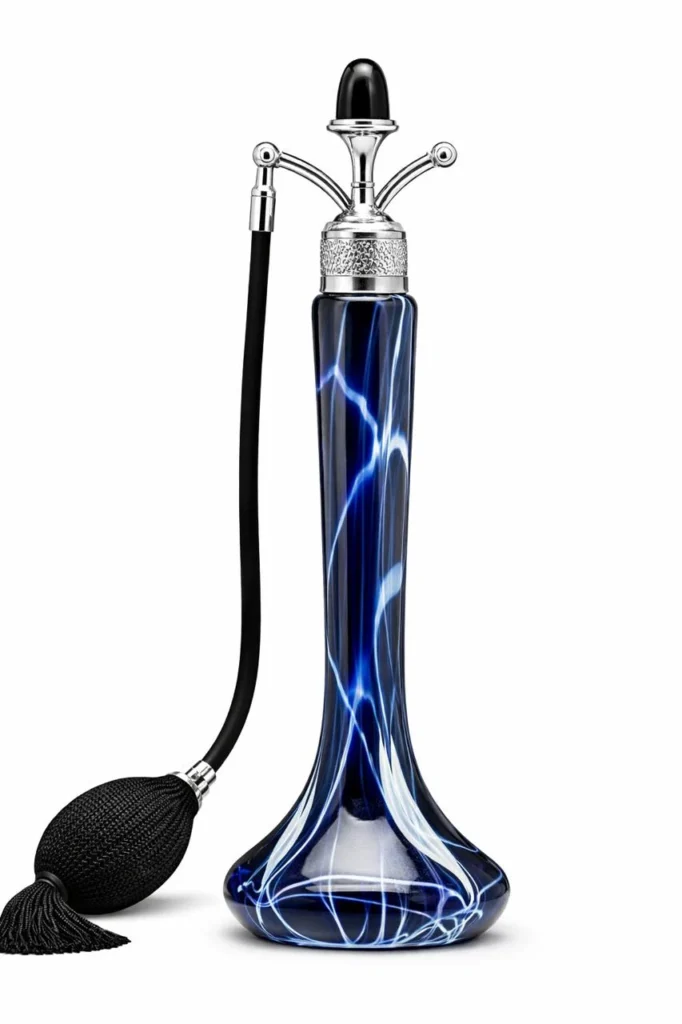
From Craftsmanship Zenith to Commercial Strategy
Part 1: Forty Years of Heritage — The Art & Engineering of Perfume Bulb Pumps
- The Renaissance of the Bulb Atomizer: Why high-end niche houses and vintage-inspired collections pivot to bulb designs. It’s not just a pump; it’s a sensory ritual that slows down the consumption experience, adding a layer of “ceremony” that standard sprays lack.
- Structural Anatomy: A deep dive into the synergy between the bulb, braided mesh, dip tube, pump engine, and nozzle. Each component must be calibrated to ensure that pneumatic pressure translates into a consistent fluid discharge.
- Core Competency: Addressing the twin industry “demons”—leakage and evaporation. After 40 years, our proprietary “Internal Shut-off Valve” (ISV) technology ensures that the fragrance path is physically sealed when not in use.
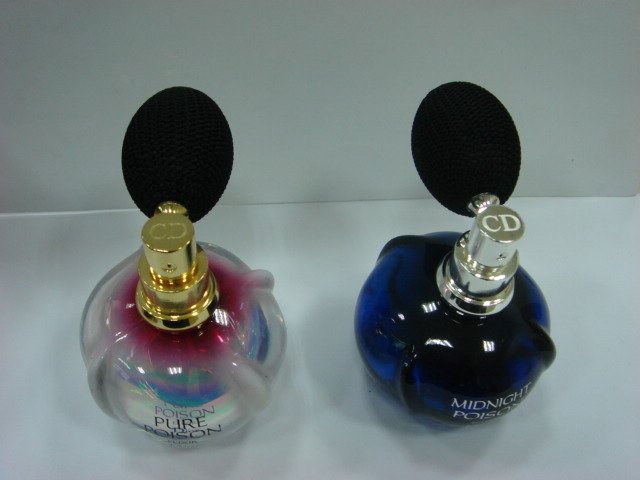
Part 2: Material Selection & Comparative Analysis
Choosing the right material is the difference between a luxury heirloom and a disposable product.
| Component | Material | Pros | Cons | Best For |
| Nozzle Head | Zinc Alloy | Premium weight, superior electroplating, high corrosion resistance. | Higher cost than aluminum. | High-end Niche Brands |
| Pure Copper | Ultimate luxury, precision threading, develops a unique patina. | Expensive; heavy. | Ultra-luxury/Collector’s Editions | |
| Aluminum | Lightweight, cost-effective, vast color range via anodizing. | Less “heft” than alloys. | Mid-market Salon Fragrances | |
| Plastic (PP/ABS) | Budget-friendly, high recyclability potential. | Lacks premium tactile feel. | Mass-market / Gift Sets | |
| Bulb Core | Natural Latex | Superior “snap-back” elasticity and soft touch. | Prone to aging/yellowing. | Classic Vintage Lines |
| Silicone | Excellent UV and chemical resistance; anti-aging. | Slightly stiffer tactile feedback. | Modern, Long-shelf-life Products | |
| Outer Braid | Silk/Rayon | High sheen, luxurious hand-feel. | Delicate; prone to snagging. | Boudoir/Decorative Bottles |
| Nylon/Polyester | High durability, abrasion-resistant. | Can feel slightly “synthetic.” | Daily-use Travel/Home Scents |
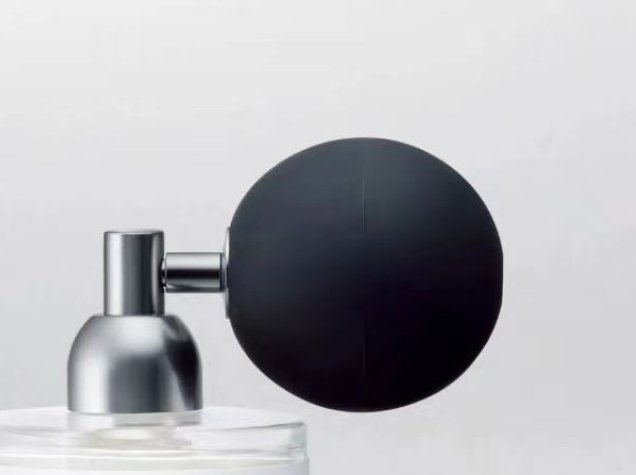
Part 3: Customization Bulb Atomizer Perfume Pump for Luxury Fragrance Packaging Workflow & Technical Parameters
Precision engineering meets aesthetic vision.
| Stage / Parameter | Technical Specification | Importance for Decision Makers |
| Tooling & R&D | 3D Modeling $\rightarrow$ SLA Prototyping $\rightarrow$ CNC Steel Molds. | Ensures physical fit before mass capital expenditure. |
| Neck Finish | FEA13, FEA15, 18/410, 18/415, 20/410. | Compatibility with glass bottle global standards. |
| Dosage (Output) | $0.05\text{ml}$ to $0.15\text{ml}$ per stroke. | Controls the “strength” of the initial scent cloud. |
| Surface Finish | PVD Coating, Electroplating, Matte/Gloss Lacquering. | Defines the brand’s visual identity and durability. |
| Dip Tube | Customized length with “V” or “U” cut. | Ensures 99% of the liquid can be extracted. |
Part 4: Commercial Dimensions (MOQ, Cost, & Lead Times)
Strategic planning for procurement and supply chain.
| Tier | Customization Level | MOQ (Typical) | Lead Time | Cost Impact |
| Stock Program | Standard colors, no logo. | 500 – 1,000 pcs | 3–5 Days | Low (Standard pricing) |
| Semi-Custom | Custom color/Logo on existing mold. | 3,000 – 5,000 pcs | 20–30 Days | Moderate |
| Full Custom | New shape/proprietery engine design. | 5,000+ pcs | 25–40 Days | High (plus Tooling Fees) |
| Sampling | CNC Prototyping or 3D Printing. | 3–5 pcs | 7–14 Days | Fixed Sample Fee |
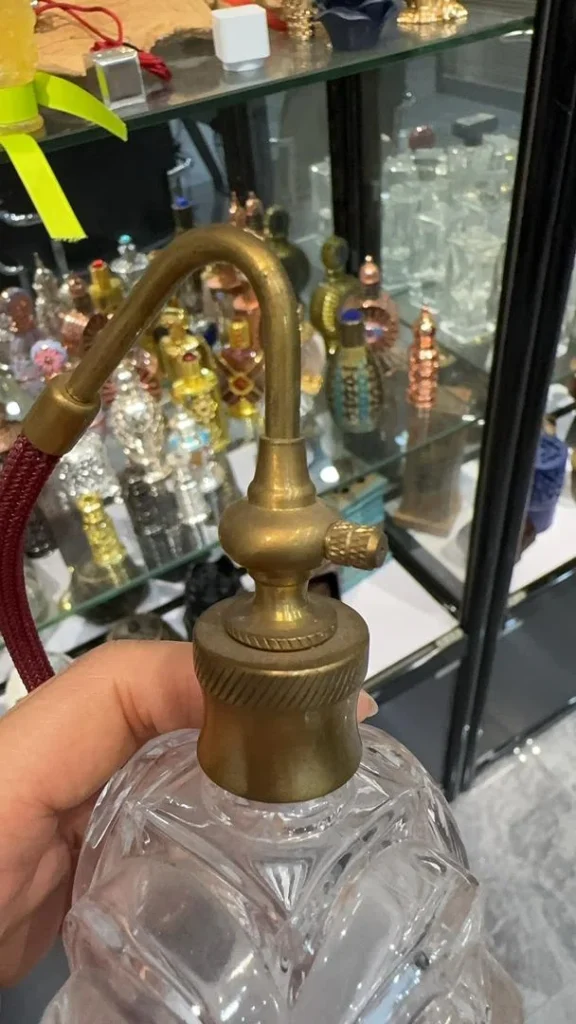
Part 5: Target Client Archetypes
- Heritage & Revivalist Brands: Focusing on 19th-century French court aesthetics.
- Artisanal Niche Houses: Using the bulb as a “visual hook” for social media and shelf-presence.
- Luxury Hospitality/Home Scents: Large-format bottles (200ml+) where the bulb serves as a permanent decorative fixture.
Part 6: 20 Professional FAQ for Executive Decision Making from Bulb Atomizer Manufacturer | 40 Years of Custom Fragrance Pump Solutions
Drawing from 40 years of manufacturing excellence, here are the technical resolutions to the 20 critical questions facing fragrance brand decision-makers today.
1. Leakage Prevention: How do we implement a “On/Off” locking mechanism for secure shipping?
Answer: We utilize a proprietary Mechanical Shut-off Valve (MSV) integrated into the swivel neck. By rotating the spray head $90^\circ$, the fluid path is physically disconnected from the bulb pressure chamber. This allows the product to pass ASTM vacuum leak tests ($-0.05\text{ MPa}$), ensuring zero leakage during high-altitude air transit.
2. Evaporation Control: What gaskets are used to minimize VOC loss in bulb systems?
Answer: Standard PE or rubber gaskets are too porous for long-term storage. We employ FKM (Viton) or PTFE-laminated gaskets. These high-density fluoropolymers provide a superior chemical barrier, reducing annual fragrance evaporation to less than 1%, preserving the scent’s integrity for years.
3. Mist Quality: How do we optimize the swirl chamber to achieve a $15–30\mu\text{m}$ droplet size?
Answer: We precision-engineer the Insert Orifice with dual-tangential channels. By optimizing the ratio of the swirl chamber volume to the exit diameter, we induce high centrifugal force, breaking the liquid into a “dry” ultra-fine mist ($D_{50} \approx 22\mu\text{m}$) that lingers in the air without staining clothes.
4. Fragrance Compatibility: How does high oil concentration (Extrait) affect the pump’s prime?
Answer: High viscosity oils (20-40% concentration) create “drag” in standard valves. We counter this by using a Heavy-Duty Return Spring and increasing the Dip Tube Internal Diameter to $1.5\text{mm}$. This ensures the bulb rebounds instantly and the engine primes without “clogging” or lag.
5. Bulb Discoloration: What UV-inhibitors are added to clear bulbs to prevent yellowing?
Answer: To protect aesthetic integrity, our silicone compounds include Benzotriazole UV absorbers and HALS (Hindered Amine Light Stabilizers). This chemical shield prevents the polymer chains from degrading under retail UV lighting, maintaining a “crystal clear” look for up to 24 months.
6. Tactile Feedback: Can the spring tension ($K$-factor) be adjusted for a “soft” or “firm” press?
Answer: Absolutely. We calibrate the $K$-factor (Spring Rate) based on brand positioning. A $0.3\text{ N/mm}$ spring offers a light, effortless touch for feminine boudoir scents, while a $0.7\text{ N/mm}$ spring provides the “Tactile Resistance” expected in high-end, heavy-weighted masculine fragrances.
7. Braid Integrity: What is the industry standard for preventing fraying at the collar junction?
Answer: We use Ultrasonic Thermal Bonding at the mesh edges followed by a Mechanical Compression Fitting. The braid is tucked into a zinc-alloy ferrule and “crimped” under high pressure, ensuring the mesh never unravels, even under the 50N “pull-test” industry standard.
8. Regulatory Compliance: Do materials meet REACH, SVHC, and California Prop 65 standards?
Answer: Yes. Every component—from the silk braid to the internal gaskets—is certified Phthalate-free and Lead-free. We provide full laboratory COA (Certificate of Analysis) to ensure your brand meets global safety and environmental regulations.
9. Automation: Can these be capped using automatic lines, or is a semi-manual process required?
Answer: While bulb pumps are historically manual, we have engineered Protective Capping Jigs for automated lines. These custom grippers protect the textile mesh while applying precise torque to the screw-neck, allowing for production speeds of up to 30 bottles per minute.
10. Chemical Resistance: How do we test for seal swelling in the presence of high-percentage ethanol?
Answer: We perform a 72-hour Immersion Stress Test in 95% Ethanol at $40^\circ\text{C}$. Any component showing a volume swell $>3\%$ is rejected. This ensures that the internal seals will not expand and seize the pump mechanism over the product’s lifespan.
11. Center of Gravity: How do we ensure a heavy metal bulb pump doesn’t tip over a slim bottle?
Answer: We conduct Counterweight Analysis during the design phase. If the pump head (Zinc/Copper) is heavy, we recommend an Asymmetric Internal Weight or a thickened glass bottle base to ensure the “Tip Angle” exceeds $15^\circ$, preventing vanity-top accidents.
12. Double-Layer Bulbs: How does internal reinforcement prevent the bulb from collapsing over time?
Answer: We utilize a Dual-Chamber Geometry. An inner high-rebound silicone “lung” provides the mechanical force, while the outer decorative shell remains under zero stress. This ensures the bulb always returns to its perfect spherical shape without “dimpling.”
13. Priming: What is the “Number of Strokes to Prime” standard (usually $<3$)?
Answer: Our high-efficiency air-recovery valves are designed for Immediate Prime. In $95\%$ of our designs, the fragrance is atomized in $\le 2$ strokes, providing the consumer with instant gratification and a sense of mechanical precision.
14. Plating Durability: Do we use 24-hour salt spray tests to ensure the gold finish won’t peel?
Answer: We exceed the standard. Our premium finishes undergo a 48-hour Neutral Salt Spray (NSS) test and a Cross-Hatch Adhesion test. This ensures the electroplating remains pristine even in humid bathroom environments or when exposed to skin oils.
15. Odor Neutrality: How do we treat the internal rubber to ensure it doesn’t taint the top notes?
Answer: We use Medical-Grade, Low-Volatile Silicone that undergoes a 4-hour Vacuum De-gassing process at $200^\circ\text{C}$. This removes residual “rubbery” odors (monomers), ensuring that the fragrance’s delicate top notes—like citrus or ozone—remain pure.
16. Anti-Counterfeiting: Can we laser-etch micro-logos on the underside of the actuator?
Answer: Yes. We offer Fiber-Laser Micro-Engraving. We can etch logos or serial numbers as small as $0.5\text{mm}$ inside the nozzle or on the collar. This provides a discrete “fingerprint” for brand protection that is nearly impossible for counterfeiters to replicate.
17. Maintenance: Are the bulbs user-replaceable to support a “bottle-for-life” philosophy?
Answer: Yes, our Modular Screw-Neck (18/415 or FEA15) allows bulbs to be detached and replaced. This supports the “Refillable Luxury” trend, allowing the consumer to keep the expensive metal pump while only replacing the glass bottle or the bulb mesh.
18. Climate Testing: How does the pump perform at $-20^\circ\text{C}$ vs. $+50^\circ\text{C}$?
Answer: We perform Extreme Thermal Cycling. At high temps, we test for “spitting” due to air expansion; at low temps, we test for silicone brittleness. Our valves are designed with a Pressure-Relief Port to normalize internal bottle pressure automatically.
19. Cost Engineering: Can we use a plastic core with a metalized shroud to save 30% on costs?
Answer: This is a common “Value Engineering” strategy. We can produce an ABS Plastic Core with a Vacuum-Metalized (PVD) Shroud. Visually, it is indistinguishable from solid metal, providing the same luxury aesthetic while significantly reducing material costs and shipping weight.
20. Sustainability: Can we integrate PCR (Post-Consumer Recycled) plastics into the pump assembly?
Answer: Yes. We can integrate up to 50% PCR-PP into the non-wetted internal components (like the shroud or collar base) and use RPET (Recycled Polyester) for the braided mesh, helping your brand meet modern ESG and sustainability targets without sacrificing luxury.
