
When Weight Defines Worth: Navigating the Stone Supply Chain
In luxury perfumery, where differentiation is paramount, natural stone has emerged as the ultimate material statement. A marble or onyx cap conveys permanence, geological authenticity, and tactile luxury that synthetic materials cannot replicate. Yet, this path is fraught with hidden complexities: inconsistent geology, structural flaws, fragrance compatibility issues, and supply chain opacity can transform a visionary concept into a costly liability.
Selecting the right partner in this specialized field is not a procurement decision—it is a strategic partnership in material mastery. This guide provides the framework, metrics, and critical questions you need to identify a supplier who can transform geological wonder into commercial-grade luxury.
The Material Reality: From Quarry to QC – The Non-Negotiable Parameters
Natural stone is inherently variable. True expertise lies not in eliminating this variability, but in mastering it through rigorous process control. Below are the critical parameters that separate artisanal craft from industrial-grade precision.
Table 1: The Marble Cap Technical Specification Framework
| Evaluation Dimension | Industry Standard / Common Pitfall | What a Premier Partner Delivers (With Data) |
|---|---|---|
| 1. Material Sourcing & Block Selection | Supplier buys “slabs” or “off-cuts” of unknown origin with hidden fissures or soft veins. | Quarry-Direct, Grade-A Block Sourcing: Partners with named quarries (e.g., Carrara, Calacatta, Imperial Danby). Provides block inspection reports and uses ultrasonic testing to map internal flaws before cutting. |
| 2. Structural Integrity & Processing | Caps crack during threading or assembly due to hidden stress or improper curing. | CNC Pre-Stress Analysis & Slow-Curing: Uses finite element analysis (FEA) on CAD models to orient grain for strength. Implements a 21-28 day mineral stabilization period after machining to release internal stresses. Guaranteed yield rate >85% on approved blocks. |
| 3. Precision Machining & Tolerances | Poorly cut threads cause cross-threading, leaks, or a “gritty” feel. | Diamond-Tool CNC Machining with Post-Processing: Achieves thread tolerances of ±0.05mm (ISO 965-1). Includes a micro-lapping step on threads and mating surfaces for smooth actuation. |
| 4. Sealing & Compatibility (The Critical Step) | Use of generic sealants that degrade with fragrance alcohol, leading to staining and odor retention. | Proprietary, Fragrance-Inert Sealing Protocol: A 3-stage process: 1) Impregnation with a fluoropolymer nano-sealant (penetration depth >2mm), 2) Surface application of a cosmetic-grade epoxy, 3) Curing under UV light. Validated via 30-day immersion test in 80% ethanol solution with zero weight gain or staining. |
| 5. Weight & Finish Consistency | Significant unit-to-unit weight variance (>10%), altering user experience. | Dynamic Weight Sorting & Spectrophotometry: Caps are sorted into ±3% weight batches. Color and veining are matched using a spectrophotometer (CIE Lab* values, ΔE < 2.5) to ensure visual coherence within a retail box. |
| 6. Certification & Traceability | No verifiable chain of custody; sustainability claims are unsubstantiated. | Full Traceability & ESG Documentation: Provides quarry certificates of origin, SGS/Intertek material composition reports, and a Life Cycle Inventory (LCI) report detailing water recycling (up to 95% in-process water is recycled) and reclaimed stone dust utilization. |
Data Point:
According to a 2024 Luxe Pack Monaco Green & Sustainable Packaging White Paper, “Material Provenance” is now the top concern for 72% of niche luxury consumers. A verifiable story adds up to 30% perceived value to the final product.
The Partner Assessment Framework: A 50-Point Scorecard for Due Diligence
Use this framework to score potential suppliers (Rate each item 0-2: 0=No Evidence, 1=Promised, 2=Documented & Verified).
Technical & Process Mastery (Max 20 pts)
- Can they provide an FEA stress analysis for your specific cap design? (2)
- Do they have a documented, multi-stage sealing protocol with chemical SDS sheets? (2)
- What is their documented production yield rate on a comparable project? (2)
- Can they share third-party test reports for sealant efficacy (e.g., ASTM C97 for absorption)? (2)
- Do they perform 100% individual weight and thread fit checks? (2)
Material & Sustainability Integrity (Max 15 pts)
- Can they name the specific quarries and provide block selection criteria? (2)
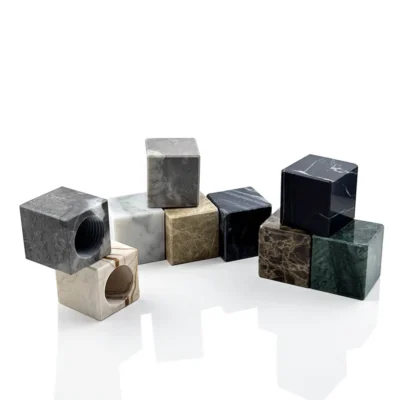
- Do they offer a “Master Sample Box” of their standard marble/onyx/granite varieties? (2)
- Is there a documented waste management and recycling process for stone slurry/dust? (2)
- Can they provide an Environmental Product Declaration (EPD) or LCI report? (2)
Commercial & Project Governance (Max 15 pts)
- Is there a clear, stage-gated process from sampling to mass production? (2)
- Do they provide a transparent cost breakdown (material, tooling, processing, QA)? (2)
- What is their policy on replacement for defects found during your assembly? (2)
- Do they offer inventory management or consignment for high-volume orders? (2)
A Premier Partner will score ≥45/50. An average supplier will struggle to score above 30.
Case in Point: The “Onyx Noir” Project – A Partnership Breakdown
A prestige brand launched “Onyx Noir,” requiring a 65g, high-gloss black onyx cap with a magnetic closure insert. Three suppliers were shortlisted.
- Supplier A (Low-Cost Focus): Quoted 40% less. Proposed using standard onyx slabs. Failure Point: Their first sample batch had a 60% breakage rate during magnetic insert gluing due to hidden calcite veins. No backup plan.
- Supplier B (Traditional Craftsman): Beautiful hand-finish. Failure Point: Could not achieve thread consistency; weight variance was ±12%. Lead time was unpredictable.
- Our Partnership (Technical Solutionist): We took these steps:
- Material Vetting: We sourced Grade-A+ Pakistani Black Onyx, rejecting two initial blocks for excessive banding after ultrasonic testing.
- Process Innovation: We pre-drilled and lined the magnet housing with a brass sleeve before final shaping, eliminating stress on the stone during assembly.
- Data-Driven QA: Every cap was weighed and its gloss level measured (≥95 GU on a gloss meter). We shipped the batch with a QC passport for each unit.
- Result: A 98% yield rate, flawless assembly at the brand’s facility, and the project delivered on schedule. The brand’s COO noted, “They managed the geology like a precision engineering project.”

FAQ: The Critical Questions Every Brand Must Ask
Q: What is a realistic minimum order quantity (MOQ) for custom stone caps?
A: For a truly custom design (new shape, new thread), expect an MOQ of 500-1,000 units to justify block sourcing, CAD/CAM programming, and custom tooling. For adaptations of a supplier’s existing “library” shapes, MOQs can be as low as 250 units. Be wary of suppliers offering very low MOQs (e.g., 50 pcs)—this often indicates use of low-quality remnant slabs.
Q: How do you handle the natural variation in veining and color?
A: We practice “Batch Kinship.” We machine an entire production run from sequentially cut pieces of the same parent block. While each cap remains unique, they share a common familial vein structure and color base. We then sort them into visually harmonious sets for shipment. You can specify the level of matching required (e.g., “loose family” vs. “tight pair-matching”).
Q: Are stone caps compatible with all fragrance juices?
A: Yes, but only with correct sealing. The risk is not the stone itself, but the sealant failing. Our sealing protocol is tested against aggressive solvents (ethyl alcohol, DPG, benzyl alcohol). We insist on conducting a compatibility test with your specific concentrate as part of the sampling process. We guarantee against staining and odor retention.
Q: What about weight and shipping costs?
A: This is a material reality. A substantial marble cap can weigh 80-150g. We provide accurate 3D models with calculated weight early in the design phase. We also design hollow interiors where structurally possible to reduce mass. While shipping cost is a factor, the unboxing moment of heft and coolness is a powerful brand premium.
Q: What is the lead time from approved sample to delivery?
A: Build a realistic timeline: Sample Development: 6-8 weeks (including material sourcing, prototyping, and sealing validation). Mass Production: 10-12 weeks after sample approval. The longest phase is often the stabilization/curing period post-machining, which cannot be rushed without risking latent fractures.
Your Scent’s Foundation Deserves a Bedrock Partner
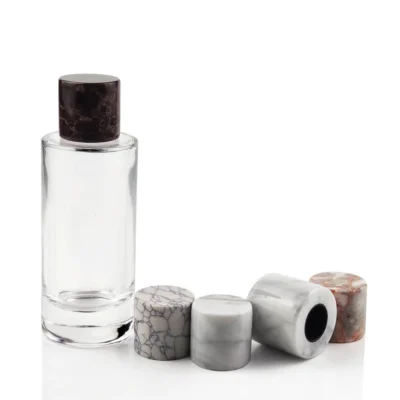
A stone cap is more than a closure; it is the foundational touchpoint of your brand’s tactile identity. The wrong partner delivers a mere rock. The right partner delivers a geological icon—engineered for precision, sealed for permanence, and sourced with integrity.
Move beyond vendor evaluation to partnership validation.
Contact us to receive our Technical Dossier for Stone Packaging, including material sample kits, full test reports, and a detailed walkthrough of our stage-gated development process.
Contact Us – Request the Stone Packaging Technical Dossier
WhatsApp: +86 18107699312
E-mail : info@fragrancepackage.com
Our team deeply understands the dreams and challenges of a fragrance entrepreneur, not a simple perfume packaging wholesaler, but a strategic partner focused on providing complete fragrance packaging solutions—from concept to shelf for emerging and growing perfume brands.
Sources & Further Reading:
- Luxe Pack Monaco & The Future Laboratory: “Green & Sustainable Packaging: The New Codes of Luxury” White Paper (2024).
- ASTM International: C97/C97M Standard Test Methods for Absorption and Bulk Specific Gravity of Dimension Stone.
- Natural Stone Institute: “Quarry to Project” Traceability Guidelines & Sustainability Standard (ANSI/NSC 373).
- Premium Beauty News Market Analysis: “The Rise of Mineral & Stone Accents in Perfumery Packaging” (Q3 2023).
