

Date: October 24, 2023
Category: Luxury Fragrance Packaging Insights / Supply Chain Management for Perfume & Cosmetics Brands
Reading Time: 8 Minutes
I. Introduction: The Invisible War Behind the Luxury
To the consumer, a high-end perfume is an object of desire—an artistic masterpiece. But to a Procurement Director or a Brand Manager, that same bottle is a complex BOM (Bill of Materials).
In the competitive world of luxury cosmetics and fragrance, packaging is no longer just a container; it is a vital brand asset. However, as designs become increasingly complex—featuring heterogeneous shapes, multi-material splicing, and composite finishing processes—the difficulty of supply chain management has risen exponentially.
This poses a critical question for every decision-maker: Should you fragment your supply chain to save a few cents on unit price, or consolidate it to ensure perfect delivery?
Today, we explore the “Game Theory” of Perfume & Cosmetics packaging procurement through a real-world story that every brand owner needs to hear.
II. Case Study: The “Tower of Babel” Dilemma of Alexandre
Let me share a story about a prestigious French perfume client of mine (let’s call them Alexandre). They came to us with a vision, but before they found us, they were trapped in a supply chain nightmare.
1. The Vision: A 150ML Olfactory Masterpiece
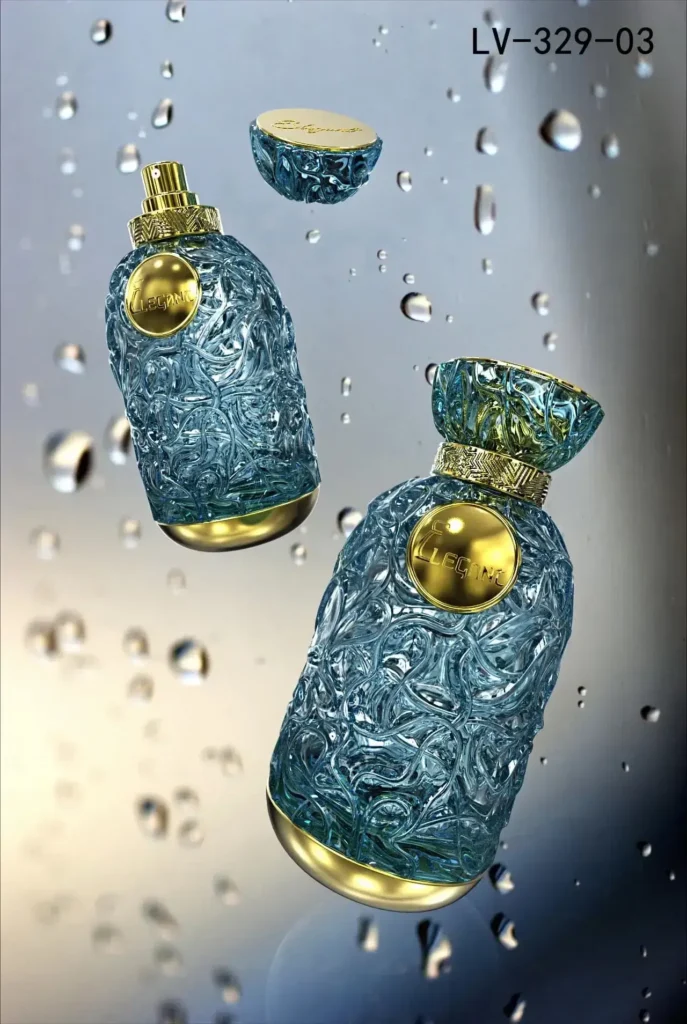
The brand conceived an ambitious 150ML limited edition perfume. It wasn’t just a bottle; it was a miniature palace. The technical requirements were staggering:
- Composite Materials: The body used a complex Embossed/Debossed Glass Bottle Mold, requiring a crystal-like texture. The surface demanded a High-Gloss UV Electroplating (Galvanization) finish to achieve a liquid “European Gold” metal luster.
- Precision Accessories:
- Pump: Customized for a specific atomization effect with an ultra-smooth actuation force.
- Shoulder Collar: A heavy Zamac (Zinc Alloy) die-casting piece designed to fit perfectly over the glass neck.
- Collar Decoration: A jewelry-like ring nested outside the shoulder collar to add opulence.
- Cap: A unique Glass Perfume Cap design featuring Graduated Spraying and a Frosted/Matte finish.
- Logo: Micron-level Laser Engraving on the metal collar.
2. The Reality: The Domino Effect of Decentralization
In an attempt to achieve the theoretical “lowest cost,” the brand’s previous procurement team split these 10-13 core processes among different suppliers:
- Factory A made the molds.
- Factory B handled the Electroplating.
- Factory C supplied the Pumps.
- Factory D produced the Glass Caps.
- Factory E did the Spraying.
- Factory F handled the Galvanization.
- ……
- Finally, everything was shipped to Location M for assembly.
3. The Explosion: A Nightmare of Tolerance Stack-up
When all the components finally arrived at the assembly line, disaster struck. The “Tower of Babel” collapsed.
- The War of Dimensions: The inner diameter of the Zamac Shoulder Collar was 0.1mm too small (within its own tolerance). Meanwhile, the Collar Decoration Ring was 0.1mm too large (also within tolerance). When they met, Engagement was impossible. The parts wouldn’t fit.
- Color Control Failure: The gold on the Glass Cap decoration and the gold on the Bottle Electroplating / Galvanization were produced by two different factories in different batches. The result? A massive Color Deviation. One looked yellow, the other looked reddish. The aesthetic unity was destroyed.
- The Blame Game (Finger-Pointing):
- Assembly Plant: “The parts don’t fit. If we force them, they will crack.”
- Glass Factory: “My bottle meets the technical drawing standards.”
- Plating Factory: “The uneven surface is due to the raw glass molding, not my plating.”
- The Hidden Costs:The procurement team spent 10 hours a day coordinating between factories that were thousands of miles apart. Everyone claimed, “I’ve already shipped, it’s not my fault.”The result? Missed launch dates and massive Air Freight fines to try to save the timeline. The money “saved” on the unit price was completely wiped out by rework costs and delays.
Conclusion: Decentralized procurement appeared to lower the Unit Price, but it drastically inflated the Total Cost of Ownership (TCO).
III. Deep Dive: Weighing the Pros and Cons
1. Decentralized Procurement (The “Silo” Approach)
- Pros:
- Transparent Unit Price: You can find the absolute lowest price for every specific component.
- Risk Dispersion: Theoretically, you don’t put all eggs in one basket.
- Cons:
- Compatibility Disaster: Lack of coordination. Suppliers care about their part, not the Overall Fit.
- Ambiguous Responsibility: When quality issues arise, suppliers engage in endless finger-pointing.
- Management Burnout: Procurement staff become “order chasers” rather than strategic partners.
- Logistics Losses: Components are moved between multiple factories, increasing Abrasion, breakage risks, and shipping costs.
2. Centralized “Turnkey” Solution (The Integrated Approach)
- Pros:
- Total Accountability: The supplier is responsible for the Finished Good, not just a single part.
- Technical Coordination: We calculate the Shrinkage Rates of glass, plastic, and metal during the mold design phase. We ensure the “Click” sound of the cap and the perfect line continuity between the collar and the bottle.
- Color Management: Unified color formulas for spraying, electroplating, and oxidation ensure visual consistency across different materials.
- Professional Focus: Frees up your team to focus on branding and marketing, not fighting quality fires.
- Cons:
- Slightly Higher Surface Price: Includes a management service fee (which is almost always lower than the hidden costs of decentralization).
- Selection Difficulty: Requires finding a supplier with strong capabilities. Recommendation: Always conduct video meetings or site visits.
IV. Industry Insights & Our Solution
1. Why High-End Fragrance & Cosmetics Brands Choose “One-Stop”
According to the Journal of Supply Chain Management, for highly customized and complex products, Supply Chain Integration can reduce time-to-market by 20-30% and reduce quality defect rates by over 50% [1].
2. Our Solution: We Are Your Fragrance & Cosmetics Packaging Engineers
We don’t just sell bottles; we are your Project Managers and Technical Consultants.
- Technical Pre-judgment: We assess risks like draft angles and electroplating hanging points at the drawing stage.
- 100% Inspection: We deliver fully assembled, tested, and perfect products. You only need to worry about filling the perfume.
References:
[1] Flynn, B. B., Huo, B., & Zhao, X. (2010). The impact of supply chain integration on performance. Journal of Operations Management.
[2] “The Hidden Costs of Low-Price Sourcing in Luxury Packaging,” Packaging Digest Analysis.
FAQ: 10 Questions Every Perfume Brand Director Asks
Here are the top questions regarding luxury cosmetic packaging sourcing, answered for brand decision-makers.
1. Why is “Tolerance Stack-up” dangerous in perfume bottle manufacturing?
Tolerance stack-up occurs when the small allowable size variations of different parts (glass bottle, pump, zamac collar) add up. In decentralized sourcing, this often leads to parts that don’t fit together (poor engagement) or leakage issues, even if individual parts are “within spec.”
2. How do you ensure color consistency between a plastic cap and a glass bottle?
Achieving the same color on different materials (e.g., Gold Electroplating or Galvanization on glass vs. Anodizing on aluminum) requires a centralized color management system. We use a unified color master batch and adjust formulas specifically for each substrate to ensure a visual match under standard light sources.
3. What is the advantage of using Zamac (Zinc Alloy) for perfume caps and collars?
Zamac is heavy, cool to the touch, and offers a premium, luxurious feel that plastic cannot mimic. It is ideal for die-casting complex shapes and takes electroplating finishes (like gold or silver) exceptionally well, making it a favorite for high-end fragrance brands.
4. Can you handle complex finishes like “Graduated Spraying” and “Laser Engraving”?
Yes. As a turnkey supplier, we integrate secondary processes. Whether it is inner spraying, graduated (ombre) painting, hot stamping, or precision laser engraving on metal parts, we manage the entire process to ensure the decoration aligns perfectly with the bottle design.
5. What is the typical lead time for a custom mold 150ML perfume bottle?
Generally, 3D drawing confirmation takes 1 week, mold creation takes 25-30 days, and sample production takes 10-15 days. Mass production typically requires 40-50 days, depending on the complexity of processes like polishing and electroplating or Galvanization. Integrated sourcing prevents delays between these steps.
6. Why should I avoid splitting my order among multiple factories to save money?
Splitting orders increases the Total Cost of Ownership. You may save on unit price, but you risk high communication costs, assembly failures, color mismatches, and expensive logistics (like emergency air freight). A centralized supplier absorbs these risks.
7. How do you prevent glass breakage during the electroplating or Galvanization process?
Glass Bottle Electroplating or Galvanization places stress on the bottle. We use high-quality glass molding with even wall thickness and conduct rigorous thermal shock tests and vacuum tests before and after plating to ensure durability and safety.
8. What is the difference between “Fire Polishing” and “Hand Polishing” for glass perfume bottles?
Fire polishing is an automated process done during molding to smooth the surface. Hand polishing is a premium, labor-intensive process used for crystal-grade perfume bottles to remove mold lines and achieve optical clarity before coating or printing.
9. Do you offer “Private Label” or “Bespoke” perfume packaging solutions?
Yes. We specialize in Bespoke (Custom) Fragrance & Cosmetics Packaging. We can work from your rough sketch or 3D concept. We handle everything from the Glass Perfume Bottle Mold design to the final assembly of the pump and cap.
10. How can I verify your capability as a supplier without visiting China?
We highly recommend Video Conference calls to see our showroom and factory floor live. We can also send you a comprehensive sample kit of past projects (like the Alexandre style components) so you can feel the quality of our pump action, Zamac weight, and printing precision.
🌟 Ready to Transform Your Perfume & Cosmetics Packaging Strategy?
Don’t let your brand suffer from the “Tower of Babel” effect. Contact us today and Costom Your Custom Packaging Quote to schedule a consultation for your next luxury perfume project. Let’s build a masterpiece, together.
- WhatsApp: +86 18107699312
- Email: [email protected]
