
This Isn’t Another Perfume Bottle Supplier List, It’s Your Risk Management Handbook
If you’re searching for custom perfume packaging for your new perfume brand, typing “custom perfume bottles China” into a search engine will yield countless articles filled with marketing jargon and supplier lists. They all start to look the same, promising “top quality,” “low prices,” and “one-stop service.”
But as a founder, your real challenge isn’t choosing a factory; it’s navigating a series of real and potentially costly risks:
- Paying a high mold fee only to receive samples that bear little resemblance to your design.
- Discovering a 5% leak rate in bottle caps from your bulk order, spoiling the entire batch in storage.
- Having a shipment held at customs because materials promised as “EU compliant” fail REACH standards.
- Finding your painstakingly original bottle design on a competitor’s product within six months.
This article will not give you another glossy “Top 10 Manufacturers” list. Instead, we provide a hands-on guide based on real project experience, verifiable data, and a structured decision-making framework. We will reveal the industry’s internal workflows, explain the real meaning behind common “jargon,” and equip you with actionable tools to turn supply chain risk into a reliable competitive advantage.
Part 1: Deconstructing Risk — The Four Most Common Pitfalls for New Perfume Brands Sourcing Custom Packaging in China
Before discussing solutions, we must honestly identify the risks. Based on our analysis of over 5,000 startup projects, issues consistently cluster around four key areas:
Risk 1: The Design-Production Disconnect — “Why doesn’t my sample match the 3D render?”
The Core Issue: A 3D render is an ideal mathematical surface, while production involves shaping physical matter. Designers may overlook draft angles, uniform glass distribution, or metal parting lines.
- Real Case Study: A brand designed a striking crystal bottle with sharp edges. The first prototype revealed a 15% breakage rate at the thin, sharp corners during pressure testing. The solution wasn’t changing factories but integrating DFM (Design for Manufacturability) analysis early on, modifying the edges to a subtle curve while preserving the visual impact.
- Your Checklist:
- ✅ Did the supplier proactively offer DFM suggestions before quoting?
- ✅ Does their design team have at least 10 years of experience with glass/metal mold design?
- ✅ Can they show complete iteration records from concept to final product for past projects (not just glossy finished photos)?
Risk 2: Vague Quality Definitions — “What level of ‘good’ is acceptable?”
The Core Issue: You say “high quality,” the factory says “no problem,” but your definitions may be worlds apart. Without quantifiable standards, consistent results are impossible.
- Industry Standards Revealed:Quality DimensionWorkshop Factory StandardProfessional Manufacturer StandardHow to VerifyDimensional Tolerance“Looks about right”Neck Finish Diameter: ±0.1mm (ensures pump compatibility)Request a CMM (Coordinate Measuring Machine) Report.Surface DefectsVisual check, no “obvious” scratchesOptical scanner inspection, allowing ≤3 flaws >0.3mm/bottle (on non-primary surfaces)Define and agree on an AQL (Acceptable Quality Level) sampling standard, typically AQL 0.65 (strict) to AQL 2.5 (normal).Seal IntegrityInverted for a few minutes without leakingPressure Decay Test: Hold at -0.03MPa for 30 sec, decay ≤5%Request raw data screenshots from a leak tester.Material ComplianceVerbal promise of “eco-friendly”Provide SGS/Intertek-issued compliance reports for REACH, FDA, LFGB with verifiable report numbers.Request original, recent (within one year) third-party test reports.
Risk 3: The Communication Black Hole — “What stage is my order actually at?”
The Core Issue: Time zones, language barriers, and vague updates lead to project derailment. Your “ASAP” might mean “in a day or two” to you but “in a week or two” to the factory.
- Structured Communication Solution: A professional partner provides a project dashboard featuring:
- Live Milestones: Mold machining (with CNC progress photos), first sample completion, mass production (Day 1/N), QC completion, container loading photos.
- Issue Log: Any deviation from standard is recorded, assessed, and requires your written confirmation.
- Single Point of Contact (SPOC): One technically proficient, English-fluent project manager with full accountability for your project, not just a salesperson forwarding emails.
Risk 4: The Hidden Costs of IP & Ethics — “Is my design safe?”
The Core Issue: A simple NDA isn’t enough to protect your core assets. Loopholes can exist in mold ownership, design file storage, and even the disposal of defective goods.
- Critical Action Points:
- Mold Ownership: The contract must state: “100% physical and intellectual property rights to all custom molds belong to the client.” Insist on having your brand logo engraved on the molds.
- Production Isolation: Ask if the factory will set up dedicated production lines or shifts for your product to prevent material mix-ups and design leaks.
- Scrap Disposal: Require the factory to physically destroy all non-conforming items (with video proof), not merely discard or rework them, preventing them from entering the grey market.
Part 2: Building Your Supplier Evaluation Matrix — Moving Beyond “Good” or “Bad”
Don’t ask, “Are you the best?” Instead, use the questions below to uncover true capability. Score potential suppliers (1-5) using this framework.
| Evaluation Dimension | Core Question (To Ask Suppliers Directly) | Weight | How to Verify Their Answer |
|---|---|---|---|
| Technical Transparency | “For our provided bottle design, please provide a preliminary DFM analysis outlining potential production challenges and suggested modifications.” | 30% | Assess the professionalism and detail of their suggestions. Good DFM specifies wall thickness, draft angles, and parting line locations. |
| Quantifiable Quality | “Please detail the complete QC test plan for this bottle, including instruments used and Accept/Reject criteria for each quality dimension.” | 25% | Request a blank but detailed QC Inspection Sheet template. A professional factory’s template will be exhaustive. |
| Structured Process | “Please share a complete Gantt chart timeline for a project of similar complexity, noting what information or confirmation is needed from us at each node.” | 20% | Ask for screenshots of their project management tools. Amateurs use WeChat for photos; professionals use Asana, Jira, or custom PLM systems. |
| Compliance Evidence | “Please provide verifiable, third-party compliance certificates for similar glass/metal/plastic materials issued within the last 12 months.” | 15% | Personally verify report numbers on SGS/BV websites. Check if material batches are relevant to your project. |
| Ethics & IP Protection | “Please explain in detail your processes for protecting client IP, covering file transfer, mold storage, and production scrap disposal.” | 10% | Request a tour (virtual is fine) of their secure server room or mold warehouse. Ask if they undergo BSCI or Sedex social accountability audits. |
Scoring Guide:
85+ Points: Potential strategic partner. Possesses the systems and mindset to reliably execute your vision.
70-84 Points: Qualified supplier. Can get the job done but may require more hands-on management and oversight from you.
Below 70 Points: High-risk option. Only consider if the budget is extremely constrained and you are prepared to accept corresponding risks. Part 4: Hard-Hitting FAQ & Answers
Part 3: From Inquiry to Delivery — A Breakdown of Critical Actions
The flowchart below maps a controlled, low-risk custom project journey, highlighting the critical actions you must take and the deliverables you must secure at each phase.
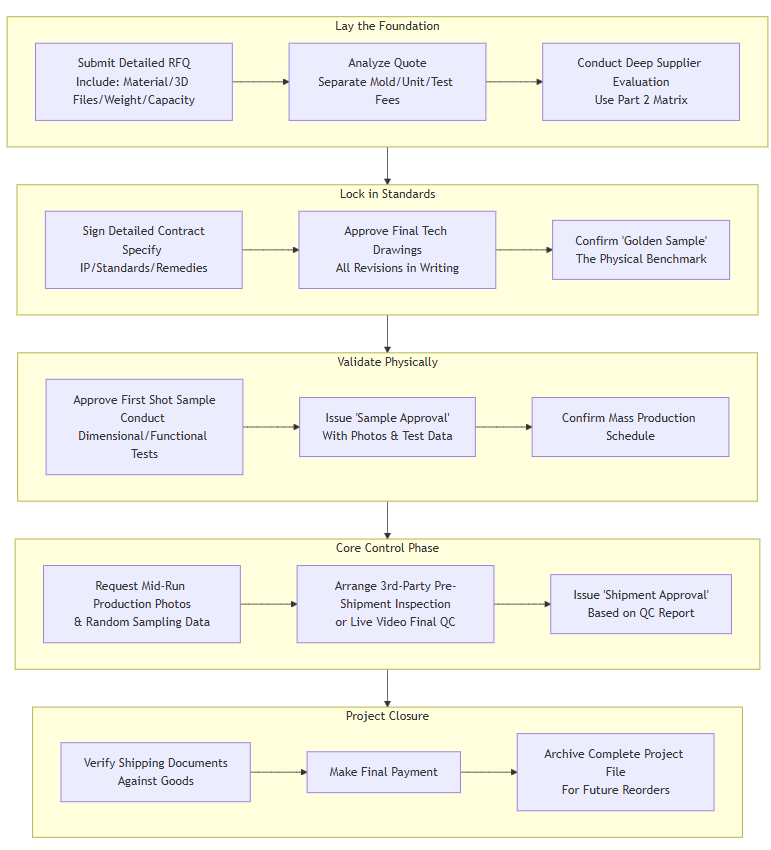
Key Process Notes:
- The Golden Sample: This is the project’s most important physical document. You and the factory lead should sign, and each retain one. All future bulk goods will be measured against it.
- Mid-Run Sampling: When 30%-50% of production is complete, request photos and key dimension checks of random, unpackaged units. This catches systemic errors early.
- Third-Party Inspection: For first-time orders or large-value orders, consider investing in a final inspection by SGS, BV, or Asia Inspection at the factory. Their report is bank- and lawyer-recognized evidence.
Part 4: Hard-Hitting FAQ & Answers
Q1: How much should I pay for molds? Is the mold fee reasonable?
A: A mold fee is an “investment,” not just a “cost.” For a 50ml glass bottle, it typically ranges from $3,000 – $8,000 USD, depending on complexity. Breakdown:
- Glass Bottle Mold (2 or 4 cavities): $1,500 – $4,000
- Metal Cap Mold (e.g., zinc alloy): $1,500 – $3,000
- Internal Plastic Part Mold (e.g., inner seal): $500 – $1,000
Crucial: The contract must state mold life (typically 500k-1 million shots) and your right to have a new mold made at cost before this lifespan ends.
Q2: How do I truly understand “material compliance”? What documents are non-negotiable?
A: Compliance is about a chain of evidence. You must obtain these three documents:
- Material Safety Data Sheets (MSDS): From your glass, metal, and plastic material suppliers.
- Declaration of Conformity (DoC): Issued by your bottle manufacturer, stating the product conforms to specific regulations (e.g., EU 10/2011 for food contact).
- Third-Party Test Report: From SGS, etc., for finished product migration testing (ensuring no harmful substances leach from the material into the fragrance). The report must list your brand name or project number.
Q3: Can the Minimum Order Quantity (MOQ) be negotiated?
A: MOQ is derived from “Mold Cost ÷ Your Acceptable Per-Unit Amortization.” Negotiate not by pleading, but by offering alternatives:
- Option A (Reduce Mold Cost): “Can we simplify the mold by changing the complex embossed side pattern to a smooth surface, thus lowering the MOQ?”
- Option B (Increase Unit Price): “We accept a 15% higher per-unit price in exchange for a 40% lower MOQ.”
- Option C (Bundle Orders): “If we order this perfume bottle and a matching lotion bottle simultaneously, sharing some mold structures, can the total MOQ be adjusted?”
Conclusion: Transform Your Supply Chain into a Brand Moat
In the fragrance industry, what separates great brands from ordinary ones often lies in invisible details—in the precise damping of a cap twist, in the color that remains true after prolonged light exposure, in the consistently fine mist of every spray.
These details are not accidental. They are the result of rigorous processes, quantified standards, and deep partnership. Choosing a partner in China should not be about finding the cheapest option, but about finding an extension of your team that understands your brand’s ambition and possesses the engineering and managerial rigor to realize it.
We invite you to a different kind of conversation.
Bring us your most complex design sketch, your most challenging material concept, or your most specific concern about your current supply chain. Our core team—comprising engineers, project managers, and compliance experts with over 20 years of experience—will conduct a complimentary “Project Feasibility & Risk Assessment” Deep Dive for you.
We won’t just send a quote; we’ll provide a comprehensive solution. We will provide:
- A detailed DFM analysis and Bill of Materials (BOM) based on your design.
- A clear project milestone map with key decision points previewed.
- A compliance roadmap tailored for your target markets.
Click here to submit your project brief and schedule your initial technical consultation. Let’s start by solving your first real challenge and build products that are not only beautiful but also robust, reliable, and truly foundational for your brand’s future.
Elegant Packaging Factory
China’s Top 10 End-To-End Custom Perfume And Cosmetics Packaging Solutions Manufacturing Provider
Our team deeply understands the dreams and challenges of a fragrance entrepreneur, not a simple perfume packaging wholesaler, but a strategic partner focused on providing complete packaging solutions—from concept to shelf for emerging and growing perfume brands.
Since 1996
Low MOQ
Fast Response, Professional Advice
Supported 5000+ New Emerging Startups and Growing Fragrance Brands to Succeed
Custom Fragrance Packaging Products :
Luxury Premium Minimalist Perfume Bottles
Perfume Bottles Lids & Caps
Refilling pocket Travel Perfume Bottles
Solid Cream Perfume Balm Container
Perfume Bulb Atomizer
Incense Burner
High-End Fragrance & Cosmetics Package Boxes
WhatsApp: +86 18107699312
E-mail : [email protected]
