

Many buyers ask Stone perfume caps and alcohol react? Yes, a reaction can happen.
Alcohol and essential oils in perfume are strong solvents. Perfume stone caps—whether natural marble or cement—contain minerals like calcium carbonate and have surface protective coatings.
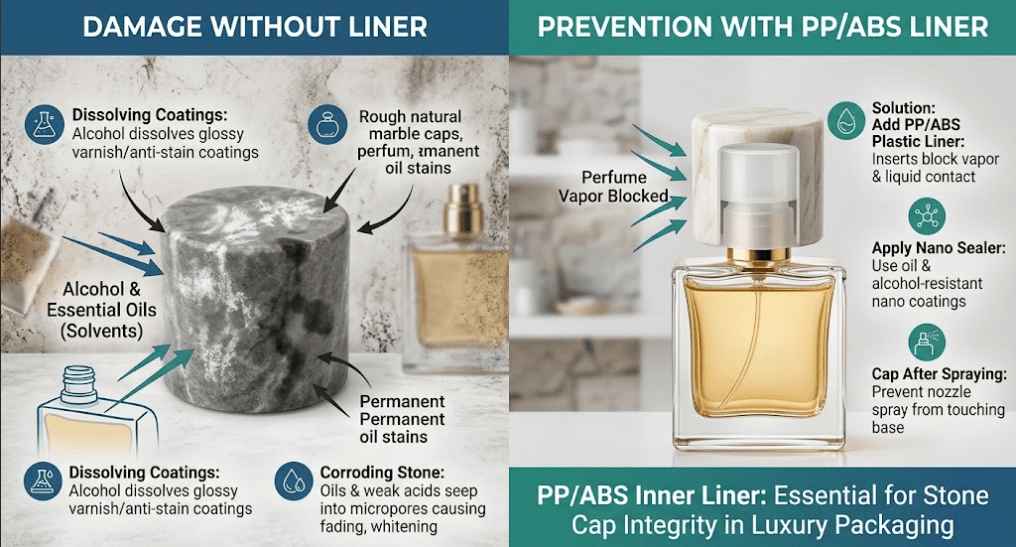
Main Reactions and Damage:
- Dissolving Coatings: Alcohol quickly dissolves glossy varnish or anti-stain coatings on the stone surface.
- Corroding Stone: Essential oils and weak acids seep into stone micropores, causing fading, whitening, or chalking.
- Leaving Stains: Penetrating oils leave permanent dark oil spots that are hard to remove.
Prevention and Solutions:
| Solution | Action |
| Add Plastic Liner | Insert a PP or ABS inner liner inside the stone cap to block perfume vapor. |
| Apply Nano Sealer | Use deep oil- and alcohol-resistant nano coatings (like fluorocarbon sealers) on the stone. |
| Cap After Spraying | Prevent residual spray on the nozzle from directly touching the cap base. |
For luxury fragrance packaging, the standard solution is inserting a PP/ABS inner liner inside the stone outer shell to completely isolate the liquid from the stone.
FAQ about Stone Perfume Cap and Plastic Sleeve
Stone is porous and vulnerable to alcohol. Adding a PP or ABS liner completely blocks perfume vapors and prevents corrosion or discoloration.
Synthetic resin stone caps have better corrosion resistance. Natural marble contains calcium carbonate, making it much easier for alcohol and fragrance oils to erode.
Yes, absolutely. Nano-coatings only handle light daily contact. Long-term exposure to perfume vapor still requires a sealed inner liner for complete protection.
PP is the top choice. It offers superior resistance to both fragrance oils and alcohol, along with excellent resistance to stress cracking.
Wipe it dry immediately using a clean, dry cloth or a slightly damp soft cloth. Never use alcohol or acidic cleaners to wipe the stone surface.
