

This guide covers the core craftsmanship challenge for stone perfume cap and plastic insert: matching a plastic inner insert with a stone outer cap. Because it pairs a rigid material with a soft material under different thermal expansion rates, improper sizing causes loose caps, leaks, jamming in winter, or cracking in summer.
TIPS:more perfume lids materials option,please click https://fragrancepackage.com/perfume-caps/
1. Who Fits Whom Between Stone Perfume Caps and Plastic Inserts?
- Correct Logic: The stone cap inner hole is the baseline. The plastic insert must adapt to it.
- Why: Stone precision is hard to control 0.1 mm is high precision). Plastic injection precision can reach 0.02 mm.
- Rule: Measure the stone hole first. Then adjust the plastic insert mold or select matching tolerance grades.
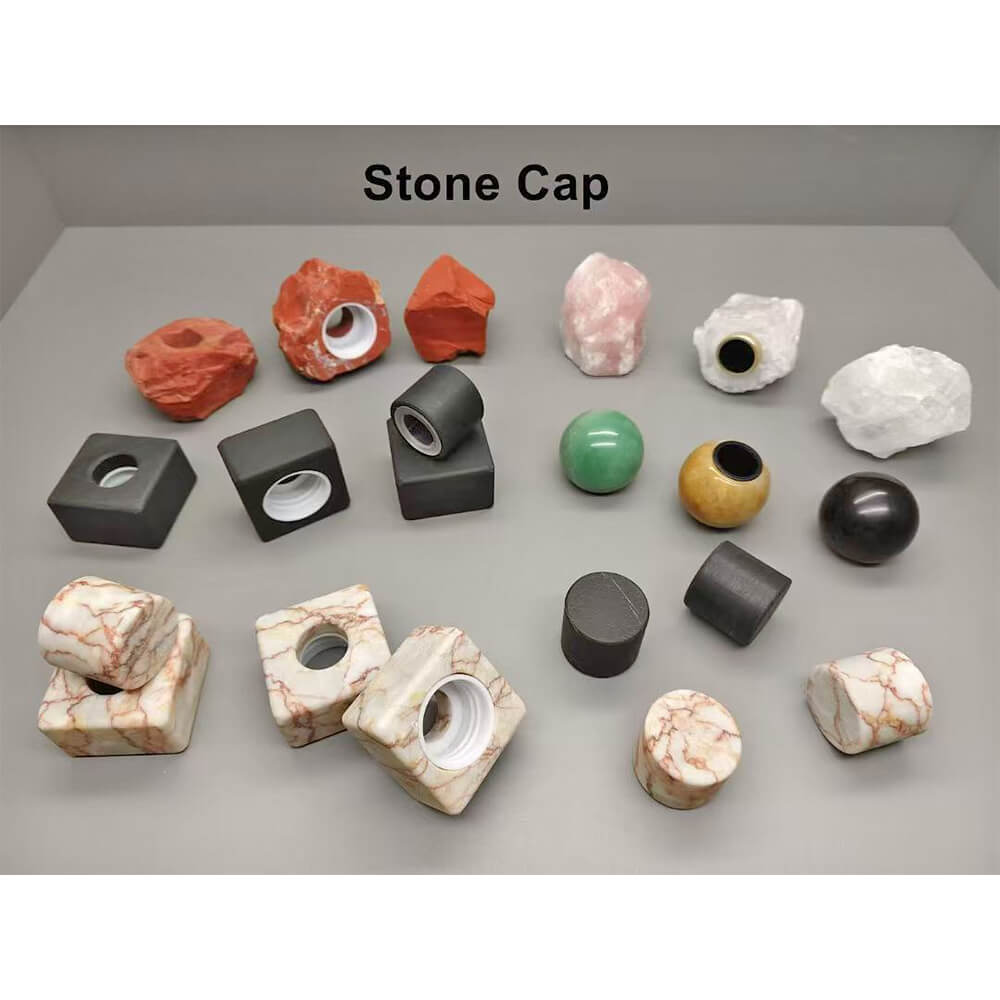
2. Key Design Dimensions for Stone perfume cap plastic insert
| Parameter | Suggested Value | Explanation |
| Stone Inner Hole Tolerance | 0.1 mm | Harder tolerance spikes scrap rates; lower tolerance causes fit failure. |
| Plastic Insert Outer Diameter | 0.05-0.1 mm larger than stone hole | Creates an interference fit via elastic compression. |
| Fit Depth | At least 8-10 mm | Too shallow wobbles; too deep makes assembly hard. |
| Insert Wall Thickness | 1.5-2 mm | Too thin deforms; too thick loses elasticity. |
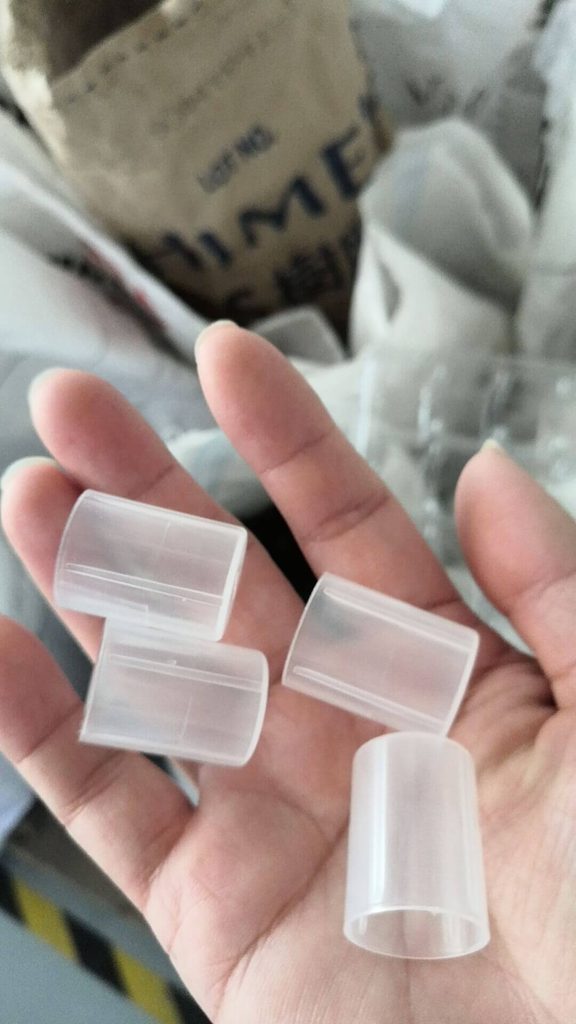
Core Principle: Use 2–3 annular ribs on the plastic insert instead of a smooth surface. The ribs flex to grip the stone wall for a tight seal.
3. Four Production Safeguards for Stone Perfume Lids Plastic Insert
- Full Inspection of Stone Holes: Measure every stone hole with an air gauge or inside micrometer. Sort them into 3 size grades (Small / Medium / Large) and match each with the right insert.
- Select the Right Plastic Material:
- PP (Polypropylene): Common, alcohol-resistant, elastic, low cost.
- POM (Polyacetal): High hardness, wear-resistant, great for threaded structures.
- TPE (Thermoplastic Elastomer): Soft rubber with top sealing, but weaker against alcohol.
- Recommendation: Two-shot injection molding (PP + TPE). Hard inside, soft outside.
- Use Thermal Assembly:
- Heat the stone cap to 50-60℃ (expands).
- Cool the plastic insert to 5-10℃ (shrinks).
- Press together while warm. Never use a hammer, or the stone will crack.
- Flexible Glue Support (Optional): Apply 5–6 dots of flexible epoxy (e.g., 3M DP460) on the joint surface. Do not cover the full area, as glue shrinkage can crack the stone.
4. Three Essential Tests Between Stone Lids and Plastic insert
- High/Low Temperature Test: Hold at -10℃ for 4 hours, then 50℃ for 4 hours. Repeat 3 cycles. Check for looseness, cracks, or torque changes.
- Torque Test: Measure with a torque meter.
- Tightening torque: 0.3-0.5 N.m
- Opening torque: 0.2-0.4 N.m
- Inversion Leak Test: Fill with water, tighten, and turn upside down for 24 hours. Zero leakage is required.
5. Wholesale & Export Options
- Option A (Low Cost): Set stone tolerance to 0.15 mm. Use 3 insert sizes (S / M / L) and pair them manually during assembly. Lowers stone scrap rates.
- Option B (High-End): Grind stone holes to 0.05 mm. Use custom molds for 1-to-1 precise fitting. Best customer experience.
Quotation Note:
“Stone cap inner hole tolerance 0.1 mm. Plastic insert customized with 3 size grades for perfect fit. Thermal assembly ensures airtight seal.”
6. Common Pitfalls to Avoid
- Mistake 1: Using regular ABS plastic (cracks after alcohol exposure).
- Mistake 2: Non-circular stone holes (causes uneven pressure, leaks, and glue failure).
- Mistake 3: Coating the entire surface with glue (curing stress cracks the stone).
- Mistake 4: Skipping thermal testing (leads to mass returns in extreme climates).

Frequently Asked Questions (FAQ) from Stone Perfume Cap Manufacturer
ABS degrades and becomes brittle when exposed to perfume alcohol over time, leading to cap failure.
This usually happens when the stone hole is not perfectly round, creating uneven force that breaks the bond.
As full-surface glue cures, it shrinks and creates strong tension that can pull and crack the outer stone.
Stone and plastic expand at different rates. Without thermal testing, caps can freeze tight in winter or burst in summer.
Thermal assembly (heating the stone and chilling the insert) is safest because force-pressing with tools cracks brittle stone.
