

Principles of Operation: Perfume Bottle Reducer Caps
In the world of perfumes and essential oils, a small yet vital component is often overlooked: the reducer cap (commonly known as an orifice reducer or dropper plug). Though it appears to be merely a small plastic plug in the bottle neck, its design principles directly determine the user experience.
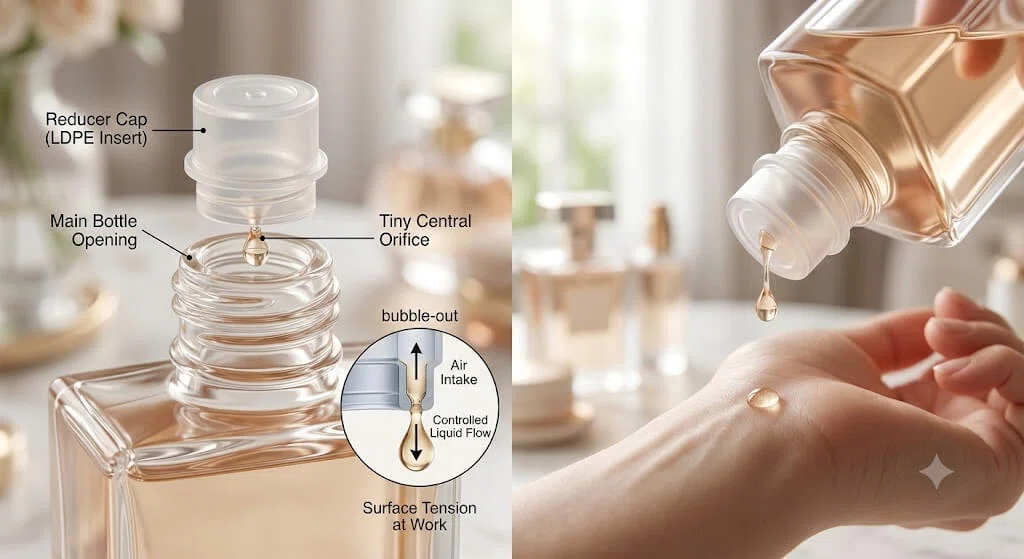
1. Core Operating Principles: A Clever Blend of Physics and Fluid Dynamics
By reducing the size of the bottle opening, the reducer cap uses simple physical principles to achieve precise dosage control.
- a. Surface Tension
Liquids like perfumes and essential oils possess cohesive forces. When the reducer cap shrinks the opening to just a few millimeters, the liquid’s surface tension becomes significant. In the absence of external forces (such as tilting or shaking), this surface tension forms a film that prevents the liquid from spilling accidentally. - b. Capillary Action
The tiny hole at the center of the reducer cap acts like a microscopic capillary tube. For many liquids—especially perfumes containing alcohol or essential oils—molecular interactions cause the liquid to collect at the aperture until a large enough drop forms to overcome surface tension and fall precisely. - c. Air Displacement
When the bottle is inverted, gravity pushes the liquid toward the orifice. At the same time, air must enter the bottle to replace the volume of the displaced liquid. Because the reducer cap constrains the opening, incoming air must overcome resistance to enter. This restriction effectively regulates the flow rate, allowing the liquid to dispense drop by drop. - d. Reduced Exposure
Beyond controlling flow, the reducer cap significantly minimizes the surface area of liquid exposed to air (oxygen). This helps slow down the oxidation process, extends the shelf life of the fragrance, and prevents volatile aromatic compounds from evaporating.
2. Design and Applications
Typically made from flexible plastics like low-density polyethylene (LDPE), reducer caps fit snugly into glass bottle necks. They are widely used in splash perfume bottles, essential oil bottles, and certain laboratory reagent containers.
3. Key Advantages
- Precise Dosage: Crucial for expensive fragrances, allowing users to dispense drop by drop and prevent waste.
- Spill Prevention: Even if the bottle is accidentally knocked over, liquid will not pour out rapidly.
- Preservation: Reduces air exposure to protect the active aromatic ingredients.
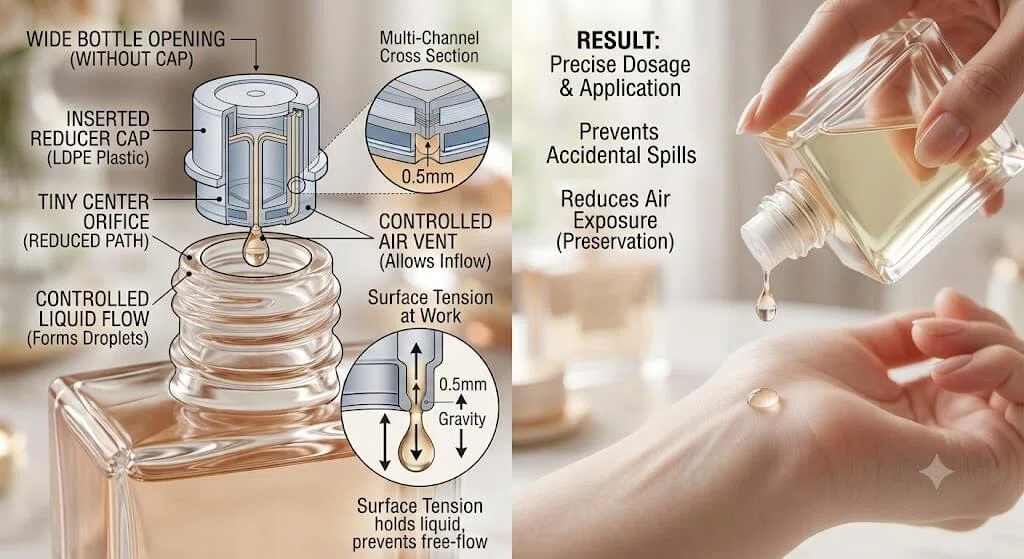
In summary, this deceptively simple plastic insert leverages clever physical principles to deliver control, elegance, and product preservation—making it a brilliant piece of everyday engineering.
